Why the Battle of San Jacinto Was More Important Than the Alamo
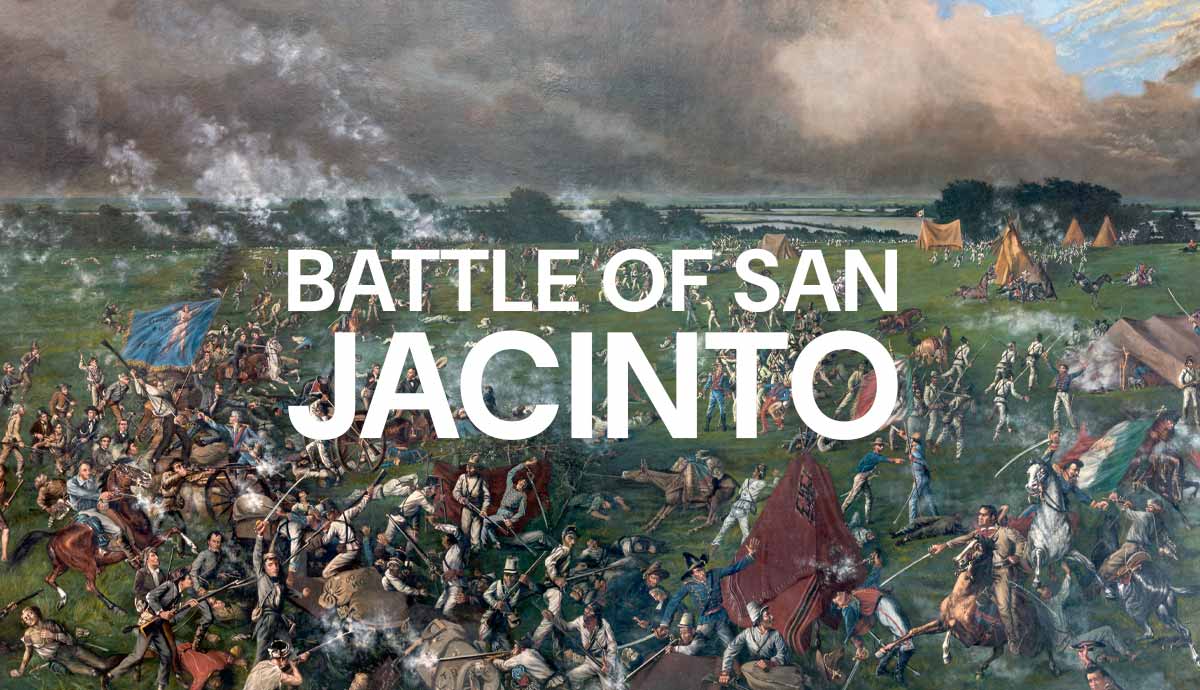
It is not often that 18 minutes can change the course of history, but such is the battle of San Jacintos claim to fame. Even though the fight lasted a mere 18 minutes, the slaughter that followed ensured the destruction of an army and changed the fate of North America forever.The Napoleon of the West?Portrait of Antonio Lopez de Santa Anna by Carlos Paris, c. 1835. Source: National Historical Museum, Mexico City.The war was over. Or so it seemed to General Antonio Lopez de Santa Anna in April 1836.Any soldier worth his trade could see it, but the Texians werent soldiers, the Mexican president thought contemptuously. What could a mob know of war?Defeated at the Alamo and along the Gulf coast, with their largest force in the field captured wholesale at Coleto Creek and massacred a week later, the Texian government had taken to its heels, screaming at General Sam Houston to turn about and make a stand with his ragtag army. Instead, Houston continued to run, retreating ever eastward towards the border with the United States.Yet just as Santa Anna closed in for the war-ending blow in the last weeks of April, he was unknowingly marching towards one of the most humiliating defeats of his military career. A defeat that altered the destiny not only of his own nation, but that of the neighboring United States as well. And it took all of 18 minutes.The Mexican generalissimo was fond of labelling himself the Napoleon of the West, and though a soldier since the age of 16, his own officers concluded he is incapable of the conceptions of that sublimedaring and enterprising genius which his namesake possessed in abundance (La Pena, p. 12). But even Napoleon himself would have scoffed at the paltry resistance thus far afforded by the rebellious Texians to Santa Annas invasion since February.If Santa Anna was bloated by his own arrogance, so too were the Texians.Texas Before the RevolutionTerritorial division of Mexico during the First and Second Centralist Republics (1835-1846). Source: Wikimedia CommonsOf all Mexicos provinces in the 1830s, Tejas stood out. Jutting forth from the countrys extreme northeastern periphery, it shared a lengthy border with the United States. As such, immigration and settlement, both legal and otherwise, was a common form of exchange between the two nations. When Mexicos Federal Republican system began to crumble in the mid-1830s, many states took to arms against the centralizing policies of Mexico City.Tejass rebellion was unique in one crucial respect in that most of its population was foreign-born. Most had been enticed to settle with the promise of new land. Initially, Mexican authorities had allowed a small number of immigrants to settle within the sparsely populated frontier region. But in later years, unchecked immigration from the United States led to a surge in population, such that by 1835 American immigrants outnumbered native born Tejanos by the thousands.Laws meant to curb further immigrant arrivals were nearly unenforceable, for Mexican military presence was meager at best. With the end of the Federal Republic of Mexico and its replacement by a more conservative Centralist regime in 1835, the Texians took to arms, declaring themselves independent of Mexico. They followed this up in the next two months by an advance against the Mexican garrison at San Antonio de Bexar. In vicious street fighting the Texians ultimately forced the Mexicans to surrender, and in this victory came what many Texians considered to be an end to the war.Santa Anna had other ideas.Santa Annas InvasionThe Fall of the Alamo or Crocketts last stand by Robert Jenkins Onderdonk, 1903. Source: Texas Governors Mansion, Austin.Marshalling an army of 7,000 men and marching it well over a thousand miles in the winter is no easy feat. As such, while formidable in numbers, Santa Annas was a host chronically short of funds and food, whose ranks were filled with recruits yet to see a battle, and which did not possess enough doctors to succor the sick and wounded.Even so, by the beginning of February that army had reentered Texas and found the Texians absolutely unprepared. There was no Texian army worth the name. Only two garrisons concentrated at the Alamo in San Antonio and at the Presidio La Bahia in Goliad, almost a hundred miles apart. Dividing his command in two, Santa Anna made a beeline for San Antonio, the scene of the Mexican armys former disgrace.After a legendary two-week defence by the garrison at the Alamo, San Antonio fell in the early hours of March 6, 1836, opening the doorway to eastern Texas. A second column under General Jose de Urrea, meanwhile, swept up the Gulf coast, overcoming petty garrisons on the way. Simultaneously, Texass provisional government was even then meeting to assert their independence and form a permanent government.That assertion was premature. Santa Anna was closing in. Two days before the Alamos fall, the nucleus of a volunteer army rallied on impulse to the commands of General Sam Houston at Gonzales. Houston, a former soldier, congressman, and governor of Tennessee did not hold these volunteers in high regard.Photograph of Sam Houston by Matthew Brady, 1856. Source: US Library of CongressFor one, Houstons volunteers were much too few. For another they were unruly and lacked the necessary discipline. A historian aptly described the average Texian as a fine fighter but a poor soldier (Haynes, pp. 13-14). During the siege of Bexar in 1835, their own officers despaired that no good would come from them except by the merest accident under heaven.It would take time for Houston to mold his men into a coherent fighting force, but the Texian general had none. Santa Anna was bearing down from the west, and with Urrea stabbing northward like a spear, Houston ordered a retreat. With him went most of Texass population.The Runaway ScrapeThe Presidio La Bahia in Goliad, Texas. Photograph by Ernest Metterndorf. Source: Wikimedia CommonsWar produces refugees like winter produces snow. Unable to meet Santa Annas forces in the field, Houstons withdrawal turned the settlers of Texas towards thoughts of flight. Homes were abandoned and burned; goods littered the roads now choked with thousands of terrified people. Houstons numbers were swelling everyday, yet still he did not make a stand.From Goliad he ordered the retreat of its garrison, seven hundred strong, under a West Point dropout named Fannin. But Fannin fatally delayed his departure for several days and by the time he was on the move, Urreas fast moving cavalry had blocked the route ahead. Making a stand in the open at Coleto Creek, Fannins command gave a good account of themselves through the fighting of March 19, and into the next day. But a lack of water, the depletion of their ammunition, and an alarming number of wounded, forced them to surrender.Believing their lives would be spared, the largest Texian force then in the field was marched into captivity, where they were massacred a week later on orders from Santa Anna. That most of Fannins men were volunteers from the United States had not escaped Santa Anna. To him these men were waging an illegal war on Mexican soil, and were now treated not as prisoners of war, but common bandits.Their slaughter would not be forgotten by Houstons army.Eighteen Minutes (April 21, 1836)The Battle of San Jacinto by Henry McArdle, 1895. Source: Texas State LibraryHaving annihilated the Alamo and Goliad garrisons, with Houston seemingly rushing for the US border, unable or unwilling to fight him, Santa Anna grew arrogant as March turned to April. Ending the war was uppermost in his mind. What better way of ending a rebellion then by seizing the men who pretentiously called themselves a government? Santa Anna divided his forces into three and sent 1,500 men to capture officials of the Texas government at Harrisburg.But in this he was thwarted. Escaping to Galveston Island mere moments ahead of the Mexican cavalry, Texass political leadership was safe for now, while Santa Annas detachment now stood isolated and bogged down.Rain saturated the Texas countryside through March and April, lashing both armies with freezing water that swelled the rivers and churned them into a muddy morass. Having failed to seize the Texian officials, Santa Anna burned Harrisburg to the ground before pressing on to nearby Lynchburg. He erected his camp near the junction of Buffalo Bayou and San Jacinto Bay. It was not well chosen. The San Jacinto River hemmed him in from the right, its oak-covered banks emptying into an open plain at the rear of which sat a marshy lake.Santa Anna had effectively cornered himself, with his line of retreat blocked by water. Houston came against this position starting April 18. Meanwhile, the men of Houstons army believed that he would not order them to stop until they reached the US border. At a crossroads on April 18, the leading elements of Houstons army defied his orders and turned south towards Lynchburg.Surrender of Santa Anna by William Henry Huddle, 1886. Source: Texas State Capitol, AustinHoustons Texians were, by most accounts, some 800 strong. Nevertheless, after crossing Lynchs Ferry the morning of April 20, they pitched their tents a mere 500 yards from Santa Annas camp. Mexican reinforcements arrived the next day, increasing their numbers to 1,500 men. Desultory skirmishing between the lines had commenced the previous afternoon and continued throughout the night. Santa Anna appears to have favored a defensive encounter and raised breastworks in front of his camp.Houston ensconced his army in a thick timber grove, sheltered from prying eyes. The march forward was done in two parallel columns under the cover of a rise bisecting the plain. Once upon its summit, Houston hastily deployed his army in a traditional line of battle, right, center, and left, having covered most of the plain unseen.But no longer. Springing forward supported by a pair of cannons, the Texians covered the last hundred yards to the Mexican lines in a rush under fire. By now fully aware of the Texian onslaught, Mexican companies opened a heavy fire but struggled to hit their targets. Bullets flew high and the Texian casualties were minimal.Mexican casualties were not, for the Texians had closed the distance and now ran rampant through the Mexican camp. The Texians cried Remember the Alamo! Remember Goliad! as they butchered the fleeing Mexicans on the points of their bayonets. Survivor accounts attest to the hours-long slaughter that followed the overwhelming of Santa Annas lines.Eighteen minutes to win a fight, but several hours to kill the fleeing enemy. From a soldiers point of view this makes sense. Santa Annas camp may have imploded but survivors could be rallied to fight on. Men fleeing in fear of their lives are far easier to kill than troops reformed by a steady hand, and in the pursuit Houstons men ensured the Mexicans had no ability to rally.Only later were prisoners taken, and amongst them stood the most consequential of all: Santa Anna himself.ConsequencesMap of Texas and the Countries Adjacent by William H. Emory, 1844. Source: University of Texas at Arlington LibrariesThat Santa Annas life was now imperiled was in no doubt. Calls for his immediate execution were everywhere. Houston saw Santa Anna as a source of political leverage. A prisoner of war, however, cannot issue lawful orders that their subordinates can obey. The simple reason is that any such orders are issued under duress.In the days that followed the defeat at San Jacinto, a crisis arose in the Mexican high command. News of the defeat reached them, leaving General Vicente Filisola in command of the Mexican army. But Filisola was not willing to accept the great burden. In a council of war, he offered command to any of his fellow generals. None stepped forward.This left a hesitant commander only too willing to obey orders from the imprisoned Santa Anna, who was compelled to sign the Treaty of Velasco. Article 2 brought hostilities to an immediate halt, while Article 3 ordered the Mexican army south of the Rio Grande. Filisola could justifiably have refused to comply with these orders. He did not. That decision changed history.Upon obtaining their independence, the Texians claimed the territory up to the Rio Grande, a claim that was never accepted by Mexico. This unresolved land dispute carried over into the next decade after the annexation of Texas by the United States in 1845. The dispute morphed led to the Mexican-American War, at the end of which Mexico was forced to sign away any rights to Texas, as well as a vast tract of land in what became the American southwest.In 1850, following Californias entrance into the Union, the United States of America stretched between the Atlantic and Pacific Oceans. The fulfilment of Manifest Destiny owed much to a few bloody hours on the banks of the San Jacinto in 1836.Further ReadingHardin, Stephen. Texian Iliad: A Military History of the Texas Revolution, 1835-1836 (Austin: University of Texas Press, 1996).La Pena, Jose. With Santa Anna in Texas. A Personal Narrative of the Revolution, trans. Carmen Perry. (College Station: Texas A&M University Press, 1992).General Vicente Filisolas Analysis of Jose Urreas Military Diary. A Forgotten 1838 Publication by an Eyewitness to the Texas Revolution, trans. John R. Wheat., ed. Gregg J. Dimmick (Denton: Texas State Historical Association, 2009).The Mexican side of the Texas Revolution, trans. Carlos E. Castenada. (Dallas: P.L. Turner, 1928).








 English
 Arabic
 French
 Spanish
 Portuguese
 Turkish
 Dutch
Dutch
 Italiano
 Russian
 Romaian
 Portuguese (Brazil)
 Greek
Greek