



WWW.THECOLLECTOR.COM
How the Kings Hospitaller Defended Malta From the Mighty Ottoman Empire in 1565
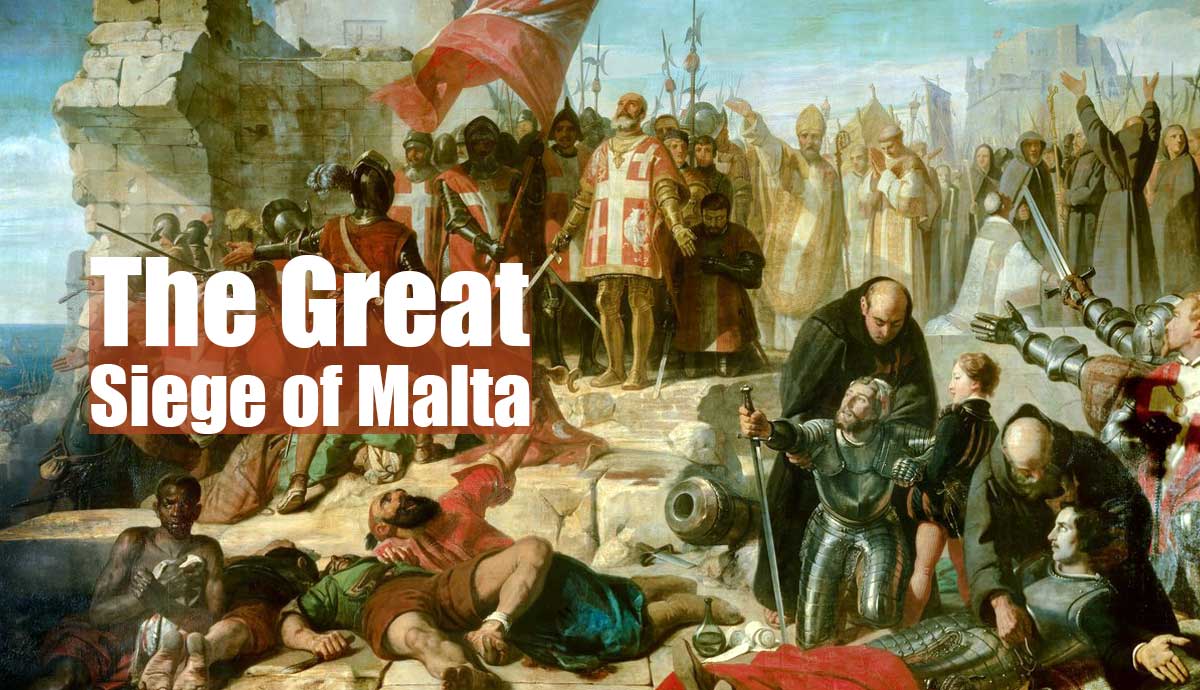
During the 16th century, the Mediterranean Sea witnessed a prolonged struggle for supremacy between Christian and Muslim powers. The primary players were the Ottoman Empire and Habsburg Spain but France, the Barbary Corsairs, Venice, and the Knights Hospitaller all clashed. It was the latter who inflicted the most stinging defeat on Suleiman the Magnificent, the most celebrated Ottoman ruler.A Strategic IslandPortrait of Suleiman the Magnificent, by Titian, 16th century. Source: Wikimedia CommonsFor some the conflict had been going on since the Crusades. The Hospitallers, also known as the Knights of St. John, had been driven from the Holy Land in the 14th century and took refuge on the Greek island of Rhodes. There they withstood Ottoman sieges until their final defeat in 1522 when they were driven from the island and forced westward to Malta. The knights reorganized themselves as an order of pirates, prosecuting a constant war against all Muslim shipping. The islands strategic location made it ideal as a base for naval warfare.The long retreat westward was part of a constant expansion by the Ottomans. In 1453 they took Constantinople and began to conquer much of the Balkans, taking Belgrade in 1521 and conquering Hungary in 1526 after the Battle of Mohcs. They were only checked at Vienna in 1529 when a hastily organised defense of the city turned them back. But at sea the Ottoman advance was relentless. The Battle of Djerba off the Tunisian coast in 1560 solidified Ottoman naval control and it was obvious that Malta was their next target.Malta was a stepping stone, a base that could be used to conquer Sicily and then push the war onto mainland Italy. Suleiman also had unfinished business with the Hospitallers from 1522. They remained a constant thorn in his side and in 1564 a Hospitaller captain captured an Ottoman convoy containing the governors of Alexandria and Cairo and the former nurse of Suleimans daughter. This insult was the final straw and gave Suleiman his casus belli.Preparations and PlanningThe Great Siege of Malta by Mattia Perez dAleccio. Source: Art UKSuleimans rival was the Grand Master of the Order, Jean de Valette, a French knight who even at 70 was a tall and strongly built man. He was fluent in Italian, Spanish, Greek, Latin, Arabic, and Turkish and had served time as a galley slave. Undeterred by the Ottoman threat, he continued to muster his strength. Since 1560 all knights of the Order had been issued instructions to return to Malta should war break out. Forts on the island were strengthened and mercenaries hired to augment the defenders.Nearly 600 of the Orders 700 knights made it to the island in time. A mix of some 2,000 mercenaries and professional soldiers joined them along with over 3,000 Maltese soldiers. These 6,000 defenders would fight against an invading force estimated to be between 30,000 to 40,000 strong. The Ottoman army consisted of elite Jannissaries (slave soldiers recruited from Christian communities) and Sipahis (elite cavalry) as well as thousands of volunteers, adventurers, corsairs, and auxiliaries. The Ottomans also brought many skilled siege engineers with them.The Maltese defensive system was centred around three critical forts; Fort Saint Angelo, Fort Saint Michael, and Fort Saint Elmo. All were around the Grand Harbor and had been substantially upgraded in the preceding decade. Valette also ordered the harvesting of all crops to deny any food to the invaders. Additionally, all wells were poisoned with bitter herbs or dead animals.The Fight for Saint ElmoBombardment of Saint Elmo by Matteo Perez dAleccio. Source: Art UKThe Ottoman fleet arrived on May 18, 1565. Their main effort was directed against Fort Saint Elmo, the fortification that dominated the Grand Harbor. While the Turks estimated it would take a few days, the battle actually went on for over a month. Turkish bombardment reduced the walls to rubble but Valette evacuated the wounded every night and sent reinforcements.Fighting was fierce with even the galley slaves inside the fort fighting as hard as the Knights and the Maltese auxiliaries. The defenders used early incendiary weapons that were lethal against the robed Turks. Hoops were wooden rings soaked repeatedly in inflammables before being ignited and flung over the walls with tongs. Trumps were metal tubes packed with inflammables that were used to defend breaches.The Turkish command was split between general Mustafa Pasha and admiral Piyale Pasha, who disagreed on everything from where to anchor the fleet to where to attack. Complicating matters was the arrival of Dragut, a famous corsair who alone realized they needed to cut off the reinforcements arriving into St. Elmo.St Elmo fell on June 23 with all the garrison perishing except a few Maltese who managed to swim the harbor. The battle had claimed the lives of 1,500 defenders and 6,000 attackers. Mustafa ordered the Knights beheaded and their corpses floated across the bay on crucifixes. Valette responded by decapitating all of his Turkish prisoners and firing their heads by cannon into the Turkish camp. There would be no quarter.Stalemate and CounterattackBombardment of Saint Michael by Matteo Perez dAleccio. Source: Art UKNow that St. Elmo had fallen, the main focus of the attack could switch to Birgu and Senglea, the two peninsulas jutting into the Grand Harbor. The Ottomans established heavy gun batteries to launch a constant bombardment against the Knights. One spectacular seaborne attack failed when a sea battery sank nearly all the Ottoman boats, drowning nearly 800 Janissaries and sailors in the Grand Harbor.Luck seemed to be on the Knights side as defectors warned them of oncoming attacks. The Turks breached the walls in Birgu on August 7 only to turn back in a panic, thinking that a Spanish relief force had arrived. In fact it was only a small body of horsemen led by the knight Anastagi from the Mdina garrison. They used the distraction of the assault to sortie into the Turkish rear and slaughter many of their wounded in the field hospital.Both sides showed desperate creativity. The Ottomans built a siege tower to storm St. Michael. It was destroyed by Maltese engineers tunneling out and firing at it point blank with chain shot. When Turkish swimmers threatened to destroy the palisades on the Senglea peninsula, Valette sent in his Maltese swimmers to fight them knife to knife. Anastagi bluffed with his meagre garrison in Mdina and continued daily cavalry raids throughout the siege, hunting Turkish stragglers and foragers. A mini relief force of several hundred Spanish and Italian soldiers even succeeded in landing on the island and crossing the siege lines at night.Turning Point and CollapseAttack on the Post of the Castilian Knights by Matteo Perez dAleccio. Source: Art UKBy September the Turkish army was in disarray. Disease was rampant and the constant fighting had sapped the morale of even the elite troops. The assaults on the walls had turned into a meatgrinder and daily cavalry raids from Mdina continued to wear them down. An estimated third of the invaders had died due to the fighting or disease. Worse still, a relief force of several thousand infantrymen had landed on the north side of the island under the command of the Viceroy of Sicily on September 7. The heat of the summer and lack of supplies had only made things worse. The decision was made to halt the siege.By September 8 most of the Ottoman artillery had been embarked. The arrival of the relief force spread panic as they did not realise they still outnumbered the Spanish and Italian troops. Contradictory orders were given to embark and disembark by Mustafa. The veteran allied infantry routed anything that opposed them. An air of recklessness spread through the force which resulted in an all out charge on the retreating Ottomans.The slaughter on September 13 was the final bout of fighting on the island. The surviving Ottomans set sail, abandoning the siege. Against all the odds, an anachronistic Order of crusading knights had defeated an invading army and turned the tide of Ottoman conquests.Legacy of the SiegeLifting of the Siege of Malta by Charles-Philippe Lariviere, c. 1843. Source: Palace of VersaillesBetween 25,000 and 35,000 of the attackers are believed to have died in the siege, while a third of the population of Malta lost their lives. The three peninsulas where the fighting had been concentrated were mostly piles of rubble. But a small mixed garrison of 6,000 defenders had withstood a siege for over four months during the heat of a Mediterranean summer. The defense seemed incredible to the wider European population as prior to this the Ottoman advance had seemed unstoppable.Valette was the hero of the hour, the man whose leadership had been central to keeping the morale of the defenders up. Donations came from across Europe to aid rebuilding and atop the ruins of St. Elmo rose a new city, Valletta, named for the Grand Master. Today it is the capital city of the small island nation.It was not the end of the Knights nor of the Ottoman Empire. A single battle rarely determined the outcome of a war. Malta was a setback for the Ottomans but only a temporary one and they soon resumed the offensive on other fronts. The successful defense of Malta did serve as a rallying point for the Christian powers and inspired the formation of a Holy League. Six years later, Venice, Spain, and the Knights would inflict another defeat on the Ottomans in the Battle of Lepanto.
0 Kommentare
0 Geteilt
16 Ansichten






 English
 Arabic
 French
 Spanish
 Portuguese
 Turkish
 Dutch
Dutch
 Italiano
 Russian
 Romaian
 Portuguese (Brazil)
 Greek
Greek