How the Ostrogoths Seized Italy After the Fall of Rome
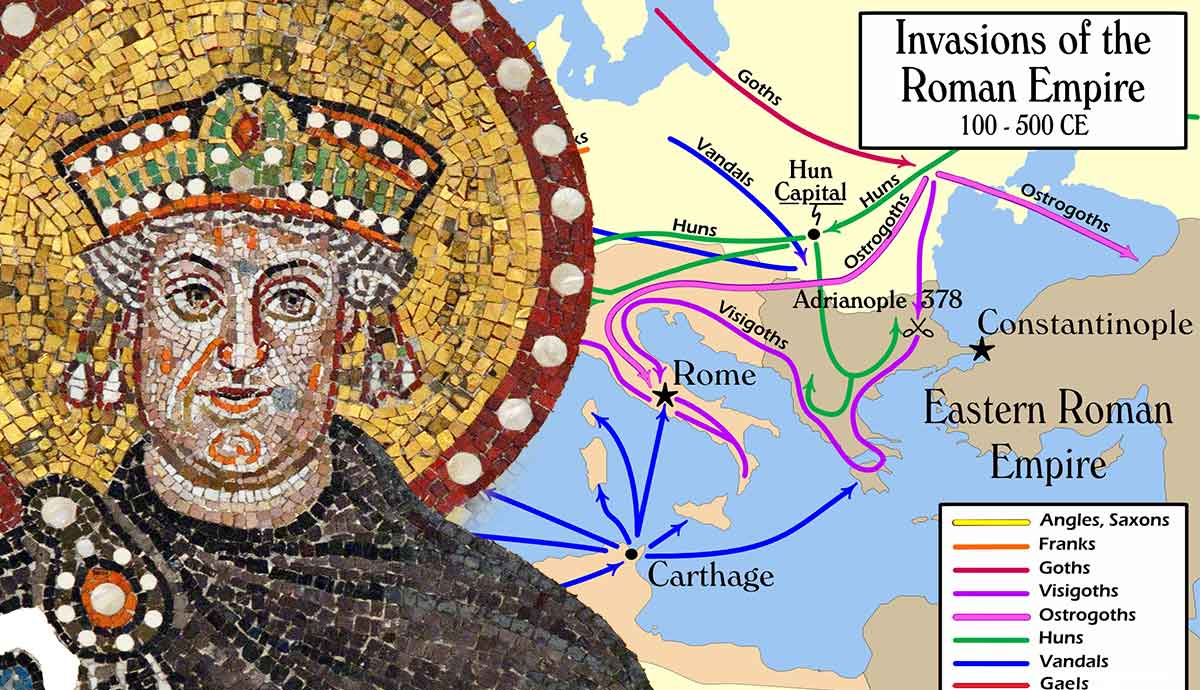
The Fall of Rome in 476 was a point of extreme historical importance. Although the changes that happened in Europe before and as a result were gradual in nature, for many historians the year marks a definitive point of reference for the end of the Ancient Era and the beginning of what is known as the Dark Ages, or the Early Middle Ages.Over the last decades of the Roman Empire, socio-economic shifts took hold in the Italian Peninsula. Across the empire, trade was diminished, the cities could not support massive populations as they had before, and the general population moved towards a more agrarian lifestyle.The biggest and swiftest change happened at the top levels of power, as the empire receded and gave way to barbarian rule. First to take the reins was Odoacer, a foederati (Germanic soldiers who fought for Rome) leader, who ruled the Italian Peninsula until he was challenged by Theodoric and his Ostrogoths.The End of the Roman EmpireDestruction from The Course of Empire by Thomas Cole, 1836. Source: The New York Historical/Wikimedia CommonsThe end of the Roman Empire is historically attributed to the single, sudden event of the end of imperial rule in 476. The reality was much more complex. Rome had been in decline for many decades. The capital moved from Rome to Constantinople before the empire was split into the Western and Eastern Empires. While the Eastern Empire thrived, the Western Empire went into decline. In 410, Rome was sacked for the first time in eight centuries, which was followed by sackings in 455 and 472, marking major points in the decline of Roman military might and imperial authority.Of major importance was the shifting balance of real power within the empire, regarding the military. Over the 5th century, Rome increasingly relied on barbarian soldiers to augment its own army. These foederati were essentially auxiliary troops, and were often treated poorly by authorities within the government who resented their inclusion into the Roman military. The dynamic led to friction and conflict as the Germanic peoples within the empire fought for more recognition, respect, and justice.Other factors, such as economic decline, internal political strife, disease, and continued pressure from barbarian forces on Romes borders, all contributed to the weakening of the Roman Empire. In 476, the greatest blow came in the form of Odoacer, a foederati leader, who deposed the last emperor, 11-year-old Romulus Augustulus. He styled himself king, although he recognized the supreme authority of Eastern Roman Emperor Zeno.King OdoacerRomulus Augustulus surrendering his crown to Odoacer. Source: Wikimedia CommonsOdoacer existed as Italys first king, but despite the stereotypical Germanic barbarian image that is common today, Odoacer and his foederati were anything but brute savages. They were civilized and had much respect for how Rome functioned. While the government may have shifted hands, and the state changed style, Odoacer preserved many other aspects of Rome. He kept the Senate, as well as much of the administrative structure. Of major importance to his reasoning for assuming power was to give the foederati what they believed they were owed. Odoacer distributed Roman lands to these soldiers in a process that was relatively smooth and unopposed.Odoacer had respect for Roman ways of life and a desire to preserve much of what the Roman Empire represented in the West. He also acknowledged the Eastern Roman Emperor as his superior. Despite all this, Emperor Zeno did not look favorably upon Odoacer and supported the legitimacy of Julius Nepos, who had been emperor of the Western Roman Empire before being deposed by Orestes, the father of the last Roman emperor, Romulus Augustulus. Zeno had had problems of his own regarding revolts and depositions. He had been deposed in 475 CE and reclaimed power the following year. Giving legitimacy to Odoacer would have meant giving legitimacy to the overthrow of emperors, thus weakening his own position. Thus, Odoacer was a rival for political influence.Theodoric and the OstrogothsA mosaic portrait of Theodoric, falsely labeled as Justinian. Source: Wikimedia CommonsBy the late 4th century CE, parts of eastern Europe were taken by the advancing Huns. Whole nations scattered as the Huns conquered, raided, and pillaged settlements before them. Of those who suffered, the Goths, a Germanic people, would end up having a great impact on the future of the Roman Empire. Around the end of the 4th century, the Goths had split into two main groups. The Visigoths lived within Roman territory and became foederati, subject to Romes authority, before establishing the Visigothic Kingdom in Iberia, while the Ostrogoths became subjects of the Huns. Into this dynamic, a future king was born.Theodoric was the son of King Theodemir of the Amal dynasty, the Ostrogoth rulers, and was born in 454 CE on the banks of the Neusiedler See, now in the far east of Austria. He was just an infant when the Goths threw off the yoke of the Huns as a result of the Battle of Nedao later that year. A dangerous power vacuum was left in its wake, leading to potential for confrontation and conflict between various non-Roman groups where once the Huns had held sway. At a young age, Theodoric was held hostage in Constantinople as part of a treaty to force the compliance of the Ostrogoths. While there, Theodoric became well-educated and was treated amicably by Emperor Leo of the Eastern Roman Empire.A decorative Ostrogothic brooch. Source: Wikimedia CommonsMeanwhile, life for the Ostrogoths was almost nomadic, as they searched for a place to call home, while dealing with bloody rivalries and challenges from other Germanic factions in similar situations. In 470 CE, Theodoric returned from Constantinople and took up life as the princely heir to a people desperate for stability.Emperor Zeno, understanding the political maneuvering that was needed, played various factions against each other. He allied himself with Theodoric, who would become king in 474 after his father, Theodemir, died. Alliances, however, were shifting, and Zeno also betrayed Theodoric, breaking agreements and taking military action against him.Zenos PlansA coin depicting Emperor Zeno. Source: Wikimedia CommonsBoth Theodoric and Odoacer represented elements that were a danger to Zeno and the Eastern Roman Empire. Theodoric, in a bid to gain recognition and authority from Zeno, raided Eastern Roman territory and threatened Constantinople. Efforts to control Theodoric through alliances and military action came to nought, and Zeno had to concede to significant demands, including granting Theodoric the title of magister militum (the highest military rank). Theodoric, however, was not satisfied, and his desire for more was an alarming development. If Zeno could not end the threat through military action, he would have to redirect it.Meanwhile, Odoacer was growing in power and represented a major challenge to Zenos power and a threat to the unity of the Roman world. Zeno saw his opportunity, and in 488 CE, he gave Theodoric authority to invade Italy. Whoever won, the likely outcome was that Zeno would eliminate one of his enemies.InvasionInvasions of the Roman Empire. Source: Wikimedia CommonsDespite later Gothic ideologists describing the invasion of Italy as a campaign of salvation, at the time, for the people of Italy, the Ostrogoth invasion was seen as a devastating catastrophe. The Ostrogoths set out from Pannonia and arrived in Italy, crossing the Julian Alps in August 489 CE. On August 28, the armies of Theodoric and Odoacer clashed at Isonzo. The Ostrogoths were victorious, and Odoacer retreated to Verona. At Verona, the Ostrogoths won another victory. Odoacer fled to Ravenna, while Theodoric continued his march, besieging and capturing Mediolanum (Milan) and, later, Pavia.A large portion of Odoacers army, led by Tufa, surrendered to the Ostrogoths and switched sides. Believing them loyal, Theodoric sent them against Odoacer, but Tufa switched sides again and rejoined Odoacer, giving the latter the troops and an opportunity to launch a counter-campaign against the Ostrogoths. Odoacer took Mediolanum and Cremona and then laid siege to Pavia. The siege, however, was interrupted by a Visigothic army commanded by Alaric II, who supported the Ostrogoths, and Odoacers forces retreated.Death of Odoacer, Killed by Theodoric, King of the Ostrogoths, by Tancredi Scarpelli. Source: meisterdrucke.usIn August 490 CE, Odoacer was defeated on the Adda River by a combined force of Ostrogoths and Visigoths, and he fled to Ravenna, which Theodoric then besieged. Throughout the campaign, the Senate and many Italian cities declared themselves for Theodoric. Due to geographical and naval constraints, the Goths could not blockade Ravennas port, and as such, it allowed for the city and Odoacers defenses to be resupplied, leading to a protracted siege. The Goths, however, were finally able to gather a fleet and cut off supplies to Ravenna.The siege lasted until March 5, 493 CE, at which point Odoacer surrendered. Theodoric extended a diplomatic hand, and believing that they would agree to rule together, Odoacer attended a banquet with Theodoric, where he was murdered. According to the Chronicle of John of Antioch, p. 445, the planned murder went awry when Theodorics men hesitated. Theodoric himself then struck Odoacer a mortal blow with his sword. Odoacer cried out, Where is God? to which Theodoric replied, This is what you have done to my people. The conquest was complete, and Theodoric ruled the Italian Peninsula.The Ostrogothic KingdomThe Ostrogothic Kingdom of Italy from 508 CE to 534 CE. Source: Wikimedia CommonsTheodoric, despite his acts of brutality and desire for power, did not take full control by declaring himself an emperor. He was still a viceroy to Emperor Zeno and acted in accordance with this position. The Romans and the Senate continued to exercise administrative functions, while Theodoric and the Goths took command of military matters. The Romans and the Goths, two very different cultures, cooperated for the most part, and the rule of law was greatly enforced by Theodoric. The two populations were kept separate, and different sets of laws were applicable. Intermarriage was forbidden. The legal and social separation of these peoples contributed to the peaceful coexistence, and there was no need for oppressive imposition of cultural and legal mores of one upon the other.Despite apparent peace within the kingdom, war did not cease. In 504 CE to 505 CE, Theodorics forces launched a campaign to retake the Gothic lands to the north, which had been taken by the Gepids. The campaign was successful, but other conflicts also played out, particularly on the religious front. The Goths were followers of Arian Christianity, while the Romans were Catholic. The Franks and the Visigoths were at war, and while the Visigoths were seen as being culturally similar to the Ostrogoths, the Franks declared themselves defenders of the Church against the heretical Arians. This culminated in Emperor Anastasius, who had succeeded Zeno, dispatching ships to raid the coast of Apulia in Southern Italy.The tomb of Theodoric in Ravenna. Source: Wellcome Collection/Wikimedia CommonsThe religious conflict also led to tension between the Goths and the Senate, and Theodoric fell out with a powerful traditionalist faction in the Senate, while the Roman elites looked to Constantinople for support. Theodoric died in 526 CE and was succeeded by his infant grandson Athalaric, with his mother, Theodorics daughter, Amalasuntha, as regent. Meanwhile, the Ostrogoths had become factionalized, and a pro-Germanic faction murdered Amalansuntha, whom they saw as being pro-Roman.Under an ineffective regency, the network of alliances outside the kingdom also began to fall apart. With the Franks, Visigoths, and Vandals all pursuing their own agendas, weakening the authority of the Ostrogoths.The End of an EraMosaic depicting Emperor Justinian I. Source: Petar Miloevi/Wikimedia CommonsDespite Theodorics effective rule and his attempts to rebuild Italy, the Ostrogothic Kingdom did not last long beyond his death. The murder of Amalasuntha provided Emperor Justinian I, the pretext he needed, as he had been on good terms with her. What followed was a two-decade-long war as the Byzantines (Eastern Romans) campaigned to reconquer the peninsula to reunite the Roman peoples. Their final victory in 554 CE would be short-lived as well, as the Germanic Lombards invaded and conquered Italy just over a decade later.











 English
 Arabic
 French
 Spanish
 Portuguese
 Deutsch
 Turkish
 Dutch
Dutch
 Italiano
 Russian
 Romaian
 Greek
Greek