


"Impossible To Imagine": Queen Ants Produce Babies Of 2 Different Species, And It's Never Been Seen Before
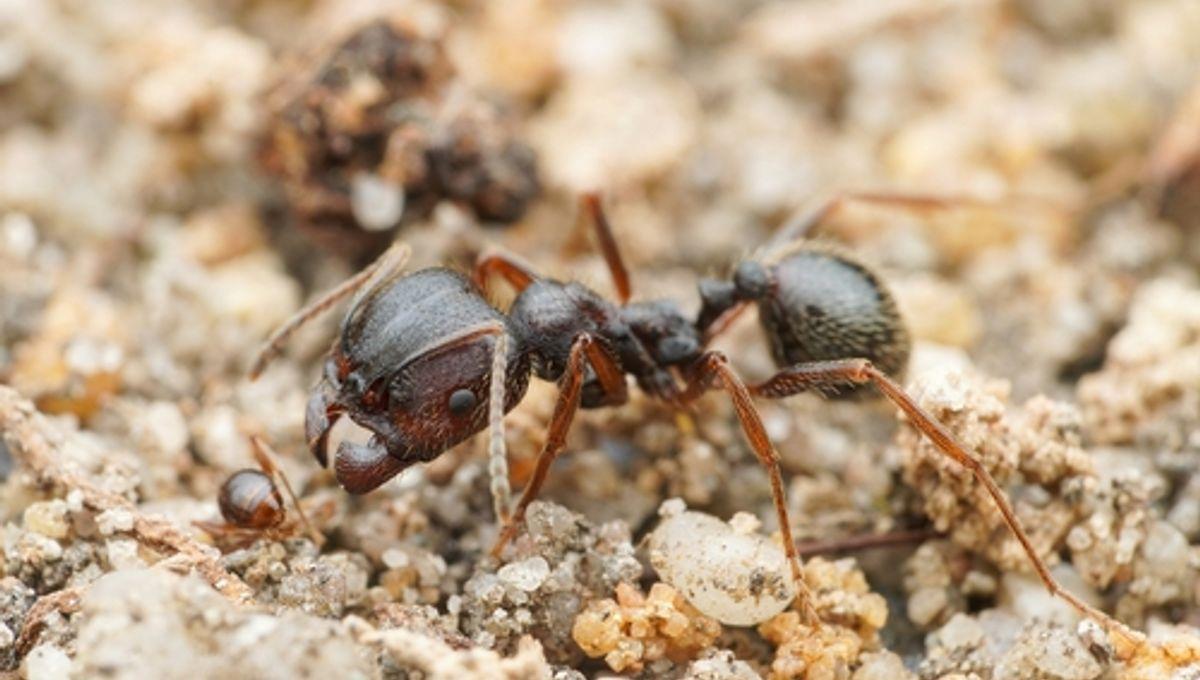
"Impossible To Imagine": Queen Ants Produce Babies Of 2 Different Species, And It's Never Been Seen Before
Reproduction in the animal world is all kinds of freaky, from penis jousting to mammals laying eggs, there seems to be just about every method going. However, one thing that is not common is females of one species being able to produce offspring of another, but that's exactly what has been discovered in Iberian harvester ants (Messor ibericus).
The rest of this article is behind a paywall. Please sign in or subscribe to access the full content. M. ibericus ant queens have been discovered to produce not only offspring of their own species, but also offspring of a different species due to a reproductive mode scientists are calling xenoparous. It's “almost impossible to believe and pushes our understanding of evolutionary biology,” Michael Goodisman, from the School of Biological Sciences at the Georgia Institute of Technology, who was not involved with the new research, told Science. “Just when you think you’ve seen it all, social insects reveal another surprise.” The process is part of the life cycle of these female ant queens who are unable to produce worker ants without mating with males of another species. The team looked at genetic data for 390 individual ants from five different species in the Messor genus. The data showed that in the M. ibericus line, the workers and queens are not that genetically similar. This suggests that the workers are hybrids. Looking closer at the mitochondrial DNA revealed that the workers all had M. ibericus mothers, and that their paternal DNA comes from a species called M. structor. What makes this even more interesting is that the females of M. ibericus strictly depend on males of M. structor to be able to have worker ants. However, the areas in which both species occur do not completely overlap. “As even more compelling evidence, first-generation hybrid workers from the Italian island of Sicily are found more than a thousand kilometres away from the closest known occurrence of their paternal species,” explain the authors. The team found that M. ibericus queens were laying very hairy males nearly half the time, and practically bald males the other half. Interestingly, these morphologies of hairy and bald perfectly line up with the two species; the hairy ants are male M. ibericus, while the bald ants are M. structor. Both male offspring share the same mitochondrial DNA, pointing to the M. ibericus queens as the mothers in both cases. However, the results show that M. ibericus queens can produce male offspring without their own nuclear genome; these offspring are clones of a sole source of genetic material that has been stored in the spermatheca. The queens allow the sperm to enter the egg and somehow remove their own genetic material, thereby creating males and not sterile female workers. Essentially, M. ibericus clone M. structor ants to have a supply of sperm, they then mate with those clones to create hybrids that function as workers inside the colony, thereby "domesticating" the M. structor ant and its genome and allowing these ant colonies to develop without M. structor around. What remains to be seen is whether the M. structor males produced by M. ibericus queens can mate and produce viable offspring with M. structor queens. Are they hybrids, one of the two species, or something else entirely? The paper is published in Nature.

 English
 Arabic
 French
 Spanish
 Portuguese
 Deutsch
 Turkish
 Dutch
Dutch
 Italiano
 Russian
 Romaian
 Greek
Greek