


On Sunday, 7 Billion People Will See The Moon Turn Red. But Who Will See The Blue Band?
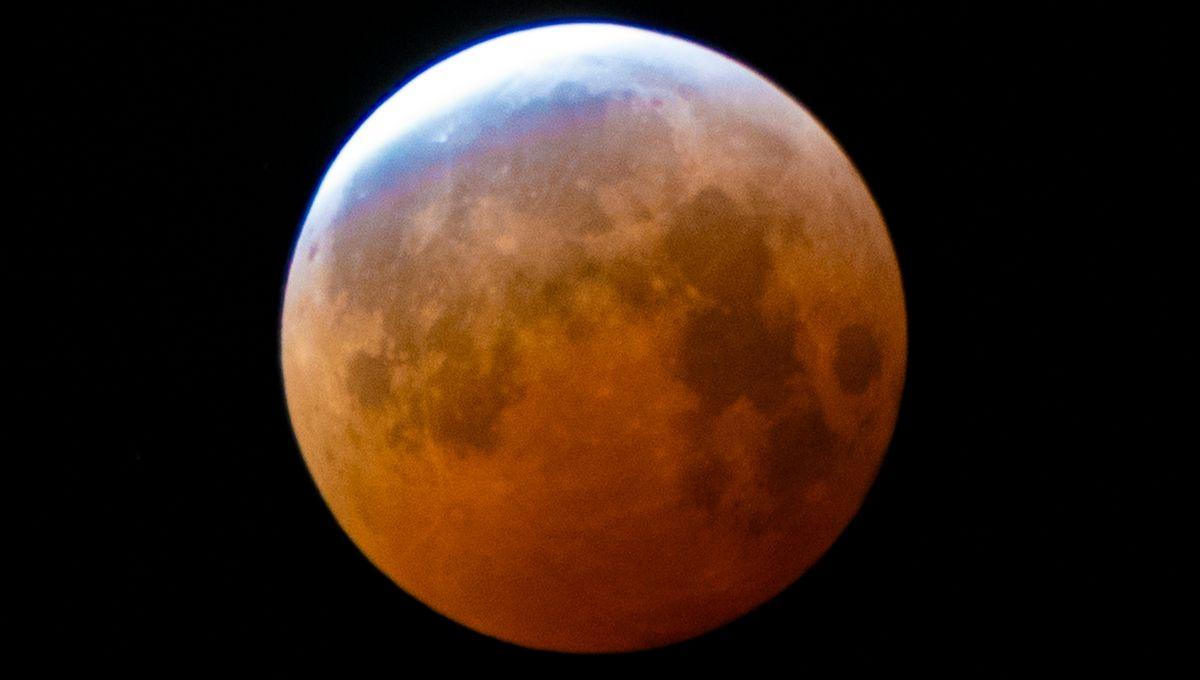
On Sunday, 7 Billion People Will See The Moon Turn Red. But Who Will See The Blue Band?
We literally can't wait for the eclipse this weekend! A record-breaking 7 billion people, from Oceania to the eastern coast of the Americas, will see the Moon’s disappearance inside the Earth’s shadow before turning red. As it is darkened by our planet, the Moon might gain some extra color: a blue band at the edge of the red. What gives?
The rest of this article is behind a paywall. Please sign in or subscribe to access the full content. A total lunar eclipse, as the one the planet is about to experience, is also known as a blood moon, as our natural satellite turns ruby red during the tens of minutes that it spends in the cone of our planet’s shadow. The reasons for the red and for the blue are connected, as we are about to see. First, the Moon travels into the penumbra, the half shadow of the Earth, where only a small portion of sunlight is blocked. A lunar eclipse happens at full Moon, so the penumbral phase has a dimmer Moon than usual, but it is not dramatically different. Then the Moon enters the umbra, the full shadow of the Earth, and it is slowly covered, getting darker and darker. This is the partial phase. From beginning to end, this lasts over three hours. ⓘ IFLScience is not responsible for content shared from external sites. When the alignment is right, the Moon will be completely covered. That’s the total eclipse, usually lasting well over an hour. During this phase, we discover something important about the shadow of the Earth. The umbra is not black: it’s red. There is some sunlight that gets into the umbra, and it gets through it because it filters through the atmosphere. The reason why the sky is blue during the day and red at dawn and dusk is the scattering of sunlight through the atmosphere. The same scattering sends some red light into the umbra. But not just red light. If the conditions are right, just before totality as the Moon gets redder, you can see a blue-violet band between the red and the white portion of the Moon. The source of that band is ozone. The red comes from stratosphere scattering, and the light is passing through a lot of the stratosphere. Still, in the upper stratosphere, there’s the ozone layer. The layer absorbs some of the red, leaving turquoise light to pass through. Given the seasonal variability of the layer, as well as its changes due to atmospheric circulation and solar activity, the effect can be more or less pronounced. Most of Asia, a sliver of East Africa, and Western Australia will get the full show. The rest of Africa, Australia, much of Europe, and the east coast of Brazil will get at least part of the totality and the partiality. You can check Time&Date.com for precise timings to see the eclipse at your location. To see the blue band, it’s best to look at the Moon in the minutes before totality or right after with binoculars or a small telescope.

 English
 Arabic
 French
 Spanish
 Portuguese
 Deutsch
 Turkish
 Dutch
Dutch
 Italiano
 Russian
 Romaian
 Greek
Greek