


We May Finally Know Where The "Hobbit" Humans Came From
We May Finally Know Where The "Hobbit" Humans Came From
The miniature “Hobbit” humans of Flores Island may have come from the nearby island of Sulawesi, where researchers have discovered evidence for hominin occupation up to 1.5 million years ago. It’s currently unclear exactly which ancestral species was present on the Indonesian island at this early point in our history, but the journey from mainland southeast Asia to Sulawesi may have seen humans cross the ocean for the very first time.
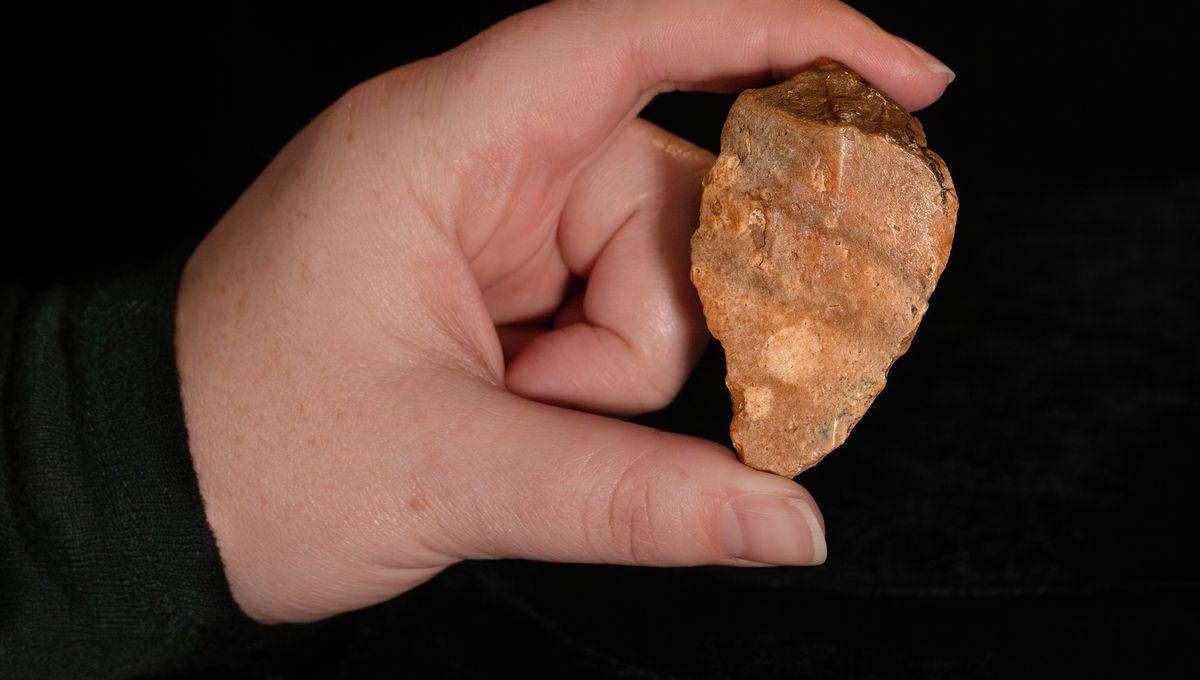
It’s well known that Pleistocene hominins voyaged through the islands of Wallacea, with artifacts on Flores dated to 1.02 million years ago. Fossils belonging to the diminutive Homo floresiensis – commonly referred to by its Tolkienesque nickname – have also been discovered, while a similarly petite species called Homo luzonensis left its remains behind on the nearby island of Luzon. Speaking to IFLScience, Dr Adam Brumm from Griffith University said, “We'd always suspected that the original Hobbits actually came from Sulawesi,” and that he and his colleague Budianto Hakim had “spent decades” searching for evidence that humans reached the island before they made it to Flores. Until now, however, no one had ever found any stone tools on Sulawesi older than 194,000 years old. Yet that all changed when the study authors came across a series of seven chert tools in a cornfield in southern Sulawesi. Analyzing the age of the surrounding sediment and a fossilized hog jaw found alongside the artifacts, the researchers calculated that the lithic items were produced by ancient hominins between 1.04 and 1.48 million years ago. To get across from the Asian mainland to Sulawesi, they had to have crossed a fairly significant sea gap, and how they did that is not really known. Dr Adam Brumm Crucially, these tools are older than the earliest known artifacts on Flores, suggesting that prehistoric hominins may have reached Sulawesi before continuing on to the smaller island, which lies hundreds of kilometers to the south. “I think we've got another piece of the puzzle here that does make it somewhat more likely that Sulawesi was the point of origin of these early humans on Flores,” says Brumm. “But until we find hominid fossils on Sulawesi itself, we can't say who was making those stone tools and whether that theory is correct.” At present, the leading hypothesis is that H. floresiensis descended from a Homo erectus population that crossed over from the mainland before undergoing an evolutionary process known as island dwarfism. Whether these early Sulawesians shared the same heritage or experienced similar morphological changes is currently impossible to say, as we’re yet to find any human remains associated with these stone tools. Regardless of the identity of the ancient toolmakers, however, Brumm says they were unlikely to have possessed the cognitive abilities to build boats. “To get across from the Asian mainland to Sulawesi, they had to have crossed a fairly significant sea gap, and how they did that is not really known,” he explains. “I think the cognitive skills required to develop maritime technology, invent boats and make planned voyages would have been beyond the abilities of these early humans.” He therefore suggests that these initial ocean crossings may have been accidental, mirroring the maritime relocation of rodents and monkeys who “were dispersing naturally by floating on vegetation mats.” Thus, while the discovery helps to fill in some of the gaps in our understanding of the human journey across Wallacea, Brumm says that many questions remain unanswered regarding the story’s protagonists: “Who they were, what happened to them after they arrived, and what happened once our species first set foot on that island, when we first colonized Sulawesi about 65,000 years ago?” he ponders. “Was the earlier population still established on the island at that time, or had they gone extinct prior to that? And if they hadn't, what was the nature of the interaction between us and them?” The study is published in the journal Nature.

 English
 Arabic
 Spanish
 Portuguese
 Deutsch
 Turkish
 Dutch
Dutch
 Italiano
 Russian
 Romaian
 Portuguese (Brazil)
 Greek
Greek