


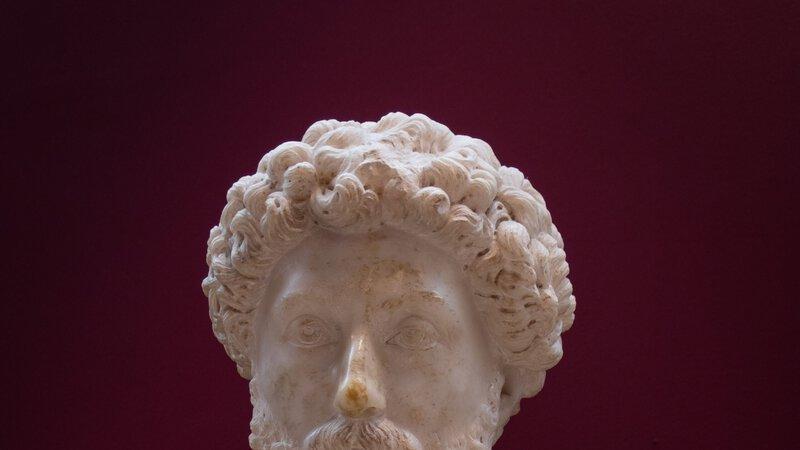

Somewhere on the frozen Danube frontier, around 170 AD, the most powerful man in the world sat alone in a military tent — not drafting a decree, not composing a speech for the Senate — but writing a quiet, almost desperate note to himself about how to be a better person before morning came.
A Roman Emperor Writing to No One — and Everyone

The manuscript Marcus Aurelius left behind carries no title in his own hand. Later editors would call it Meditations. In some surviving copies, the Greek heading reads simply Ta eis heauton — “To Himself.” That phrase is the first and most important thing to understand about the book: it was never meant for you. It was never meant for anyone. And that is precisely why, nearly two millennia later, strangers are still reading Marcus Aurelius quotes on their phones during lunch breaks and sleepless nights.
There was no audience, no legacy project, no imperial communications strategy. No court scribe was ordered to polish the prose. Marcus was not performing wisdom — he was wrestling with it, alone, in the flickering light of a campaign tent, while an empire groaned around him. The very privacy of the text turned out to be its superpower.
Who Was Marcus Aurelius? The Man Behind the Purple Cloak

He was born in 121 AD into a well-connected Roman family — prosperous, respected, but not obviously destined for greatness. What changed everything was the emperor Hadrian, who looked at the boy Marcus and apparently saw something worth cultivating. Through a chain of adoptions that reads like a succession of bets placed on promising bloodlines, Marcus found himself heir to the Roman throne almost by institutional accident. He became emperor in 161 AD and ruled until his death in 180 AD — nineteen years of plague, war, political intrigue, and relentless personal loss.
He suffered chronic illness throughout his life, likely gastrointestinal problems serious enough to affect his daily functioning. He outlived several of his children. He managed a court riddled with flattery and corruption, fought wars on the Germanic frontier that he found philosophically troubling, and did all of this while trying — genuinely, almost painfully trying — to be a decent human being. Historians often call him the last of Rome’s “Five Good Emperors,” and his reign is frequently described as the high-water mark of the Roman Empire. The gap between that official grandeur and the private self-doubt recorded in his journal is one of the most extraordinary contradictions in recorded history.
The philosophical tradition that shaped every line he wrote was Stoicism. Marcus Aurelius’s Stoic philosophy was not an academic hobby — it was the operating system he ran his life on. The Stoics taught that virtue is the only genuine good, that external events — wealth, reputation, even health — are ultimately indifferent to a life well-lived, and that what we control is not the world but our response to it. Marcus had absorbed this framework from boyhood tutors and carried it into every crisis his reign threw at him. It gave him a language for suffering. It didn’t make suffering easier. That tension is what makes the journal worth reading.
The Secret History of Meditations — How a Private Journal Survived

Marcus wrote in Greek, not Latin — a telling choice. Latin was the language of power, of edicts and legislation. Greek was the language of philosophy, of inner life, of the tradition he loved. He wrote across roughly a decade, mostly during military campaigns, in short passages that have the quality of daily exercises — a man returning to the same themes the way a physical trainer returns to the same movements, not because he has mastered them, but because mastery keeps slipping away.
The manuscript nearly vanished. After Marcus died on campaign near modern-day Vienna in 180 AD, the text entered a long, precarious drift through history. There are fragmentary references to it in late antique sources suggesting it circulated in at least some educated circles, but it surfaces more fully only in Byzantine sources around the 10th century. It did not reach the printing press until 1558 — almost 1,400 years after it was written. For fourteen centuries, one of the most consoling documents in Western literature existed in a state of near-erasure, copied by hands whose names we will never know, preserved by a chain of luck and care that could have broken at any point.
The modern chapter of the Meditations story has its own turning point. Gregory Hays’s 2002 Modern Library translation brought Marcus to a generation raised on self-help and suspicious of anything that smelled like a classics lecture. Hays rendered the Greek in clean, unadorned, almost conversational English — prose that felt urgent rather than preserved-in-amber — and the book became a surprise bestseller. A text written to be destroyed, possibly by the man who wrote it, became one of the most widely read works of philosophy in human history. The irony would have made Marcus uncomfortable. He would have written a journal entry about not being attached to irony.
What the Quotes Actually Mean — Reading Marcus Slowly

The lines that circulate most widely on social media are worth slowing down for, because they are almost always richer and stranger than they appear at first glance.
Take one of the most frequently shared: “You have power over your mind — not outside events. Realize this, and you will find strength.” This is not toxic positivity. It is not a motivational poster telling you to think happy thoughts. It is a precise statement of Stoic doctrine — the dichotomy of control — written by a man who was managing an empire he could not fully control, watching a plague kill millions of his citizens, and fighting wars whose outcomes were uncertain. He is not claiming life is manageable. He is claiming that the one small patch of territory we actually govern is our own judgment, and that this patch, tended carefully, is enough to stand on.
Or consider: “The happiness of your life depends upon the quality of your thoughts.” Read it not as a lecture but as a daily practice note — Marcus reminding himself, not an audience, that perception is the medium through which reality arrives. In 170 AD, this was a philosophically precise claim rooted in centuries of Stoic teaching. In the age of social media feeds engineered to colonize attention, it is quietly radical still.
“It is not death that a man should fear, but he should fear never beginning to live.” Give this one its full biographical weight. Marcus watched children die. He watched friends fall to illness and battle. He lived with his own physical fragility every morning. This was not philosophy from an armchair — it was grief processed in ink, fear examined rather than avoided. The line reads differently when you know it was written by a man who had considerable personal experience with mortality.
And then there is this, which surprises people who think Stoicism is cold: “Dwell on the beauty of life. Watch the stars, and see yourself running with them.” Marcus’s prose could be lyrical, almost mystical. The caricature of Stoicism as grim endurance misses this entirely. He was not advocating numbness — he was advocating presence, the kind of full-bodied attention to existence that makes loss bearable because it makes the living genuinely felt. You can find more of these layered Marcus Aurelius quotes collected and examined by scholars of the tradition he helped define.
Six Themes That Run Through the Meditations
Rather than treating the Meditations as a grab-bag of inspirational lines, it helps to see the recurring themes Marcus returned to across all twelve books. The same concerns surface again and again — not because he was repetitive by design, but because these were the problems he could not solve once and file away.
- Control and acceptance. The dichotomy between what is and is not “up to us” appears on nearly every page. “Never let the future disturb you. You will meet it, if you have to, with the same weapons of reason which today arm you against the present.” This is not fatalism — it is a precise cognitive discipline.
- The brevity of time. Marcus was preoccupied with impermanence in a way that reads as urgent rather than morbid. “Confine yourself to the present.” He returned to this instruction constantly, as if the present kept escaping him — which, of course, it did, as it does for everyone.
- Anger and patience. For a man who commanded armies and sentenced people to death, Marcus wrote about anger with startling humility. “How much more grievous are the consequences of anger than the causes of it.” He seems to have struggled with irritability and used the journal to talk himself down from it.
- Duty without ego. He returned repeatedly to the obligation to act for the common good while resisting the hunger for praise that power generates. “Do not indulge in dreams of what you have not, but count the blessings actually present.”
- The nature of the self. Marcus was genuinely interested in what a person is — the relationship between body, mind, and the ruling faculty he called the hegemonikon. His introspective passages anticipate questions that psychology would not formalize for another eighteen centuries.
- Death as teacher. Memento mori — the deliberate contemplation of death — was a formal Stoic exercise, and Marcus practiced it seriously. He did not use it to generate despair but to calibrate what actually mattered on any given day.
Understanding these six threads transforms how individual quotes land. A line about anger or death is not a fortune cookie — it is one entry in a long, ongoing argument Marcus was having with himself about how to live well under impossible pressure.
The Stoic Philosophy That Holds the Quotes Together

Stoicism began in Athens around 300 BC with a philosopher named Zeno of Citium, who reportedly started teaching after a shipwreck left him stranded and rethinking everything. The school traveled to Rome, where it found a natural audience among people preoccupied with duty, self-discipline, and the management of catastrophe. By Marcus’s era, Stoicism was less a formal academic institution than a practice — a set of daily habits including journaling, meditation on death, and the deliberate examination of one’s own reactions before acting on them.
The core engine driving so many Marcus Aurelius Meditations quotes is deceptively simple: the Stoics divided the universe into what is “up to us” — our judgments, desires, and responses — and what is “not up to us” — everything else, including outcomes, other people’s behavior, and the body’s decline. Marcus returned to this distinction obsessively throughout the journal. He returned to it because he kept forgetting it, just as we do. That is the key. He was not recording his mastery. He was recording his attempts.
“Be tolerant with others and strict with yourself.” As a statement of personal ethics, this line is quietly revolutionary. The most powerful man in the Western world is instructing himself to hold himself to a harder standard than the citizens he rules. Most leadership philosophy runs in exactly the opposite direction. The range of themes across Marcus Aurelius’s Meditations — from anger to ambition to the fear of obscurity — reveals a man mapping the full interior landscape of power and its temptations.
What makes the philosophy durable is its honesty about failure. Marcus is not a guru announcing enlightenment from a mountaintop. He is a man who slips, lectures himself, slips again, and gets up again. The journal is the evidence of both the falling and the rising, and readers sense this even when they encounter a single extracted quote on a screen. Something in the texture of the writing signals: this is not performance.
Which Translation Should You Read?
The question of translation matters more than most readers realize, because the Greek of the Meditations is itself unusual — compressed, sometimes grammatically rough, occasionally obscure even to classical scholars. Marcus was not composing for posterity; he was writing fast, for himself, in a language that was his philosophical mother tongue but not his administrative one. Different translators have made very different choices about how to handle that texture.
Gregory Hays’s 2002 Modern Library edition remains the most widely recommended starting point for general readers. Its English is clean and direct without flattening the strangeness of Marcus’s thought. For readers who want something closer to the literal Greek, the older George Long translation (1862) is freely available online and retains a formal dignity, though its Victorian syntax can feel remote. Robin Hard’s 2011 Oxford World’s Classics edition offers rigorous scholarly apparatus alongside a readable translation and is particularly useful for anyone who wants to understand the philosophical context of specific passages. No single translation is definitive — reading two side by side for passages that matter to you is more instructive than any commentary.
Why These Words Hit Different in the 21st Century
Marcus wrote during the Antonine Plague, one of the deadliest pandemic events in ancient history, which killed millions across the Roman Empire during his reign. He wrote during endless frontier wars. He wrote through political betrayal and personal grief. The emotional landscape of his journal maps onto the contemporary reader with uncomfortable precision — not because human nature has changed, but because it has not changed at all.
The format matters enormously in the social media context. Short Marcus Aurelius quotes are almost perfectly engineered for the scroll — dense meaning compressed into a single sentence, no prior context required to feel the impact, but rich enough to reward the reader who goes deeper and actually picks up the book. Communities of readers regularly debate which passages hit hardest, and the conversation never quite settles, because different lines land differently depending on where you are in your life when you encounter them.
But the deeper reason these words endure is the journal format itself. Readers sense, even without being told explicitly, that they are not being preached at. They are overhearing a conversation a man is having with himself — a private argument, never fully resolved, conducted with complete honesty because no one was ever supposed to hear it. That quality of overheard intimacy is something no self-help book written for an audience can fully replicate. The most resonant Marcus Aurelius quotes carry this texture in every line — the texture of genuine private struggle rather than public wisdom polished for effect.
Common Misreadings — and What the Text Actually Says
The widespread circulation of Marcus Aurelius quotes has produced a small industry of misattribution and misreading that is worth addressing directly.
First, several popular quotes attributed to Marcus are not in the Meditations at all and cannot be verified in any of his surviving writings. The line “The impediment to action advances action. What stands in the way becomes the way” is a loose paraphrase of Meditations 5.20, popularized by Ryan Holiday’s book The Obstacle Is the Way — it captures the spirit of the passage but is not a direct translation. Readers who want the actual text should check against a reputable translation rather than relying on social media attribution. When a quote sounds suspiciously perfect, it is worth verifying.
Second, Stoicism is frequently misread as emotional suppression — the stiff upper lip school of philosophy. Marcus’s own writing contradicts this at every turn. He writes about grief, about love for friends, about the genuine pleasure of watching the natural world. The Stoic goal was not the absence of feeling but the absence of being ruled by feeling. That is a meaningful distinction that most motivational uses of Marcus’s quotes quietly erase.
Third, the emphasis on individual mental control in Marcus’s quotes is sometimes imported uncritically into contexts — particularly workplace wellness culture — where it functions to redirect attention from structural problems onto personal attitude. Marcus was writing for himself as a private discipline, not offering a political philosophy. Reading him carefully makes this clear. He was addressing his own tendency to react badly, not instructing citizens to accept unjust conditions with good cheer.
The Journal That Was Never Finished — and Never Had To Be
Somewhere around 180 AD, Marcus Aurelius put down his stylus for the last time. He never decided his notes were good enough to share. He died on campaign, still at war, still imperfect, still trying. He left behind a manuscript with no title, no conclusion, no preface explaining what he had meant by any of it.
The journal’s lack of conclusion is not a flaw. Neither are its repetitions, or its contradictions, or the passages where he says the same thing he said three books earlier as if he had completely forgotten he had already worked it out. These are the proof of a life actually lived in philosophy rather than performed for admiration. He was not building a monument. He was doing the work, day by day, in the dark.
When you read “You have power over your mind — not outside events”, you are not reading a quote. You are reading a man’s private argument with himself — an argument he never won and never stopped having. He is not speaking to you. He is speaking to himself. The fact that his words reach across nineteen centuries and land with the force of something you already knew but could not say — that is the accident of a man who wrote honestly into the void and found, without meaning to, that the void was full of other people who needed exactly those words.
The best way to honor Marcus Aurelius is not to screenshot his lines and move on. It is to do what he did: sit down somewhere uncomfortable, pick up a journal, and start writing honestly to yourself. Do not worry about the title. He did not have one either.

 English
 Arabic
 French
 Spanish
 Portuguese
 Turkish
 Dutch
Dutch
 Italiano
 Russian
 Romaian
 Portuguese (Brazil)
 Greek
Greek