


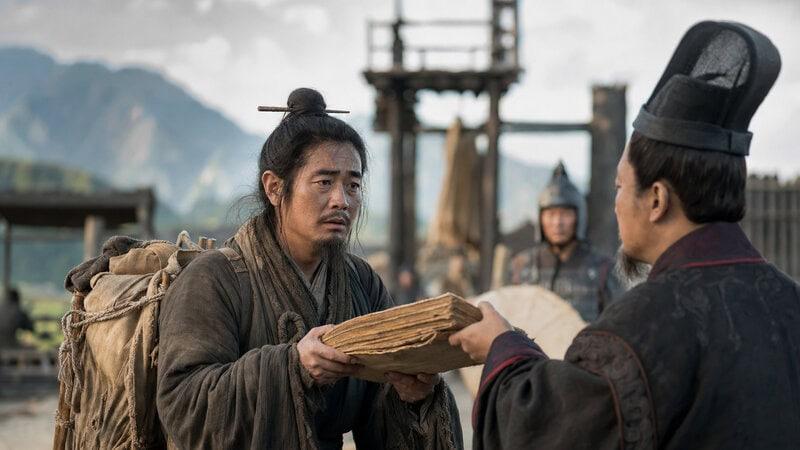

A merchant stands at a checkpoint somewhere in the former kingdom of Chu, around 200 BCE, clutching a sheaf of contracts he has carried for weeks across mountain roads. The local official stares at the documents, turns them sideways, and hands them back. The writing is incomprehensible — not because the language is foreign, but because every kingdom in pre-unified China had developed its own visual code for the same spoken words, and no one had yet decided that should change.
One Script to Rule Them All

This was the world the Han Dynasty inherited — a patchwork of regional scripts stitched together by conquest but not yet by comprehension. The Qin Dynasty (221-206 BCE) had unified China by military force, and the minister Li Si had begun standardizing written characters, but Qin burned itself out in fifteen years, too brutal and too brittle to finish what it started. When the Han rose from the civil war that followed, they faced a civilization that could march under one emperor but still could not read each other’s mail. Their solution — to standardize the written language across millions of square miles — was the most consequential cultural engineering project the ancient world had ever attempted. Han Dynasty history, it turns out, begins not with armies, but with ink.
A Dynasty Born from Rubble

The man who founded the Han was not supposed to be emperor. Liu Bang was a commoner — a minor village official from a peasant family, a drinker of rough wine who charmed soldiers as easily as he offended aristocrats. He had no dynastic pedigree, no philosophical training, no obvious claim to the Mandate of Heaven. What he had was a gift for keeping talented people loyal, and the political instinct to understand that Qin had failed not from weakness but from cruelty. Where Qin crushed, Liu Bang would breathe.
The early Han pursued a deliberate policy called xiūyǎng shēngxī (休養生息) — rest and recuperation — reducing taxes, freeing slaves, and allowing a population hollowed out by war and famine to slowly rebuild. It was unglamorous governance, the kind that rarely makes it into popular histories, but it was the economic foundation on which everything else rested. By the time Emperor Wu ascended the throne in 141 BCE, the Han had accumulated four generations of stored wealth, military confidence, and institutional momentum. The empire was ready to move — not just militarily, but culturally and linguistically.
The Han Dynasty (206 BCE – 220 CE) endured for over four centuries across two periods — the Western Han, centered on Chang’an, and the Eastern Han, centered on Luoyang — making it one of the longest-reigning dynasties in Chinese history and a foundational chapter in any serious account of ancient China.
The Language Problem No Empire Could Ignore

To understand what the Han accomplished, it helps to visualize what written Chinese looked like before them. The State of Chu used characters with long, elegant, almost serpentine strokes. The State of Qi used blockier, more angular forms. Yan, in the north, had its own conventions. These weren’t mere stylistic preferences — they were functionally different systems, much as Cyrillic and Latin are different systems, except that the underlying spoken languages shared deep common roots. A merchant, a diplomat, or a general crossing regional boundaries carried documents that might as well have been in code.
Han scholars addressed this by developing and codifying what is known as lìshū (隸書) — clerical script — a more fluid, efficient form of writing suited to brush and ink on silk or paper, replacing the laborious seal script previously carved into bronze and stone. Clerical script could be written quickly, reproduced consistently, and taught systematically. It gave every literate person from the Korean peninsula to the edges of Central Asia the same visual vocabulary, so that a decree issued in the capital could be read, without translation, by an official at the empire’s furthest reach.
The implications compounded. A census conducted under the Han — one of the earliest large-scale population counts in world history — recorded approximately 57 million people. Coordinating that count across mountains, rivers, and steppes was only possible because the officials conducting it were all reading and writing the same administrative characters. Han Dynasty achievements in technology — paper-making, the seismoscope, improvements to the iron plow — spread with unusual speed across the empire because technical knowledge could now be written down in a universally readable form and copied without distortion from region to region.
Emperor Wu and the Confucian Master Stroke

Standardizing a script by decree is one thing. Getting millions of people to actually adopt it is another. Emperor Wu solved this problem with a stroke of institutional genius that had nothing obvious to do with linguistics: he made Confucian classical texts the basis of the imperial examination system, the gateway to government employment and social advancement across the entire empire.
To pass those exams, candidates had to master a canon of classical works written in standardized Han script. Suddenly, every ambitious young man in every corner of the empire had a powerful personal incentive to learn the same written language. This linked linguistic standardization to social mobility in a way that no royal decree alone could achieve. The script spread on its own momentum — a self-reinforcing loop — because careers depended on it. The Taixue, the Imperial Academy established in 124 BCE, enrolled thousands of students studying these canonical texts, functioning effectively as the world’s first state university system built around a standardized written curriculum. The Han didn’t just issue mandates; they built institutions that made compliance feel like opportunity.
What the Unified Script Actually Built

The Silk Road, which reached its first great flowering under the Han, required diplomatic correspondence with dozens of foreign states and steppe confederacies. The standardized script gave Han diplomats a consistent, prestigious written voice that foreign courts recognized as the language of the world’s most powerful civilization. Embassies arrived from Parthia, from Rome’s eastern frontier, from kingdoms in Southeast Asia. All of them encountered the same formal Han written register — confident, precise, and impossible to mistake for anything provincial.
Meanwhile, inside the empire, something remarkable was happening at the level of identity. Spoken dialects continued to diverge — what we now call Cantonese, Hokkien, and Shanghainese were already pulling apart into forms that would eventually become mutually unintelligible in speech. But the shared written script kept literate Chinese in conversation across those divisions for century after century. A scholar in Guangzhou and a scholar in Beijing could correspond fluidly in writing even if, standing face to face, they couldn’t understand each other’s spoken words. This is a Han Dynasty legacy with no real parallel in the Western world, where the fragmentation of Latin into the Romance languages gradually dissolved the shared literate culture of the Roman world.
Historians frequently compare the Han to Rome as the two great classical empires that defined their respective civilizations. When Rome fell in the fifth century CE, Latin splintered, and the literary cultures of the Mediterranean fractured along with it. The Han’s written standard held. The dynasty ended in 220 CE, but the script endured, keeping China’s literary culture unusually continuous across nearly every political upheaval that followed.
Why the Han Dynasty Still Shapes the World

The deepest measure of the Han’s impact is also the simplest: Chinese people today call themselves Hàn rén (漢族) — Han people. The dynasty’s name became the name of an ethnicity, a civilization, and a script family. That a political entity which ended roughly 1,800 years ago still lends its name to the self-identification of over a billion people is, by any measure, an extraordinary legacy. The characters used in Chinese writing today are direct descendants of the clerical script the Han standardized. Every character brushed in a calligraphy class, every menu printed in a Chinese restaurant, every text message typed on a smartphone carries that inheritance forward.
Han Dynasty history feels less like ancient trivia and more like a live wire running beneath the present. Its decisions about language, bureaucracy, and cultural identity are not finished decisions — they are still conducting current, still shaping how more than a billion people read, write, and understand themselves.
Tasting the Han Legacy in Manayunk
On Main Street in Philadelphia’s Manayunk neighborhood, Han Dynasty Manayunk carries the dynasty’s name into a very different kind of institution — a spicy chili oil infused Chinese restaurant built around chili oil, numbing peppercorns, and food that demands your full attention. Located at 4356 Main St, it was the fourth location opened by the Han Dynasty restaurant group and operates seven days a week, from 11:30 a.m. to 10:00 p.m. Walk-ins are welcome for smaller parties; reservations are accepted for groups of five or more. The restaurant is BYOB — a detail the regulars have clearly embraced.
The numbers tell a story of genuine loyalty: 456 Yelp reviews with a 3.7 rating and a steady stream of returning diners place Han Dynasty Manayunk firmly among the neighborhood’s most established dining destinations. WHYY noted that the opening heated up the Manayunk food scene — a description that, given the Sichuan peppercorn situation on the menu, is meant quite literally. Main Line Today has also covered the restaurant as part of the broader regional dining landscape it has come to shape.
The name “Han Dynasty” is doing real cultural work on that restaurant sign. It invokes the specific civilizational moment when a people decided that food, language, and identity could travel together across impossible distances — that a shared table, like a shared script, is what turns a collection of strangers into something that lasts. Whether you’re there for the dan dan noodles or the Sichuan-spiced heat that lingers long after the meal, you’re eating in the shadow of an empire that understood, two thousand years ago, that culture is infrastructure. Get there hungry. Bring your own bottle.

 English
 Arabic
 French
 Spanish
 Portuguese
 Deutsch
 Turkish
 Dutch
Dutch
 Italiano
 Russian
 Portuguese (Brazil)
 Greek
Greek