


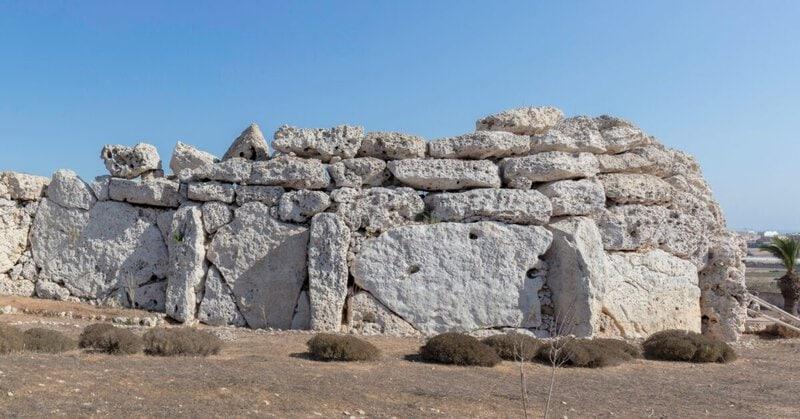
Somewhere on a sun-bleached hilltop on the island of Gozo, a traveller presses a palm flat against a limestone wall and feels something shift inside them — not the stone, which hasn’t moved in five and a half thousand years, but their sense of where human history actually begins.
A Stone Room Built Before History Had a Name

The wall belongs to Ġgantija, and the first thing you notice is the scale. The blocks are enormous — some weighing up to 50 tonnes — stacked with a precision that seems almost argumentative, as if the builders were making a point. The second thing you notice, once someone tells you the date, is the vertiginous drop that opens beneath your feet. These temples were already ancient when the first Egyptian pharaoh was crowned. They were standing, complete and in use, more than a thousand years before anyone dragged the first stone to Salisbury Plain.
The Ġgantija temples on Gozo date to roughly 3600-2500 BCE, placing them among the oldest free-standing stone structures on Earth. They predate Stonehenge by at least a millennium. They predate the Great Pyramid of Giza by more than five hundred years. And they were built on a tiny Mediterranean island that most of the world still struggles to place on a map.
That island is Malta — officially the Republic of Malta — a mere 316 square kilometres of limestone and light squeezed between Sicily and the coast of North Africa. What happened here, in near-isolation, across more than a thousand years of prehistoric ambition, is one of the most remarkable and least-told stories in all of human history.
The Improbable Island at the Centre of Everything

Geography, in Malta’s case, is destiny. The archipelago sits at the heart of the Mediterranean, close enough to Sicily and North Africa to absorb the currents of several civilisations, yet isolated enough — especially in prehistory, before reliable open-water navigation — to develop something entirely its own. It is, in the language of evolutionary biology, a kind of cultural Galápagos: a closed system where unusual things happen fast.
Today, as Britannica notes, approximately 519,500 people live here, speaking Maltese and English across a landscape where limestone seems to glow amber in the afternoon light. The capital, Valletta — a compact city of Baroque churches, Knights’ palaces and sweeping harbour views — feels magnificently old, with much of its fabric dating to the sixteenth century and later. And yet, by Maltese standards, Valletta is practically a newborn. Drive twenty minutes into the countryside and you are standing beside structures that were already ruins when Valletta’s architects were drawing their first plans.
Smallness mattered enormously to what happened here in prehistory. Islands concentrate people and resources. They force innovation under pressure. Malta offered its earliest inhabitants something invaluable: an abundance of soft globigerina limestone, easy to cut with stone tools, alongside harder coralline limestone suited to structural load-bearing — a ready-made two-material construction kit lying everywhere underfoot. Combined with the relative shelter of island life, the conditions were set for a culture to flourish, build, and refine itself across generations with fewer of the disruptions that plagued mainland peoples.
Before the Knights of St. John fortified these harbours, before Romans and Phoenicians and Arab rulers each left their mark, before any of what we call recorded history on the islands begins, someone was already here. And they were building on a scale that still defies easy explanation.
Who Were the Temple Builders? The People History Forgot

Archaeologists call this the Temple Period, running roughly from 3600 to 2500 BCE. The people at its centre have no name we can give them — no written language, no surviving oral tradition, no descendants we can identify with certainty. They arrived in the archipelago, probably from Sicily, around 5000 BCE as farmers and herders. Over the centuries, something shifted in their culture — a deepening of ritual life, a growing investment in communal sacred space — and they began to build.
What we know of them comes almost entirely from stone and the objects found within it. They were sophisticated in ways that continue to surprise archaeologists: they performed animal sacrifices, held communal feasts inside their temples, and created a body of portable art that ranks among the most evocative of any prehistoric culture. The most famous examples are the so-called ‘Fat Lady’ figurines — large, serene, heavy-limbed statues found across multiple Maltese sites. Whether they represent a deity, an ancestor, a priestly ideal, or something else entirely remains debated. They sit in the National Museum of Archaeology in Valletta with an expression of absolute composure, as if they find the argument slightly tiresome.
The civilisation also appears to have developed a specialist or priestly class — people whose role was ritual rather than farming, supported by the broader community. That degree of social specialisation, long considered a hallmark of more complex societies, was taking shape here while much of Europe was still in the early Neolithic.
And then, around 2500 BCE, it stopped. The temple-building culture collapsed entirely; the cause remains unknown. Climate deterioration, prolonged drought, soil exhaustion after centuries of farming, epidemic disease, social fragmentation — all have been proposed, none proven. The temples were abandoned. A different people, with different tools and different burial practices, eventually arrived. The memory of what had come before was so completely erased that, when Maltese folklore later tried to make sense of these enormous structures, the only explanation that seemed to fit was giants.
Ġgantija: The Giant’s Tower

The name itself tells you everything about the impression the temples make. Ġgantija means, in Maltese, ‘giant’s tower.’ When later inhabitants looked at these walls — outer courses still standing up to six metres high after five and a half millennia of Mediterranean sun, earthquake, and neglect — they concluded that no ordinary human hand could have raised them. It is a folk etymology that captures something true: the achievement feels genuinely superhuman, even once you accept that it was entirely human in fact.
The engineering is worth sitting with. Two conjoined temples, built from coralline limestone quarried and transported without wheeled vehicles or metal tools, form a complex whose outer walls have outlasted almost every other structure of comparable age on Earth. The builders apparently used a combination of sledges, rollers, ropes, earthen ramps, and the organised labour of a community that understood, collectively, what it was trying to achieve.
The interior layout follows a trefoil, or clover-leaf, plan: a central corridor opening into pairs of curved apses on either side, with a terminal apse at the rear. This design appears not only at Ġgantija but is repeated, with local variations, at multiple sites across Malta and Gozo — evidence of a shared architectural tradition so consistent it amounts to what some scholars have called the world’s first recognisable architectural school. Whoever taught the design, whoever transmitted it between communities and generations, created a template that endured for over a thousand years.
Ġgantija is a UNESCO World Heritage Site, part of a grouped inscription covering seven Maltese megalithic temples. It is arguably more intact than Stonehenge, unambiguously older, and set in a landscape of striking beauty above the Gozitan village of Xagħra. It receives a fraction of Stonehenge’s annual visitors. That disproportion is, in its quiet way, one of the stranger facts in heritage tourism.
A Constellation of Stone Across the Islands

Ġgantija is the oldest and most celebrated, but it is far from alone. Malta and Gozo together host a concentration of megalithic temple architecture that has no parallel anywhere on Earth — seven UNESCO-listed structures, each with distinct character, collectively forming a map of a civilisation’s spiritual geography.
At Mnajdra, on Malta’s southern coast, the builders achieved something that hints at a depth of astronomical awareness we rarely associate with the Neolithic. At the spring and autumn equinoxes, sunlight passes through a specific temple doorway and falls directly upon the altar — a precision that could only be intentional. The temple functions, in effect, as a solar marker carved in stone, almost certainly used for the ritual management of planting seasons, festivals, and the turning of a sacred year.
Beneath the streets of modern Paola lies the Hypogeum of Ħal Saflieni — perhaps the most astonishing of all Malta’s prehistoric sites, and among the hardest to describe in words. It is a subterranean necropolis carved entirely by hand into the living rock, descending through three levels to a depth of around ten metres. An estimated seven thousand individuals were buried here over the course of the Temple Period. Its chambers include a space known as the Oracle Room, where the acoustic properties — apparently deliberate — cause a low voice to resonate through the entire underground complex in a way that visitors consistently describe as overwhelming. Standing inside it, you understand viscerally why ancient peoples might have believed the earth itself could speak.
Taken together, these sites do not read as isolated curiosities. They read as the surviving evidence of a coherent, island-wide civilisation — one with shared religious practice, shared architectural language, and a command of stone that remains remarkable by any era’s measure. For anyone planning a visit, the range and density of Malta’s prehistoric and historic attractions makes the island unusually rewarding for history-focused travellers.
Why the World Doesn’t Know — and Why That Is Changing

Malta’s ancient story suffers from an unfortunate case of famous neighbours. When the history books need a prehistoric wonder, Stonehenge is photogenic and English-speaking. When they need monumental antiquity, the Pyramids are enormous and Egyptian. Malta’s temple builders left no writing, no famous names, no conquests, no legends that crossed into other cultures’ records. They built in silence and vanished in silence, and the civilisations that came after — Phoenician, Roman, Arab, Norman, Knight — were too busy making their own histories to look carefully at what lay in the fields.
That is changing. Advances in isotope analysis are revealing where individual temple builders ate and moved during their lifetimes. Ancient DNA research is beginning to trace their origins and fate with a precision that traditional archaeology never achieved. Three-dimensional laser scanning of temple interiors is capturing details of construction technique invisible to the naked eye. New findings emerge almost yearly, building — fragment by fragment — a portrait of a society more complex, more organised, and more intellectually ambitious than the word ‘prehistoric’ might suggest.
There is urgency to this work. Limestone erodes. The same Mediterranean climate that made these islands habitable five thousand years ago now brings increased moisture, atmospheric pollution, and the physical pressure of tourist footfall. Some temples have been fitted with protective canopies — an aesthetic compromise that conservationists debate — because the alternative is to watch ancient carvings dissolve within a generation. Discovery and decay are in a race, and the outcome is not guaranteed.
Yet visitors are coming. The traveller who would rather stand inside a Neolithic apse than queue for a theme park is discovering that this 316 square kilometre island offers one of the world’s greatest concentrations of human heritage per square kilometre. From megalithic temples to Valletta’s Baroque grandeur, from the Hypogeum’s underground silence to the cliff-top panoramas at Ħaġar Qim, Malta repays sustained attention in a way that larger, louder destinations rarely manage.
What Draws People Back
Beyond the prehistoric record, Malta holds layers that reward the curious at every turn. Valletta — the smallest national capital in the European Union — was built to a plan by the Knights of St. John after the Great Siege of 1565, one of the most dramatic episodes of sixteenth-century Mediterranean history, in which a numerically inferior force held off a vastly larger Ottoman fleet. The city’s grid streets, bombardment-proof architecture, and sequence of extraordinary Baroque interiors earned it the designation of European Capital of Culture in 2018 and UNESCO World Heritage status in its own right.
The island of Gozo, smaller and quieter than Malta proper, offers a different pace altogether — steep-sided valleys, the domed skyline of Victoria (the island’s small capital), working salt pans that have operated since the Roman period, and the Azure Window’s former location at Dwejra, now a dive site since the iconic arch collapsed in 2017. Between the two main islands, the tiny island of Comino is best known for the Blue Lagoon, a shallow bay of startling turquoise water that draws summer visitors in large numbers but empties almost entirely outside the peak season.
Food, language, and daily life in Malta reflect the island’s layered history in ways that are felt rather than catalogued. Maltese — the national language and the only Semitic language written in a Latin script — evolved from medieval Arabic overlaid with Italian, Sicilian, and English borrowings. Its survival on a small island, surrounded by Romance and Germanic languages, is itself a kind of cultural monument. A meal of rabbit stew (fenek), the island’s unofficial national dish, eaten in a village bar on a weekday afternoon, communicates more about Maltese continuity than any museum label.
Standing in the Apse, 5,500 Years Later
Return, for a moment, to that hilltop on Gozo. The hand is still on the limestone. The curved wall rises overhead, and the silence inside the apse has a quality to it — dense, somehow deliberate — that makes you lower your voice without being asked. This silence was shaped by intention. The curve of the wall, the careful placement of the threshold stones, the orientation toward the horizon: all of it was decided by people who had no wheel, no metal instrument, no writing in which to record their plans. They had stone, muscle, time, and a compulsion so powerful it moved fifty-tonne blocks up a hillside.
That compulsion is the real subject of Malta’s ancient story. These temples are not footnotes to a more famous civilisation. They are not curiosities on the margins of the human record. They may represent its earliest surviving chapter — the first clear physical evidence that human beings felt an overwhelming need to build sacred, monumental, communal space; to gather inside stone walls and perform rituals that connected them to something larger than a single life. That need runs unbroken from a Gozitan hilltop to every cathedral, mosque, synagogue, and temple raised in any culture since.
The approximately 519,500 people who live in Malta today — going about a modern Mediterranean life, speaking two languages, living well into their eighties on average — occupy the same small islands where an unnamed people once moved mountains of stone to honour gods whose names we will never recover. The continuity is not ethnic or linguistic. It is geographical, and it is humbling.
Stonehenge gets the documentaries. The Pyramids get the tourists. Malta built first. It is long past time to pay attention.

 English
 Arabic
 French
 Spanish
 Portuguese
 Deutsch
 Turkish
 Dutch
Dutch
 Italiano
 Russian
 Romaian
 Portuguese (Brazil)