


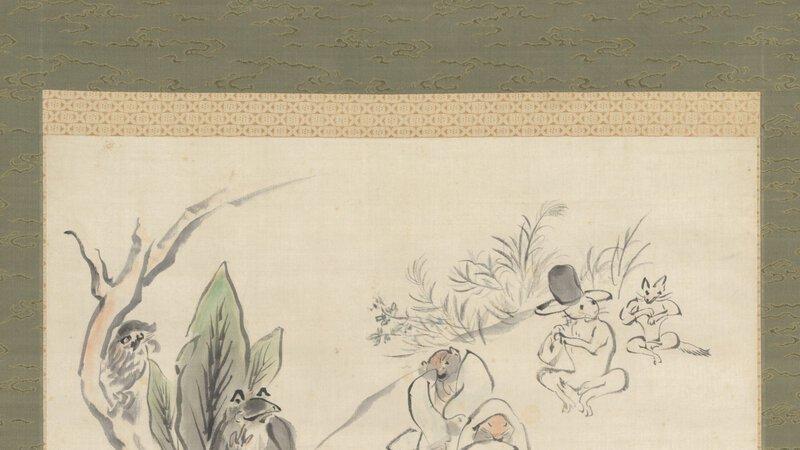

Most people think manga began with postwar Japan — with ink-stained teenagers and rocket-armed robots. In fact, the story stretches back more than twelve centuries, to a bored monk lifting his brush from a sacred text and drawing something that made a fellow priest laugh. Understanding that longer arc changes what manga is: not a publishing category but a living tradition, one that has survived wars, isolation, and digital disruption by remaining, at its core, irresistibly human.
Mid-700s CE: Buddhist Monks Sketch Caricatures in Temple Margins

In eighth-century Japan, the margins of Buddhist manuscripts were not always sacred. Monks working by lamplight in temple scriptoriums occasionally let their brushes wander, filling the white space beside sutras with rotund officials, strutting animals, and figures caught mid-stumble. These doodles — exaggerated, irreverent, unmistakably comic — are among the earliest known examples of comic-like drawing in Japanese history, and they place the history of manga firmly inside temple culture rather than a publisher’s office.
The impulse was not uniquely Japanese. A broader East Asian tradition of playful ink drawing ran through China and Korea as well, but in Japan it found particularly fertile ground among artists trained to handle a brush with both discipline and sensitivity. The wit encoded in those cramped margin sketches — the way a single curved line could turn a frog into a bureaucrat — would echo through the next thirteen hundred years of the form.
Late 1100s: The Chōjū-giga Scrolls Establish Sequential Visual Storytelling

Sometime between 1150 and 1200 CE, an extraordinary set of scrolls took shape at Kōzanji temple on the wooded outskirts of Kyoto. The Chōjū-giga — commonly translated as “Scrolls of Frolicking Animals and Humans” — unfurl across four long sheets of ink on paper to show frogs refereeing sumo bouts, rabbits shooting arrows, and monkeys dressed as Buddhist priests performing solemn rites with barely concealed absurdity. Scholars widely regard them as among the oldest sequential comic-style works in Japan, and the reason is apparent the moment you unroll them: the figures move across the scroll in implied sequences, with momentum, cause and effect, and punchlines that land as cleanly today as they must have in the twelfth century.
Attribution remains contested. The monk-painter Toba Sōjō is the traditional candidate, but art historians continue to debate whether the scrolls were the work of a single hand or several contributors across different periods. The cultural significance, however, is not in dispute. The Chōjū-giga established that Japanese visual art could be simultaneously narrative, satirical, and wildly funny, embedding all three qualities into what would become the DNA of the tradition. Anyone asking when manga started as a sequential storytelling form can make a credible case that it started here, in a Kyoto temple garden.
Edo Period (1603-1868): Woodblock Print Culture and the Birth of a Mass Audience

The long peace of the Edo period produced something Japan had never seen before: a mass reading public hungry for cheap, illustrated entertainment. Woodblock printing made illustrated books and broadsheets affordable to merchants, craftspeople, and curious townspeople alike. Among the most popular were kibyōshi — “yellow-cover books” — illustrated novellas from the 1770s onward that wove pictures and text together for adult readers in ways that feel strikingly close to the modern manga format, with visual gags, character-driven stories, and a knowing satirical edge.
Comic prints lampooning samurai pretension and merchant greed circulated openly in the streets of Edo, the city that would later become Tokyo, establishing satire and mass readership as twin pillars of the form. It was during this period that the term “manga” — combining the kanji for “whimsical” (man) and “pictures” (ga) — began to circulate, giving a name to a visual tradition that had been building for nearly a thousand years without one. The word did not yet carry its modern meaning; it described loose, informal sketches rather than a genre. That would change with one famous artist’s decision to put the word on a cover.
1814: Hokusai Coins ‘Manga’ in Print and Makes It Famous

In 1814, the woodblock master Katsushika Hokusai published the first volume of his Hokusai Manga, a sprawling collection of sketches ranging from wrestlers and demons to pine trees and kitchen utensils. Fifteen volumes would eventually follow, making Hokusai’s Manga one of the most ambitious illustrated publishing projects of its era. By placing the word prominently in his title, Hokusai effectively stamped “informal, playful pictures” into the national vocabulary and demonstrated, through sales alone, that expressive drawn imagery had a vast commercial audience.
It is worth being precise about what Hokusai’s volumes were and were not. His pages were sketchbooks rather than narratives — no continuous story threaded the volumes together, and the work sits closer to a naturalist’s illustrated field notes than to a modern comic. But Hokusai’s importance to manga history lies less in the format he used and more in the word he popularized and the appetite he proved existed. He gave the art form its name at the moment the form itself was still finding its shape.
Meiji Era (1868-1912): Western Cartoons Collide with Japanese Tradition

When Japan ended two centuries of self-imposed isolation, it imported not just steam engines and legal codes but also European cartooning conventions. The British artist Charles Wirgman had already founded the satirical Japan Punch in 1862, introducing Yokohama’s foreign community — and curious Japanese observers — to panel borders, speech bubbles, and the punchline-driven strip. Japanese artists absorbed these tools rapidly and began grafting them onto a visual vocabulary already rich with scroll painting and woodblock wit.
Newspapers launched dedicated cartoon supplements, and the word “manga” began its slow pivot from Hokusai’s loose sketches toward something closer to sequential comic art. Political cartoonists used the new panel format to comment on modernization, foreign pressure, and social upheaval in ways that single images could not sustain. The hybrid visual language that emerged from this collision — Eastern brushwork sensibility fused with Western panel structure — became the direct ancestor of the modern manga style that a first-time reader picking up manga today would immediately recognize.
1900s-1930s: Newspaper Strips, Children’s Magazines, and a Darker Turn

Japan’s booming newspaper industry found in manga a reliable way to sell papers to families. Tagosaku to Mokube no Tokyo Kenbutsu, published in 1902 by cartoonist Rakuten Kitazawa, is frequently cited as one of the earliest modern manga strips — a comic built on recurring character, visual sequence, and the pleasure of returning week after week to familiar faces. By the 1920s and 1930s, dedicated manga magazines aimed at children appeared on newsstands, and the serialized, chapter-by-chapter format that still defines how manga is published and consumed worldwide took firm hold.
These same decades darkened the picture significantly. As Japan’s military expansion intensified through the 1930s and into the 1940s, manga was enlisted for wartime propaganda, its imagery stripped of playfulness and conscripted into nationalist messaging. The fact that the medium could be turned to that purpose demonstrated, grimly, how thoroughly it had moved from temple margins into the mainstream of Japanese communication. A tradition born in sacred spaces had become a tool powerful enough to shape public opinion at a national scale — a lesson the postwar generation of artists would not forget.
1947: Osamu Tezuka Publishes New Treasure Island and Reinvents the Form

Japan was still rebuilding from the rubble of the Second World War when a young cartoonist named Tezuka Osamu handed readers something they had never quite seen before. Shin Takarajima — “New Treasure Island” — arrived in 1947 and sold an estimated 400,000 copies, a staggering figure for a country whose economy lay in ruins. What made it electric was not just the adventure story but the way Tezuka told it: cinematic close-ups that thrust readers into a character’s expression, speed lines that made a running figure feel genuinely airborne, dramatic camera angles borrowed directly from the films he had studied obsessively as a student.
Tezuka, who would later be called “the God of Manga,” proved in that single volume that the medium could carry genuine emotional weight — that a drawn page could make a reader grieve or exult the way a novel could. His visual grammar spread rapidly through a generation of artists and editors, and it is largely his language that defines what readers around the world recognize as manga today. He went on to create Astro Boy, Black Jack, and dozens of other influential works across his career, but New Treasure Island was the door he kicked open for everyone who followed.
1959-1960s: Weekly Manga Magazines Create a Mass Reading Culture

The launch of Weekly Shōnen Magazine and Weekly Shōnen Sunday, both in 1959, changed the social texture of Japan in ways that extended far beyond publishing. Manga moved from something children enjoyed to something nearly everyone consumed — on commuter trains, in barber shops, tucked into school bags. Combined circulations across the major weeklies eventually reached tens of millions, and the rhythm of weekly serialization created a reader loyalty unlike anything Western comics publishers had managed: fans followed the same storyline for years, sometimes decades, bonded to characters the way they would be to old friends.
These decades also crystallized the genre categories that gave manga its remarkable breadth. Shōnen titles targeted boys with action and camaraderie; shōjo titles for girls emphasized emotion, relationship, and visual interiority; seinen publications for adult men ranged from corporate drama to literary experimentation. The system was commercial in origin but liberating in effect: it meant there was, in principle, a manga for every reader in Japan, and it created the scaffolding on which the global export of the medium would eventually hang.
1980s-90s: Manga Goes Global and Acquires a New Meaning Abroad

When translations of Dragon Ball, Akira, and Sailor Moon reached Europe and North America in the late 1980s and 1990s, foreign readers needed a word for what they were holding — something that distinguished these books from American superhero comics or European bandes dessinées. The word they reached for was “manga,” and in their hands it acquired a narrower, more specific meaning than it carries inside Japan. Outside Japan, “manga” typically refers to comics originally published in Japan. Inside Japan, the word covers both comics and cartooning regardless of origin, with no need for such a distinction.
That semantic split is itself a measure of how fully the medium had traveled. Publishers in the United States began releasing manga in its original right-to-left reading format rather than flopping the page order, a decision that signaled a new respect for the work on its own cultural terms and helped build an audience that wanted the authentic reading experience. By the end of the 1990s, manga sections had appeared in mainstream bookstores across North America, Europe, and Australia, a geographic spread the medium’s Kyoto temple origins could scarcely have anticipated.
21st Century: Digital Platforms Return Manga to the Scroll

There is something quietly circular about the way manga arrived in the smartphone age. Apps and platforms deliver stories in vertical scroll format, designed for a thumb moving steadily downward across a glowing screen — a gesture not entirely unlike unrolling a paper scroll in a twelfth-century Kyoto temple. The technology is unrecognizably different; the reading motion carries a faint echo of the Chōjū-giga. Digital serialization has also dissolved much of the gatekeeping power of print publishers, allowing independent creators anywhere on Earth to build an audience without waiting for editorial approval from a Tokyo magazine.
Global manga sales surpassed three billion dollars annually by the early 2020s, a figure that reflects not just commercial success but the confirmation of something those margin-doodling monks intuited more than a millennium ago: that ink, humor, sequence, and the human face rendered with a little exaggeration make up one of the most durable storytelling combinations our species has ever discovered. Manga today functions as an umbrella term for a wide variety of comic books and graphic novels originally produced and published in Japan, read in dozens of languages by audiences who may never have heard of Toba Sōjō or Hokusai but who feel the pull of the same sequential storytelling instinct those figures embodied.
What Twelve Centuries of Manga Tell Us

The through-line from eighth-century margin doodles to billion-dollar digital platforms is not a straight one. Manga has been a sacred curiosity, a street entertainment, an artist’s sketchbook, a propaganda tool, a cinematic revolution, a children’s Saturday ritual, and a global cultural export — sometimes several of these at once. What has remained constant is the combination of elements Tezuka identified when he studied those postwar readers turning his pages with something close to hunger: sequence, expression, pace, and the willingness to take a drawn face seriously as a vessel for genuine feeling.
From a monk’s idle brush stroke in the margins of a sacred text to an industry read on devices that fit in a pocket, manga’s twelve-century lineage is less a straight line than a living scroll — still unrolling, still finding new readers, still making people laugh in ways that no other medium has ever quite managed to replicate.

 English
 Arabic
 French
 Spanish
 Portuguese
 Turkish
 Dutch
Dutch
 Italiano
 Russian
 Romaian
 Portuguese (Brazil)
 Greek
Greek