


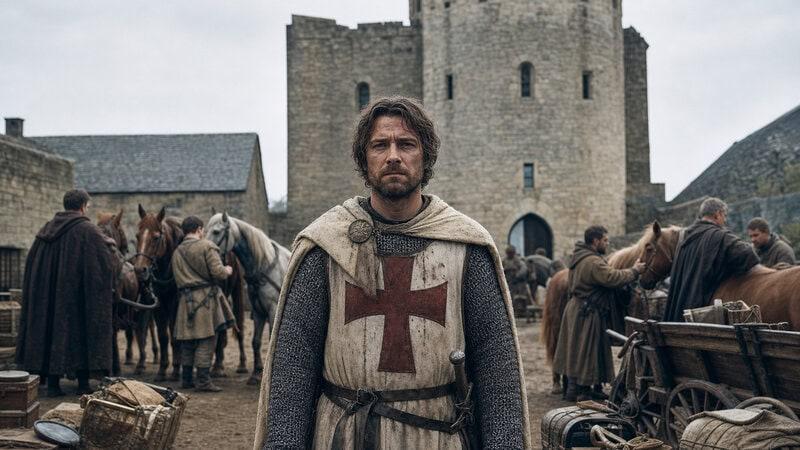

In the autumn of 1096, a French knight stood in the courtyard of his ancestral estate and watched strangers lead away his horses, his cattle, his mill — everything his family had accumulated across generations — all of it sold or pledged so he could afford the journey to Jerusalem. He might never come back. He almost certainly knew that. And yet he went.
A Question That Refuses a Simple Answer

That knight’s decision sits at the heart of one of history’s most charged arguments: were the Crusades bad? It sounds like the kind of question a student dashes off on a Sunday night. It is not simple at all. Depending on who you ask — and when they were writing — the Crusades have been cast as a noble defense of Christendom, a cynical land grab dressed in holy robes, a protocolonialist catastrophe, and a foundational chapter of Western identity. Each verdict captures something real. None of them captures enough.
What serious medieval scholarship has done over the last three decades is quietly dismantle both the triumphalist myth and the pure-greed myth, replacing them with something far messier and far more human. The Crusades were not one thing. They were an entire era of religiously licensed violence, shaped by faith that was genuine, ambition that was real, and horror that was undeniable. Understanding them requires holding all of that at once — and resisting the pull toward a clean verdict.
What the Crusades Actually Were

The Crusades were a series of military campaigns launched under papal authority between 1095 and 1291, aimed at recovering and defending the Holy Land from Muslim rulers. The First Crusade ended with the capture of Jerusalem in 1099. The last of the major numbered campaigns collapsed in North Africa in 1270 with the death of the French king Louis IX from dysentery. In between: roughly two centuries of campaigning across battlefronts stretching from the Iberian Peninsula to the Baltic coast to Egypt.
Even that tidy timeline misleads. Church-sponsored military action, carrying papal indulgences, continued against unbelievers and heretics well into the sixteenth century. The Crusades against the Cathars of southern France, the Northern Crusades against pagan Lithuanians, the campaigns against the Ottoman Turks — none of these fit the Holy Land narrative neatly, yet all carried the same theological machinery. The Crusades were not a tidy medieval episode with a clean ending. They were an entire mode of religiously authorized violence that the Western church deployed across four centuries.
Then there is the problem of how later eras have read them. Enlightenment thinkers reached for the Crusades as evidence of religion’s inherent barbarism. Nineteenth-century nationalists drafted crusading imagery for romantic myths of European greatness. Twentieth-century postcolonial scholars saw in them a medieval dress rehearsal for empire. Each generation loaded the word with its own anxieties, often without pausing to ask what the people actually involved thought they were doing — a question that turns out to be both harder and more illuminating than the verdict-seeking usually is.
The ‘Pure Greed’ Theory — and Why It Breaks Down

The land-grab argument has obvious appeal. Feudal Europe in 1095 was full of younger sons locked out of inheritance by primogeniture, merchants eyeing Levantine trade routes, and minor lords hungry for territory. If you squint at the map of crusader states that emerged in the Levant, it can look like a real-estate scheme blessed by Rome.
The economics tell a different story. Crusading was staggeringly expensive. Knights routinely sold property, pledged estates to monasteries, or borrowed at ruinous rates just to equip themselves for departure. Serious historical analysis has shown that crusading was notoriously bad for plunder — most participants returned poorer than they left, if they returned at all. The survival rate on the First Crusade has been estimated at roughly one in three. Men who crossed the Mediterranean in 1096 were not making a rational investment. They were making what they understood to be a spiritual one.
None of this means greed was absent. It was present, loudly, in individual crusaders — in the Venetian merchants who redirected the Fourth Crusade toward Constantinople, in the lords who carved out principalities and called them God’s work. But greed alone cannot explain why tens of thousands of people, across eight major campaigns and dozens of smaller ones, repeatedly undertook a journey with catastrophic odds. The financial evidence actively contradicts profit as a primary driver. A genuinely greedy person in 1096 had far better options closer to home.
The ‘Unprovoked Aggression’ Argument — Also Incomplete

The opposite pole of the debate casts the Crusaders as the original medieval colonialists — Western aggressors descending on a flourishing Islamic civilization without provocation. This narrative has been enormously influential in postcolonial academic culture and popular history. It is also, as serious historical scholarship has argued, incomplete in ways that matter for an honest assessment.
Consider what the world looked like in 1095. The Byzantine Emperor Alexios I had sent an urgent appeal to Pope Urban II — not for a crusade exactly, but for military help against the Seljuk Turks, who had swept into Anatolia after the Battle of Manzikert in 1071 and now threatened Constantinople itself. Christian pilgrimage routes to Jerusalem, which had functioned for centuries, had become genuinely dangerous. The lands of the eastern Mediterranean had been, within living memory and recorded history, Christian-majority territories. None of this justifies what followed. But calling the First Crusade purely unprovoked requires ignoring a generation of geopolitical upheaval — and while that context does not change the moral weight of atrocity, it does change its meaning.
The atrocities themselves must be named directly. The sack of Jerusalem in 1099 was a massacre — Muslim and Jewish inhabitants were killed in scenes that contemporary chroniclers, including crusading ones, recorded with appalled detail. The Rhineland pogroms of 1096 — Jewish communities slaughtered by crusading mobs before the armies ever left Europe — represent a crime with no defensive justification whatsoever, a pattern of persecution that would echo across the following centuries. The Fourth Crusade’s sack of Constantinople in 1204 turned Christian armies against a Christian city, looting its wealth and producing a fracture between Eastern and Western Christianity that has never fully healed. Any honest accounting of the Crusades must begin with these facts, not end with them.
What Actually Drove People to Take the Cross

So if not primarily greed, and not simple colonial aggression, what motivated the Crusades? Medieval historians have converged on an answer that modern secular readers often find genuinely surprising: it was, largely, faith — but faith of a very specific, very physical, very medieval kind.
The medieval Christian worldview did not treat the liberation of Christ’s tomb as a metaphor. It was a literal imperative, charged with urgent physical reality. The papal indulgence attached to crusading was not a minor administrative detail — within the theological framework of the time, it represented a guaranteed remission of the temporal punishment due for sin. For men who lived in daily awareness of purgatory, that was not a small offer. It was the most consequential promise imaginable.
Layered onto this was the penitential dimension that modern readers almost entirely miss. Many crusaders explicitly described their participation as a form of penance — a grueling, potentially fatal ordeal accepted willingly as punishment for sin. In that frame, the suffering of the journey was not a regrettable cost but the point. Historians including Thomas Asbridge and Jonathan Riley-Smith argued strenuously that religious motivation was primary and genuine, not a cynical cover for material ambition — a position that was controversial when Riley-Smith first advanced it in the 1970s and has since become mainstream in medieval studies.
Social forces reinforced the theological ones. Crusading was bound up with ideals of knightly honor, dynastic reputation, and the intense peer pressure of a warrior culture in which a man’s identity was inseparable from his willingness to fight for sacred causes. The church’s achievement — or, depending on your perspective, its terrible innovation — was to redirect that violent energy outward and give it a sacred object, transforming bloodshed into an act of devotion.
The Moral Ledger: What Did Two Centuries of Holy War Produce?

Tallying the human cost honestly is not optional. Hundreds of thousands of people died across the crusading era — Muslim, Jewish, Christian, combatant, civilian. Communities were destroyed. The Fourth Crusade’s sack of Constantinople weakened Byzantium so severely that it never fully recovered, a blow that historians have argued contributed to the Ottoman conquest of 1453. The Rhineland massacres established a template for organized anti-Jewish violence in Europe that would be repeated for centuries.
The counterweights exist but are uncomfortable to deploy without care. The crusading presence in the Levant bought Byzantium additional time — perhaps a century — against Ottoman westward expansion. Pilgrimage access to Jerusalem, which held enormous significance for medieval religious life, was maintained during periods of crusader control. And the sustained contact between Islamic and European scholarly traditions across the crusading period — translation movements, exchanges of medical and philosophical knowledge — fed intellectual currents that contributed to the European Renaissance. History is rarely tidy about who benefits from whose suffering.
The deeper challenge is the moral framework itself. Judging twelfth-century knights by twenty-first century humanitarian law commits a category error — those knights did not have access to modern concepts of civilian immunity or proportionality, and holding them to standards that had not yet been articulated is anachronism, not justice. But retreating into pure cultural relativism — treating the massacre of Jerusalem as simply a different value system, immune from evaluation — is its own form of intellectual evasion. The honest position is that the Crusades were not unusually brutal by the warfare standards of their era, and also that the warfare standards of their era were frequently monstrous. Both things are true, and neither cancels the other.
Why the Debate Reveals More About Us Than About Them
The question of whether the Crusades were good or bad has never really been about the Middle Ages. It has always been a proxy argument about the present — about colonialism, about religious violence, about whether Western civilization should feel guilt or pride about its history, about how Islam and Christianity have related across a millennium. Both sides of the modern culture-war version of this argument flatten the Crusades into propaganda: the defensive-civilization narrative requires looking past documented atrocities; the colonial-guilt narrative requires projecting contemporary political categories onto a world that did not have them and could not have recognized them.
Real history asks something harder. It asks you to stand in that French knight’s courtyard in 1096, watching your inheritance led away by strangers, and to understand — not excuse, not celebrate, but genuinely understand — what kind of belief could drive a man to do that. He believed he was doing something holy. He believed the physical tomb of Christ required his presence, his suffering, possibly his death. That belief, more than land or gold or papal politics, is what the Crusades were principally about. Refusing to take it seriously produces a history that is easier to judge and much less true.
The answer that medieval historians have arrived at is not a verdict of guilty or not guilty. It is an invitation — to sit with genuine moral complexity, to resist the comfort of simple condemnation and simple celebration alike, and to recognize that the past was populated by people who were entirely human and sometimes capable of extraordinary cruelty, often simultaneously. Which is, of course, what honest history has always asked of us.

 English
 French
 Spanish
 Portuguese
 Deutsch
 Turkish
 Dutch
Dutch
 Italiano
 Russian
 Romaian
 Portuguese (Brazil)
 Greek
Greek