


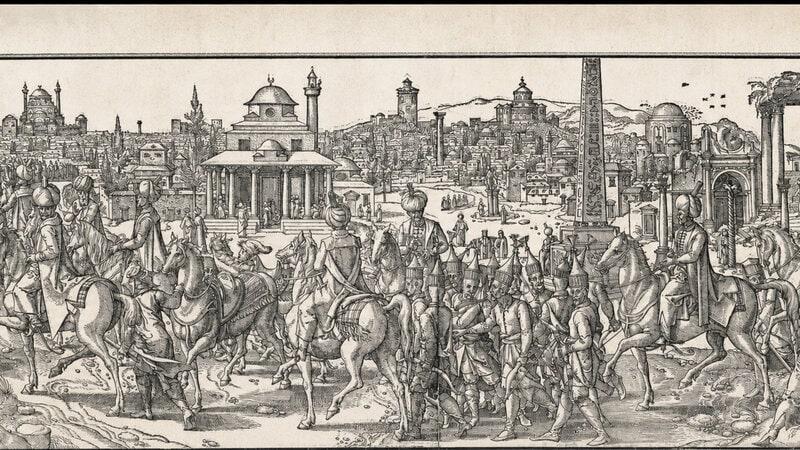

Before dawn on 29 May 1453, a twenty-one-year-old sultan sat on horseback on a hill above the Bosphorus and watched Greek fire ripple across the water below. By nightfall, he would ride through the gates of Constantinople — a city that had stood as the heart of Christian civilization for more than a thousand years — and change the course of world history. His name was Mehmed II, and what came next would define six centuries of global politics.
The Morning Constantinople Fell

The arithmetic of that day still staggers the imagination. Byzantium had survived for over a millennium: it had outlasted the western Roman Empire by a thousand years, absorbed pressure from the Visigoths, repelled Arab armies, and endured the catastrophe of the Fourth Crusade in 1204. The Ottoman state preparing to swallow it had existed for barely 150 years. And yet by sunset on that May evening, the great chain across the Golden Horn had been broken, the walls of Theodosius breached, and the last Byzantine emperor, Constantine XI, lay dead somewhere in the chaos of the streets. A dynasty that had been a minor footnote in Anatolian history had just erased one of the defining empires of Western civilization.
That single siege — its monstrous artillery, its desperate defenders, its audacious young sultan — forms the dramatic spine of Rise of Empires: Ottoman on Netflix, a Turkish-produced docu-drama that premiered on 24 January 2020 and introduced millions of casual viewers to one of history’s most consequential stories. The series blends lavish dramatic reenactments with on-camera commentary from working historians, and it found an audience well beyond the usual documentary crowd — in part because of a smart casting decision: Game of Thrones actor Charles Dance narrates, lending the series the same cold authority he projected as Tywin Lannister. Suddenly, Ottoman history had the voice of prestige television.
But 1453 was not the end of the Ottoman story. It was barely the midpoint. The more demanding question — the one that rewards serious attention — is how one dynasty managed to dominate three continents for six centuries, outlasting the Mongols, the Habsburgs, the Spanish Empire, and nearly every rival it ever faced. The conquest of Constantinople was a coming-of-age moment. What followed was something far more remarkable.
From Tribal Footnote to World Power: The Ottoman Rise

Around 1299, in the northwest corner of Anatolia, a minor Turkic chieftain named Osman I led a principality so small that his neighbors probably gave it little thought. He was hemmed in by rival Turkic beyliks on one side and the battered but still-functioning Byzantine state on the other. There was no obvious reason to expect greatness. What Osman possessed — and what his successors would ruthlessly exploit — was a frontier location, a border zone between the Islamic and Christian worlds that acted as a magnet for ghazi warriors, men driven by a mixture of religious conviction and the very practical hunger for land and plunder.
The early Ottomans were unusually pragmatic for a conquering power. Rather than destroying the populations they absorbed, they incorporated them: Greek administrators, Balkan soldiers, Jewish merchants, Genoese sailors. Institutional borrowing was a survival strategy elevated to an art form. When the Ottomans encountered a more effective way of doing something — taxing, governing, building ships, casting cannon — they adopted it without the ideological rigidity that paralyzed more doctrinaire states. This flexibility would prove to be the secret engine of their longevity.
The first explosive expansion came quickly. Osman’s son Orhan crossed into Europe in the 1350s, establishing the bridgehead that would eventually swallow the entire Balkan peninsula. The Ottoman victory at Kosovo in 1389 shattered Serbian power and announced to Europe that something new and dangerous had arrived. Then came the near-death experience that would have broken most empires: in 1402, the Central Asian conqueror Timur — known in the West as Tamerlane — annihilated the Ottoman army at the Battle of Ankara and captured Sultan Bayezid I. The dynasty collapsed into civil war. Most observers would have written its obituary. Instead, the Ottomans recovered, reunified, and came back stronger — a pattern of resilience that would define them for the next five centuries.
It was Mehmed II who transformed recovery into triumph. The fall of Constantinople in 1453 did not merely erase Byzantium. It gave the Ottomans something priceless: legitimacy. Mehmed declared himself Caesar of Rome, installed himself in the great imperial city, and gave his dynasty a foundation myth — a world-historical story of destiny fulfilled — that they would retell and reinforce for five hundred years. The same story, rendered with considerable dramatic flair and genuine historical grounding, is what Rise of Empires: Ottoman dramatizes across its first season.
How the Ottoman Government System Actually Worked

Empires are easier to conquer than to keep. What made the Ottoman system of government remarkable was not its elegance — it was frequently brutal — but its structural ingenuity. At the apex sat the sultan, theoretically absolute, in practice dependent on a vast administrative machine. Below him, the grand vizier managed the daily machinery of state. Below that came the Kapıkulu, literally the “slaves of the gate” — a military and bureaucratic class whose members owed their positions, their wealth, and their lives entirely to the sultan. Because they had no independent power base, they had every incentive to keep the imperial system functioning.
The mechanism that produced this class was the devshirme: a periodic levy in which Christian boys, primarily from the Balkans, were recruited by the state, converted to Islam, educated in palace schools, and elevated to the highest offices in the empire. Former peasants from Serbia or Albania could rise to command armies or govern entire provinces. It was a counterintuitive meritocracy that simultaneously created a loyal administrative class and undercut the old aristocratic families who might otherwise threaten the throne. Several of the empire’s most capable grand viziers were men of Balkan Christian origin.
Religious diversity was managed through the millet system, which granted Jewish, Greek Orthodox Christian, and Armenian communities a substantial degree of communal autonomy. Each community governed its own legal and religious affairs under its own leaders, paying taxes to the imperial center in exchange for protection and self-governance. It was not modern pluralism — conversion to Islam was encouraged, and minorities faced real legal constraints — but it was a workable framework for governing an empire of extraordinary ethnic and religious complexity, stretching from the deserts of Algeria to the mountains of the Caucasus.
The system carried one unresolved and ultimately fatal flaw: succession. Ottoman sultans did not follow primogeniture. When a sultan died, his sons competed — sometimes violently — for the throne. This produced a steady supply of capable, hardened rulers who had survived genuine competition, but it also generated catastrophic civil wars at critical moments. In the empire’s final centuries, this instability made coherent reform increasingly difficult to separate from factional survival.
Peak Empire: Three Continents and the Age of Suleiman

If there is a single reign that captures the Ottoman Empire at the height of its power, it is that of Suleiman I, known in the West as Suleiman the Magnificent, who ruled from 1520 to 1566. Under Suleiman, Belgrade fell. Rhodes fell. Hungary became a vassal state. Ottoman fleets controlled the eastern Mediterranean. The empire’s revenue dwarfed anything contemporary European powers could produce, and its territory stretched across three continents — Europe, Asia, and Africa — in an arc so vast that no single rival could threaten it on every front simultaneously. This geographic scale was itself a strategic asset: setbacks against the Habsburgs in Hungary did not threaten Ottoman control of Egypt; pressure from the Safavids in Persia did not endanger Algiers.
Suleiman was simultaneously a military commander of the first order and a poet who wrote verse in Ottoman Turkish. His relationship with Hürrem Sultan — a former slave of probable Eastern European origin who became his legal wife and closest adviser — shattered centuries of Ottoman precedent and illustrates something essential about the empire’s social dynamics: it was rigidly hierarchical in its official structures, yet strikingly open about who could actually rise within them. Slaves became legal consorts to sultans. Peasant boys became admirals. The system reproduced itself precisely because it was not a closed aristocracy.
This is also the moment to answer a question many viewers search for directly: how long did the Ottoman Empire last? The state founded by Osman around 1299 was not formally dissolved until 1922, when Mustafa Kemal’s nationalist movement abolished the sultanate. Six hundred years, by any reasonable reckoning — longer than Rome governed the western Mediterranean, longer than any European colonial empire, and longer than almost any other political structure in recorded history. At its territorial peak in the sixteenth century, the empire covered an area roughly comparable to the continental United States.
The Long Unraveling: Rise and Fall Explained

Decline, when historians write about it, tends to feel inevitable in retrospect — a comfortable narrative arc bending toward a predetermined end. The reality of the Ottoman Empire’s long unraveling was messier, more contingent, and in many ways more instructive than any clean story of decay would suggest. The seventeenth and eighteenth centuries produced genuine reform efforts, military modernization programs, and significant military recoveries. The empire was not passively sliding toward dissolution. It was fighting, adapting, and occasionally winning.
But the pressures were real and accumulating. The failed siege of Vienna in 1683 — the second Ottoman attempt on the Habsburg capital — is the moment most historians identify as a structural turning point. After Vienna, the Ottomans spent two centuries in slow territorial retreat: losing Hungary to the Habsburgs, losing the northern Black Sea coast to a rising Russia, losing Greece, then Serbia, then Bulgaria to nationalist uprisings that the millet system had inadvertently helped incubate by preserving communal identities and institutions. By the nineteenth century, European diplomats were calling the empire “the Sick Man of Europe” — a phrase that captured both its military weakness and its continued geopolitical relevance, because even a weakened Ottoman Empire was a problem none of its neighbors could easily resolve.
The final act was catastrophic. Siding with the Central Powers in World War One, the empire faced military collapse on multiple fronts simultaneously — the Gallipoli campaign, the Arab Revolt, the British advance through Palestine and Mesopotamia. Allied forces occupied Istanbul in 1918. The sultanate that had survived Timur, the Habsburgs, and the Russians seemed finally finished. What happened next surprised nearly everyone: a nationalist military commander named Mustafa Kemal organized a resistance movement in Anatolia, defeated the Allied-backed Greek military campaign, and negotiated the Treaty of Lausanne in 1923, which established the borders of modern Turkey. He abolished the sultanate in 1922 and the caliphate in 1924, formally closing six centuries of Ottoman history and opening a new chapter of Turkish national identity.
The Ottoman Empire did not simply disappear. It dissolved into the present. The borders of the modern Middle East were drawn on the ruins of Ottoman administrative districts by British and French diplomats. The contested status of Jerusalem — an Ottoman administrative and religious question for four centuries — became an international crisis whose contours were shaped by the empire’s collapse. The ethnic geography of the Balkans still carries the imprint of Ottoman settlement patterns and millet organization. Understanding these connections is one of the most practical reasons to engage seriously with Ottoman history, not merely as spectacle but as explanation.
Rise of Empires: Ottoman — What the Netflix Series Gets Right and Where It Falls Short

Rise of Empires: Ottoman on IMDb ran across two seasons between 2020 and 2022, using the same hybrid format Netflix had deployed for its earlier Roman Empire series: dramatic reenactments of key events intercut with commentary from actual historians who supply context and, where necessary, correction. The format has genuine virtues. The spectacle keeps casual viewers engaged through material that might otherwise feel remote; the historians prevent the dramatizations from wandering too far into invention. The result sits somewhere between documentary and prestige drama, and for a subject as cinematically rich as the 1453 siege, the balance mostly holds.
The show earns real credit for its tactical specificity. The extraordinary maneuver by which Mehmed had his fleet hauled overland on greased timbers to bypass the Genoese-controlled chain blocking the Golden Horn — one of the most audacious logistical gambits in medieval military history — is dramatized with genuine care. The siege artillery, the engineering challenges of breaching the Theodosian Walls, and the desperation of the Byzantine defenders are rendered with a fidelity that historians of the period have generally found credible. Contemporary reviews noted the series’ attention to the Byzantine perspective alongside the Ottoman, which gives the narrative more moral texture than a straightforward conquest story might offer.
The caveats deserve honest acknowledgment. This is a Turkish production, and its sympathies naturally incline toward Mehmed, whose characterization is consistently heroic in ways that compress the ambiguity present in the historical record. Dramatic license shapes personalities and timelines throughout. The inherent compression of six episodes requires events that unfolded over months to be telescoped into tight narrative beats. Critics reviewing the series at launch praised its visual ambition while noting its occasional tendency to subordinate historical complexity to dramatic momentum. None of this makes the series unreliable — the core military and political history holds up — but viewers who want the full picture will need to supplement the screen with serious reading.
Why Ottoman History Matters Now — and What to Read Next
The Ottoman Empire is not ancient history in the way that phrase usually implies — a safely distant past with no living connections. The borders imposed on the Arab world after Ottoman collapse, negotiated by British and French diplomats through arrangements such as the Sykes-Picot Agreement of 1916, generated territorial and political disputes that have never been fully resolved. Turkey’s modern identity debates — secular governance versus political Islam, Western alignment versus regional leadership — are inseparable from the question of what the Ottoman Empire was and what its end actually meant. To understand the contemporary Middle East, the Balkans, or Turkey itself without understanding the Ottoman framework is to read a story that begins at chapter twelve.
The lesson of Ottoman longevity is ultimately not about military power or dynastic fortune, though both mattered. It is about structural adaptability. The Ottomans lasted because they absorbed rather than excluded — peoples, religions, bureaucratic techniques, military technologies. They built institutions capable of outlasting individual sultans, created loyalty structures that did not depend on ethnic solidarity, and governed diverse populations through frameworks that made compliance rational rather than merely coerced. Most of their rivals insisted on a narrower definition of who belonged to the imperial project. Most of those rivals are gone.
For viewers who want to go deeper after finishing Rise of Empires: Ottoman, Caroline Finkel’s Osman’s Dream is the single best one-volume history of the empire in English — rigorous, consistently readable, and free of the teleological decline narrative that distorts many popular accounts. Jason Goodwin’s Lords of the Horizons offers more narrative sweep and literary texture for readers who want to feel the world the Ottomans built as much as understand it analytically. Both books reward the curiosity that a good documentary series should, ideally, provoke.
Return, finally, to that hillside above the Bosphorus in the pre-dawn darkness of 29 May 1453. Mehmed II was twenty-one years old. He would reign for another twenty-eight years after that morning, going on to campaign across Anatolia, the Crimea, and the Balkans, and to style himself Caesar of Rome. The empire he transformed would still be flying its flag 469 years after his death. That number — not the drama of the conquest, not the splendor of Suleiman’s court, not the tragedy of the final collapse — is the only figure that truly captures what made the Ottomans extraordinary. They did not merely rise. They endured.

 Arabic
 French
 Spanish
 Portuguese
 Deutsch
 Turkish
 Dutch
Dutch
 Italiano
 Russian
 Romaian
 Portuguese (Brazil)
 Greek
Greek