


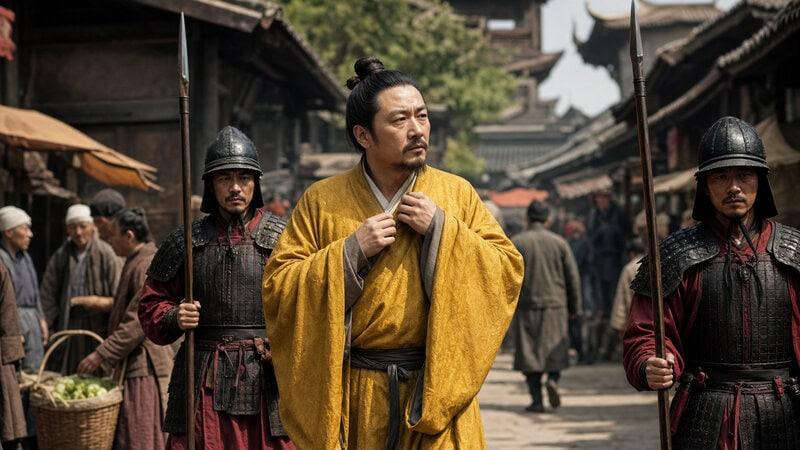

Somewhere in a Ming Dynasty market, a merchant adjusts his robe and steps into the morning crowd — not knowing that the particular shade of yellow he chose this morning has just made him a criminal. In imperial China, what you wore was not a personal statement. It was a legal declaration, and the wrong one could cost you everything.
The Color That Killed: Yellow and the Emperor’s Wardrobe

Ming dynasty clothing was not fashion in any sense we would recognize today — not primarily, anyway. It was a codified system of power stitched into silk and brocade, a legal document worn on the body from the moment of dressing until the moment of death. Color, fabric, embroidery pattern, collar height: every element was regulated by imperial law, and violations were prosecuted with the full weight of the state.
At the apex of this system sat the emperor, wrapped in what contemporaries called huangse — imperial yellow, a color so saturated with political meaning that no one else in the empire was permitted to wear it. Not a shade close to it. Not a gold that might be mistaken for it in low light. The emperor’s yellow was his alone, and unauthorized wear could be punished by execution. The merchant who grabbed the wrong robe in the dark, or who let vanity override caution, was not merely committing a fashion mistake. He was committing something closer to treason.
This was the central paradox of Ming dynasty clothing: it was simultaneously one of history’s most creative textile eras and one of its most ferociously policed. Senior officials glittered in robes embroidered with cranes and coiling pythons, while commoners were legally barred from silk, gold thread, and entire categories of dye. Dress had rarely been more spectacular, and it had rarely been more dangerous.
Hanfu Reimagined: What the Ming Dynasty Actually Wore

Hanfu — the broad tradition of Han Chinese dress stretching back millennia — reached its most elaborate imperial expression during the Ming. The word itself simply means “Han people’s clothing,” but the reality it describes is a vast, evolving family of garments: crossed collars, layered robes, wide sleeves that pooled at the wrist, and silhouettes built from the inside out by careful layering rather than tailored structure. By the Ming period, this tradition had absorbed centuries of refinement, and the results were extraordinary.
A Ming scholar on his way to the imperial examinations would have worn a yisan — a straight, formal robe — paired with a distinctive cloth headscarf tied in a specific knot that announced his scholarly status as clearly as any diploma. The robe fell to the ankle, its sleeves wide, its fabric typically a sober blue or dark silk signaling Confucian virtue rather than flamboyant wealth. Restraint in color was the mark of the educated man. Dignity was the point.
Commoners dressed in an entirely different visual language: short, practical jackets suited to labor, paired with small caps or simple net scarves. The contrast was immediate and intentional. Ming clothing encoded social rank at a glance, before a single word was exchanged. You could read a near-complete social biography — merchant, farmer, scholar, soldier — in the cut and cloth of a passing stranger.
This visual hierarchy was no accident. The Ming’s founding Hongwu Emperor, who reigned from 1368 to 1398, issued sweeping sumptuary laws at the dynasty’s very beginning, deliberately using dress to restore Han Chinese identity after nearly a century of Mongol Yuan rule. Restoring traditional garment forms was a nationalist act, a repudiation of foreign influence woven into everyday life. From the dynasty’s first day, fashion was explicitly political.
The Rank Badge System: Embroidery as Identity

If the color hierarchy was the Ming dress code’s blunt instrument, the buzi was its masterstroke of refinement. These square embroidered badges, sewn onto the front and back of official robes, created an instantly readable visual bureaucracy — a system so elegant and practical that it was adopted by neighboring states and echoes in every uniform insignia worn anywhere in the world today.
The animal hierarchy stitched onto each badge was precise and non-negotiable. Civil officials wore birds: a crane for the highest, first-rank officials, a golden pheasant for the second rank, a peacock for the third, and so on down through a carefully graded avian ladder. Military officials wore beasts — lions, tigers, bears — their badges projecting ferocity where their civil counterparts projected elegance. A single glance across a throne room told you exactly who outranked whom, without a word being spoken.
Because the stakes were high — rank determined salary, legal protection, and social standing — the buzi system inevitably attracted fraud. Wearing the wrong badge was a criminal offense, but the temptation to claim a higher rank than one actually held was apparently irresistible. Threading quietly through the official records of Ming fashion history is a parallel history of forgery, impersonation, and desperate social climbing executed in silk thread.
The Collar That Defied Gravity: Ming Structural Tailoring

Among the most visually striking elements of Ming dress was a construction that modern eyes might mistake for theater costume: the standing collar, engineered to fan upward and outward from the neck, framing the face like a piece of architecture rather than a piece of clothing. On the zhiduo — a formal outer robe worn by scholars and officials — these collars could rise several inches, stiffened and shaped into forms that seemed to defy the natural drape of fabric.
Ming tailors achieved this without a single synthetic material. Multiple layers of silk were built up and stiffened with rice-starch sizing, reinforced with horsehair interfacing, and secured with hand-stitching so precise that the structures could hold their shape for decades — as it turned out, for centuries. The collar was not decorative excess. It was engineering, accomplished entirely by hand, in an era when the tools were needles and knowledge passed from master to apprentice.
We know this not only from paintings and historical records, but from surviving garments themselves. A Ming Dynasty tomb in China yielded 500-year-old clothing in remarkable condition — garments that still showed their original layered structure and unchanged proportions. Separately, ornate clothing unearthed from another Ming Dynasty tomb revealed embroidery of exceptional fineness and pleating so controlled it suggests the Ming atelier operated with the discipline of a modern couture house. These were not merely burial goods. They were the finest work of their makers, preserved by accident and recovered by archaeology, still speaking across half a millennium about what it once meant to dress well.
The Korean Skirt That Caused a Fashion Crisis

For all its ferocious regulation, the Ming dress code had one persistent weakness: it could not suppress desire. Nothing illustrates this more vividly than the strange, irresistible story of a horsehair underskirt that crossed the border from Korea and promptly triggered what can only be described as a fashion emergency.
The skirt’s appeal was immediately physical. Made from stiff horsehair woven into fabric, it created a dramatically exaggerated, bell-shaped silhouette — a sweeping volume that Chinese fabrics of the era could not easily replicate on their own. It was new. It was foreign. It was covetable across class lines. And it sparked a genuine fashion frenzy in Ming China, spreading from the capital outward with a speed that made the court deeply uneasy.
The Ming court’s response was predictable: ban it. The Korean horsehair skirt was officially prohibited, condemned as an improper foreign influence on correct Chinese dress. Within its own logic, the court’s reasoning was coherent — Ming fashion was meant to be a statement of Han Chinese cultural identity, and here was a Korean import disrupting the visual order of the empire. But as reporting on the banned Korean horsehair skirt details, the prohibition accomplished almost nothing. The skirt kept spreading. Women kept wearing it.
This episode reveals something true and slightly subversive about the entire Ming fashion system: even within one of history’s most controlled dress-code regimes, appetite for the new and the foreign proved impossible to fully suppress. The women who kept wearing that Korean skirt despite the ban were not rebels in any formal sense. They were doing what people in every era do — wanting what they wanted, wearing what they wore, and leaving the authorities to catch up if they could.
Silk, Dye, and the Global Trade That Ming Fabric Built

The fabric that made all of this possible — the silk that emperors monopolized, merchants coveted, and commoners were forbidden to wear — was produced at an industrial scale the modern world would recognize, even if the looms looked different. Ming textile production, centered in Suzhou and Hangzhou, fed not just a domestic fashion system but a global export economy stretching to Europe, Southeast Asia, and the Middle East. Chinese silk was, in a meaningful sense, a world currency.
The dyeing palette available to elite Ming consumers was extraordinary by any era’s standards: deep indigo in gradations from navy to near-black, crimson derived from mineral and plant sources, saffron yellow in its many carefully regulated shades, and the coveted yuebai — moon white, a near-silver off-white associated with mourning and contemplative robes, worn by those stepping outside the ordinary social order. Each color carried meaning. Each dye was a choice with consequences.
Yet the very richness of Ming textile production created an enforcement problem that worsened as the dynasty aged. As merchant wealth expanded through the middle period, prosperous traders in Suzhou and Hangzhou could simply afford to buy silk and gold thread legally reserved for the official class. Sumptuary laws were updated, reissued, and tightened repeatedly — and the pattern repeated each time. The Ming dynasty dress code is, at one level, a nearly three-century argument between a state trying to keep luxury exclusive and a commercial class that kept growing wealthy enough to ignore the rules. The argument is not unfamiliar. Luxury brands and status dressing still represent, at root, the same negotiation: who gets to wear what, and who decides.
Why Ming Dynasty Clothing Still Matters: The Tomb, the Trend, the Legacy
Return, for a moment, to those tomb garments — the robes, collars, and embroidered badges pulled from the earth after five centuries of darkness. They were made for living. They were worn at banquets and court audiences and morning markets, put on by people who cared intensely about what they signaled and how they looked. They ended up in the ground because Ming burial practice honored the dead with the finest things they owned in life. And now they speak directly across all that time about how deeply people invested their identities in what they wore.
That investment has not disappeared. The hanfu revival movement in modern China draws heavily on Ming-era silhouettes — those standing collars, those wide sleeves, those layered robes — making ancient Chinese clothing a live cultural conversation rather than a museum display. Young people in Beijing and Shanghai wear reconstructed Ming garments not as costume but as statement, conducting an argument about identity and heritage in fabric, not unlike the argument the Hongwu Emperor made when he issued his first sumptuary laws in 1368.
Ming dynasty clothing was never frivolous. It was law, politics, identity, global commerce, and personal desire all stitched into a single robe. It was the rank badge that told the court exactly where you stood. It was the Korean horsehair skirt that spread no matter what anyone decreed. It was the collar that defied gravity through sheer human patience and skill. And sometimes it was the most dangerous thing you could put on your body.
The merchant in the marketplace chose the wrong yellow and paid for it. The young woman in a modern Chinese city chooses a Ming collar and wears it down the street, arguing without words about what it means to be Chinese. Five centuries apart, the same fabric, the same question: what does what you wear say about who you are — and who gets to answer?

 English
 Arabic
 Spanish
 Portuguese
 Deutsch
 Turkish
 Dutch
Dutch
 Italiano
 Russian
 Romaian
 Portuguese (Brazil)
 Greek
Greek