




Alexander Tamargo/Getty Images
We may receive a commission on purchases made from links.
The late Anthony Bourdain appreciated food of all kinds as he traveled the world, exploring local culinary traditions and offerings. With his try-anything personality so prominent, it can be easy to forget that he had some longtime food favorites of his own. Among them are classic French sauces, a naturally sophisticated choice for a longtime chef. He spoke particularly highly about rouille, an ultra-garlicky, saffron-infused mayonnaise-style condiment.
Bourdain praised rouille as "the magical condiment", offering up a recipe of his own for the mixture to Food & Wine before his 2018 passing. Like many aspects of the maverick chef's life, it differs somewhat from the traditional version. Typically, rouille is made from a mixture of egg yolks, chile powder, saffron, garlic, olive oil, and breadcrumbs. Bourdain's recipe replaces the breadcrumbs and chile powder with roasted red pepper for sweetness and body, and lemon juice for brightness.
There's not much involved in executing the recipe: the ingredients (other than the olive oil) are puréed in a food processor until combined, after which the olive oil is drizzled in to integrate it. The simple preparation is what makes the quality of the ingredients so important. Bourdain's notes on making rouille include an all-caps admonishment to "USE GOOD SAFFRON." The quality of the olive oil used is also crucial to the overall outcome.
A versatile, historic, but lesser-known condiment
Alleko/Getty Images
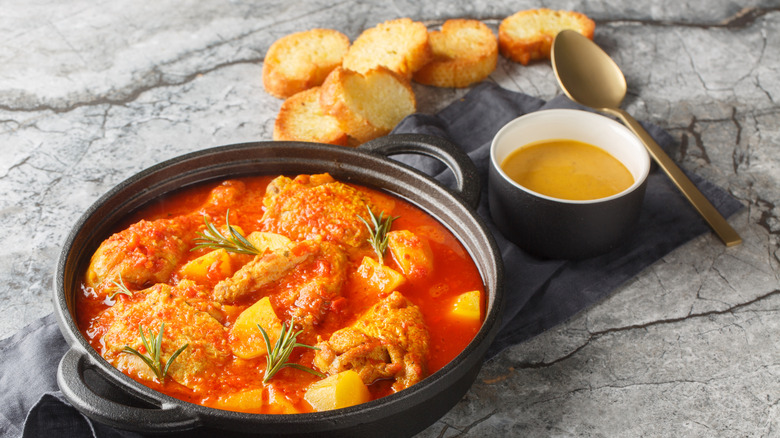
Those unfamiliar with the sauce might be wondering about how best to use rouille to enhance their meals. Historically, rouille traces its roots to the southern French region of Provence. Traditionally, it is eaten with bread and served alongside Provençal fish dishes, including the seafood stew known as bouillabaisse or soupe de poisson (another Anthony Bourdain favorite). It can also be delicious as a salad dressing, dip, or sauce for grilled meat or fish.
Bourdain's strong opinions were a hallmark of his writing and media appearances, so it should be no surprise that he felt just as passionately about his least favorite sauce. This was hollandaise, which he advised diners to never order. His complaints were more focused on the painstaking process required to keep the sauce from breaking, which leaves it at a vulnerable temperature for bacterial growth. Hollandaise may also have been linked to Bourdain's legendary hatred of brunch.
There's no doubt that rouille has flown under the radar, especially compared to the five "mother sauces" that dominate much of French cooking (these include béchamel, velouté, and yes, hollandaise). Still, Bourdain was never one to shy away from lesser-known or less popular choices in his quest for flavors and experiences. So, the next time you need a creamy, garlicky, flavorful boost (with an iconic chef's approval) to enhance a meal, whip up a batch of this tasty condiment.

 English
 French
 Spanish
 Portuguese
 Deutsch
 Turkish
 Dutch
Dutch
 Italiano
 Russian
 Romaian
 Portuguese (Brazil)
 Greek
Greek