


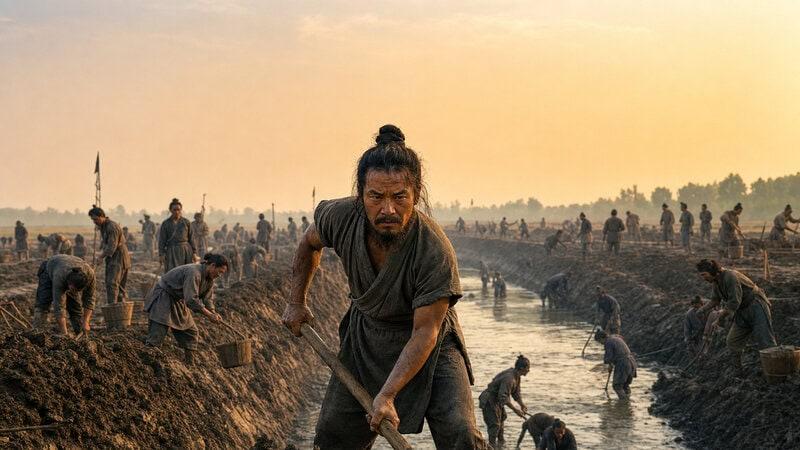

Dawn breaks over the mudflats of central China in the year 605 AD, and as far as any overseer can see in either direction, there are people digging. Hundreds of thousands of conscripted laborers — peasants hauled from their fields by imperial decree — hack at the earth with wooden tools, their breath clouding in the cold air, their dead recorded in ledgers alongside daily digging quotas as if exhausted men and cubic feet of soil were equivalent units of imperial accounting.
A Million Workers, One Emperor’s Dream

The project those workers were dying to complete was the Grand Canal — a waterway so audacious in scale that it would eventually stretch more than 1,100 miles, linking the Yellow River basin in the north to the rice-rich Yangtze River delta in the south. It worked. It still works. Cargo moves through sections of that canal today, more than 1,400 years after the hands that dug it turned to dust. And yet the dynasty that ordered it built — the Sui dynasty of China — was itself dead within a generation of the canal’s completion, consumed by the very ambition that made it legendary.
This is the central paradox of the Sui: a dynasty that ruled for only 37 years, produced only two emperors, and ended in mutiny and assassination, yet transformed China so completely that every imperial dynasty that followed built on its foundations. On any Chinese dynasties timeline, the Sui appears as a brief flicker between long, luminous periods. Look closer, and you realize the flicker was a controlled burn — one that cleared the ground for everything that came after.
Four Centuries of Chaos: The World the Sui Inherited

To understand what the Sui accomplished, you have to feel the exhaustion of what came before it. From roughly 220 AD onward, after the collapse of the Han dynasty, China shattered. Warlords rose and fell. Nomadic peoples swept in from the steppes and established their own kingdoms across the north. The south developed its own courts, its own culture, its own sense of being the true inheritor of Chinese civilization. For nearly four centuries, North and South China were less like two regions of one country and more like two countries that shared a language and a memory of once having been the same place.
The Northern and Southern Dynasties period (420-589 AD) was the final, grinding act of this fragmentation — a complicated contest of competing kingdoms that produced remarkable art, philosophy, and the deep roots of Buddhism in Chinese culture, but could not produce political unity. The human cost was staggering. Without a unified grain-distribution network, famine in the north could not be relieved by surplus in the south. The empire’s geography — its great rivers running east to west rather than north to south — was also its greatest structural vulnerability, carving the land into isolated regions that could starve independently of one another.
Into this exhausted landscape stepped Yang Jian, a general from the northwest, who in 581 AD declared the founding of the Sui dynasty and set about ending four centuries of division with methodical, ruthless efficiency.
Emperor Wen: The Ruthless Architect of Unity

Yang Jian’s path to power was itself a study in cold calculation. He had been a high official under the Northern Zhou kingdom and used his position — and his formidable military standing — to effectively force the abdication of the Northern Zhou court and install himself as the founder of a new dynasty. Emperor Wen, as history would call him, was not a man who hesitated when he saw an opening.
His reforms moved with the same decisive speed as his political maneuvering. He standardized coinage across a fractured monetary landscape and restructured the bureaucracy away from the old aristocratic model — where birth determined office — toward a merit-based system in which officials were evaluated on knowledge and competence. He slashed redundant government posts, rebuilt granaries that had been depleted by centuries of warfare, and eventually filled them so thoroughly that later historians noted they held enough grain to sustain the empire for decades. He was, by all accounts, aggressively frugal — a deliberate signal of restraint to a court accustomed to extravagance.
In 589 AD, Emperor Wen ordered the Sui army across the Yangtze River to crush the last remaining southern kingdom, the Chen dynasty. The conquest was swift — almost shockingly clean for a campaign that ended four centuries of division. One kingdom fell, and legally, geographically, and administratively, the long fragmentation was over. The reunification of China under the Sui dynasty was complete.
What Emperor Wen built was a unified but fragile thing — a machine assembled from incompatible parts, running on the goodwill of a population that had been promised stability after generations of war. It needed careful handling. His son would not provide it.
Emperor Yang and the Ambition That Cracked the Empire

Yang Guang came to power in 604 AD under circumstances that made even his contemporaries uneasy. His father, Emperor Wen, died abruptly, and court records from the period prompted later historians to question whether the succession was entirely natural. Whether or not that is true, what Emperor Yang did with the power he inherited is not in dispute.
He was not a simple villain. By temperament and education, Yang Guang was a man of genuine vision — a poet, a patron of culture, an emperor who understood that China’s reunification needed to be institutionalized, not merely declared. He relocated the imperial capital to Luoyang, a more central location better suited to governing a reunified empire. He expanded the canal network his father had begun. He advanced the merit-based examination system that would eventually become the famous imperial examination structure used by successive dynasties for more than a thousand years.
But Emperor Yang’s gifts came packaged with catastrophic impatience. He launched three massive military campaigns against the Korean kingdom of Goguryeo, mobilizing forces of enormous scale. All three campaigns failed. The dead were numbered in the hundreds of thousands, and the conscription demands fell on the same peasant families already strained by taxation and canal labor. He ordered the Grand Canal completed not as a generational project but as an immediate reality to be carved from the earth within a few years. He built palaces. He traveled in processions of extraordinary extravagance. He treated a newly reunified and still-fragile empire as if it were a fully loaded machine rather than one that desperately needed time to settle into itself.
The concept historians reach for here is dynastic overreach — and it is worth noting that this was not purely a personality flaw. The Sui had inherited a reunified empire, but reunification is not the same as consolidation. The tax base was strained, the population was battle-worn, and the goodwill earned by Emperor Wen’s frugality and order was a finite resource. Emperor Yang spent it as if it were infinite.
The Grand Canal: Engineering Miracle, Human Catastrophe

The Grand Canal is the Sui dynasty’s most enduring achievement and its most damning indictment simultaneously. Beginning around 605 AD, Emperor Yang ordered the construction of a canal system that would solve China’s greatest geographic vulnerability: the inability to move food from the grain-surplus south to the population-dense and militarily critical north. The logic was sound. The execution was punishing.
Accounts from the period describe labor mobilizations in the hundreds of thousands, drawn from peasant households already taxed to their limits. Historical records describe deaths from exhaustion, disease, and the brutal pace of construction. Families lost sons, fathers, and brothers to a ditch — however historically significant that ditch would prove to be.
And it did prove significant. The canal functioned brilliantly as an engineering solution. It moved grain, troops, and trade goods on a scale previously impossible in China. The Tang dynasty that replaced the Sui used it. The Song, Yuan, Ming, and Qing dynasties used it. A section of the Grand Canal was designated a UNESCO World Heritage Site in 2014, and portions of it remain navigable and commercially active today — one of the oldest infrastructure projects in the world still performing its original function.
The cruelty of the Sui’s historical position is that the canal worked perfectly, and it still helped kill the dynasty that built it. Had Emperor Yang spread construction across several decades, the human cost might have been absorbable. Compressed into a few furious seasons of digging, it became one more unbearable demand on a population running out of the capacity to bear demands. The canal was a gift to every dynasty that came after the Sui. For the Sui itself, it was part of the price of extinction.
Emperor Yang reportedly traveled the full length of the newly completed canal on an imperial fleet of extraordinary size — attended by an elaborate court, consuming resources in the very act of inspecting the waterway that had consumed so many lives to build. The spectacle captured something essential about the gap between imperial vision and the peasant reality that paid for it.
Collapse: When the Peasants Stopped Obeying

By around 611 AD, the Sui dynasty was not falling — it was fraying. Peasant uprisings erupted across the empire, fed by a convergence of disasters: flood damage along the Yellow River, failed harvests, military conscription for the Korean campaigns, and the particular bitterness of starving next to granaries that imperial bureaucracy kept locked and inaccessible to local populations. The grain was there. People were dying of hunger anyway. That detail, more than any other, captures how completely the Sui’s administrative machinery had become disconnected from the human beings it was supposed to govern.
The uprisings did not stay small. Regional warlords and ambitious commanders began carving out independent power bases. The fragmentation the Sui had spent a generation ending was reasserting itself with terrible, familiar speed — as if the empire retained a memory of being broken and knew how to return to that state. Within a few years, the coherent political structure Emperor Wen had built was dissolving at the edges, then at the center.
Emperor Yang, rather than meeting the rebellions directly, retreated south to Jiangdu — modern-day Yangzhou — and appears to have understood, at some level, that the situation was beyond recovery. In 618 AD, his own palace guards mutinied. He was killed by members of his own entourage. A dynasty of two emperors ended with the second emperor dead at the hands of his own household troops, in the southern city to which he had retreated from a country that no longer accepted his authority.
This pattern — ambitious overextension, peasant exhaustion, elite defection, rapid collapse — appears across Chinese history with uncomfortable regularity, from the Qin dynasty, which unified China for the first time and collapsed within fifteen years, to dynasties far longer-lived that still traced the same arc toward their ends. The Sui is almost a textbook case, compressed into 37 years, of how political capital can be spent faster than it can be earned.
What the Sui Left Behind
By conventional measures, Sui dynasty history is largely a story of failure: a short reign, a violent end, two emperors, and a collapse dramatic enough that it partially reassembled the fragmentation it had worked so hard to eliminate. And yet the historical verdict on the Sui is not simple failure. It is something more complicated and more instructive.
The Tang dynasty that rose from the Sui’s ashes — and which would become one of the great golden ages of Chinese civilization — inherited a unified administrative structure, a functioning canal network, a merit-based bureaucratic model, and a physical infrastructure the Sui had paid for in blood. The Tang did not have to solve the problem of reunification. The Sui had solved it for them, at the Sui’s own expense. This is the dynasty’s strange immortality: it failed as a political entity and succeeded as a foundation.
Consider what that foundation comprised. The three-department and six-ministry system of central government that the Sui formalized became the template for Tang and later administrations. The early imperial examination reforms the Sui initiated gave subsequent dynasties a mechanism for recruiting officials outside the hereditary aristocracy — a structural shift whose consequences rippled forward for more than a millennium. The Grand Canal reoriented China’s economic geography, making the agriculturally productive south the logistical engine of a politically unified north-south state. None of these were incidental achievements. They were the operating system on which subsequent dynasties ran.
The most visible piece of that foundation still moves water and cargo through China today. The Grand Canal is not a ruin or a monument — it is a working system, older than most nations, performing the function it was designed to perform by conscripted laborers who had no choice in the matter and no way of knowing they were building something that would outlast every argument about whether it was worth the price.
The Sui dynasty sits on the Chinese dynasties timeline as a brief, costly, and consequential hinge — the dynasty that absorbed the price of ending four centuries of fragmentation so that the next dynasty could flourish. Like the Qin before it, the Sui was consumed by the transformation it made possible. The muddy water moving through the Grand Canal today has been moving since before the Tang dynasty was born, since before the Sui collapsed, since before the overseers put down their ledgers and stopped counting the dead alongside the dirt.
It is still moving. The empire that ordered it dug burned out in 37 years. The ditch remains.

 English
 Arabic
 French
 Spanish
 Portuguese
 Deutsch
 Turkish
 Dutch
Dutch
 Italiano
 Russian
 Romaian
 Greek
Greek