



Somewhere between three and five meters beneath the streets of modern London, there is a layer of reddish-brown ash that has never fully gone away. Archaeologists call it a “destruction horizon.” Historians call it Boudica.
The City That Vanished

Around 60 or 61 AD, the Roman settlement of Londinium was barely a decade old — a busy, unfortified trading post on the Thames with timber buildings, imported pottery, and the particular vulnerability of a place that had grown wealthy before it had grown walls. When the Iceni queen’s army arrived, the Roman governor Suetonius Paulinus had already made a cold calculation: the city could not be defended, so it would not be. He marched his legions out and left the inhabitants to whatever was coming.
What came was total. Residents who could not flee — the elderly, the sick, those who trusted that the Romans would surely return — were killed. Ancient sources describe heads offered to the goddess Andraste in sacred groves nearby. Then the buildings burned. The reddish-brown layer that archaeologists have found consistently beneath Lombard Street, beneath Fenchurch Street, beneath the foundations of the modern city — charred wood, melted glass, heat-warped pottery — is the physical residue of that destruction. The geology of London still carries the scar of Boudica’s revolt, even though history, in a strange and telling way, eventually lost track of the woman herself.
This was not random destruction. It was a theological and political statement from a queen who believed, with considerable justification, that Rome had stolen everything from her.
Who Was Boudica?

The story of the Boudica revolt in Roman Britain begins not with fire but with a will — the last testament of King Prasutagus of the Iceni tribe, who ruled over the people of what is now Norfolk in eastern England. Prasutagus had spent his reign attempting the delicate diplomatic work of accommodation: accepting Roman authority while preserving Iceni independence. As a gesture of loyalty and pragmatism, he named the Emperor Nero co-heir to his kingdom alongside his two daughters, apparently believing Rome would honor the arrangement and leave his family protected.
Rome did not honor it. When Prasutagus died, imperial agents descended on Iceni territory and treated it as conquered land to be carved up at will. They seized aristocratic estates. They flogged Boudica publicly — a queen, treated as a criminal in her own kingdom. Her daughters were assaulted. The specifics of this brutality come primarily from the Roman historian Tacitus, writing decades after the fact, but the broad shape of the provocation is not in serious historical doubt. What Rome had done was take a manageable client kingdom and transform its ruling family into a catalyst for unified rebellion.
Boudica became the leader of that rebellion. Ancient writers describe her as tall, with long red hair and a fierce bearing — descriptions that may reflect literary convention as much as physical fact, since Roman authors held particular ideas about how barbarian queens ought to appear. What is not in dispute is her military and political effectiveness. She assembled not just the Iceni but the neighboring Trinovantes and other aggrieved tribes into a coalition of enormous size. Ancient figures ranging from 100,000 to more than 200,000 warriors should be read as impressions of scale rather than precise military census data, but the coalition was plainly vast enough to threaten the entire Roman project in Britain.
Three Cities Destroyed, One Legion Shattered

Before Londinium burned, Camulodunum burned first. The settlement we now call Colchester was then the capital of Roman Britain — a place of temples, colonnades, and the specific arrogance of a colonial administration that had dispossessed local people of land to build a veterans’ colony. Boudica’s forces destroyed it almost completely. The temple of the divine Claudius, that monument to Roman imperial power, was razed to its foundations. A relief force — detachments of the Ninth Legion marching south — was ambushed and routed, with its infantry cut down and its commander escaping with the cavalry.
After Londinium came Verulamium, the Roman town at what is now St Albans. Three cities gone, a legion effectively broken, and ancient sources citing tens of thousands of Romans and pro-Roman Britons killed across the course of the revolt. Those figures carry the usual uncertainties of ancient arithmetic, but the scale of the crisis is not in doubt. The Iceni queen’s revolt was so structurally damaging to Roman authority that the Emperor Nero reportedly considered withdrawing all imperial forces from Britain entirely. Had that happened — had Rome simply cut its losses and sailed home — the history of the island, and by extension much of European history, would have run along an almost unimaginably different track.
It did not happen because Suetonius Paulinus, retreating to regroup with his legions, had no intention of presiding over Rome’s most humiliating withdrawal since the Teutoburg Forest disaster of 9 AD.
The Final Battle: Terrain as Weapon

The location of the decisive battle between Boudica and Paulinus remains genuinely unknown. Historians and archaeologists have proposed sites across the Midlands and beyond without reaching consensus, and no physical evidence has confirmed any candidate location. What Tacitus describes is a Roman commander who understood that Boudica’s greatest strength was also her greatest vulnerability: sheer numbers become a liability when an army cannot deploy them effectively.
Paulinus chose a position with forest at his back, open ground ahead, and a narrowing approach that would force an enormous army to compress itself before it could engage his lines. The Britons, according to Tacitus, brought their families in wagons to the edges of the plain to watch what they expected to be a final victory. Those wagons, arranged behind the assembled warriors, would later seal the defeat. When the Roman wedge formation broke through the Iceni front lines and the warriors turned to run, they ran directly into their own wagons, their own families, their own chaos. A retreat became a massacre. Roman discipline — tight formations, short stabbing swords, soldiers trained for exactly this kind of methodical close-quarters killing — made the outcome swift and catastrophic.
It is at this point that Boudica disappears from history. What happened next is where the genuine mystery begins.
The Fate of Boudica: Two Accounts, No Certainty

The question of what happened to Boudica after her defeat has no clean answer, and the honest approach is to say so plainly from the outset. We have two ancient sources. They disagree with each other. Neither can be fully verified.
Tacitus, writing roughly fifty years after the revolt, states that Boudica took poison to avoid capture. In this version her death is an act of deliberate defiance — a refusal to be paraded through Rome in chains, the fate that had befallen other defeated leaders. It is a dramatically satisfying ending of the kind a Roman writer would have appreciated: a proud queen who chose her own terms even in total defeat.
Cassius Dio, writing more than a century after the events, offers a different account. In his telling, Boudica fell ill after the battle and died of disease, receiving a lavish burial from her surviving followers. This version lacks the drama of self-poisoning but may preserve a genuinely separate tradition — something that survived in oral memory long enough to reach Dio’s sources before being written down. Neither account can be dismissed, and neither can be confirmed.
No burial site has ever been identified with any archaeological credibility. Over the centuries, folklore has placed her grave beneath Platform 8 at King’s Cross station, under Parliament Hill on Hampstead Heath, and at scattered locations across East Anglia. Every one of these claims lacks supporting evidence. The honest answer to where Boudica died and where she was buried is simply: we do not know. That silence is itself historically significant. It speaks to how thoroughly the Roman provincial administration moved to suppress and erase the memory of the woman who had come closest to ending their entire British enterprise.
How Rome Quietly Admitted Its Mistake

In the years immediately following the revolt, the new governor Publius Petronius Turpilianus reversed the harsh policies that had partly provoked Boudica’s uprising in the first place. It was a quiet acknowledgment of the kind empires make without ever stating it directly: that Rome had contributed substantially to creating the crisis it had barely survived. No official declaration admitted wrongdoing. No memorial was raised for the civilians abandoned in Londinium. The province was stabilized, the ash layer was buried under new construction, and Boudica’s name faded from administrative memory.
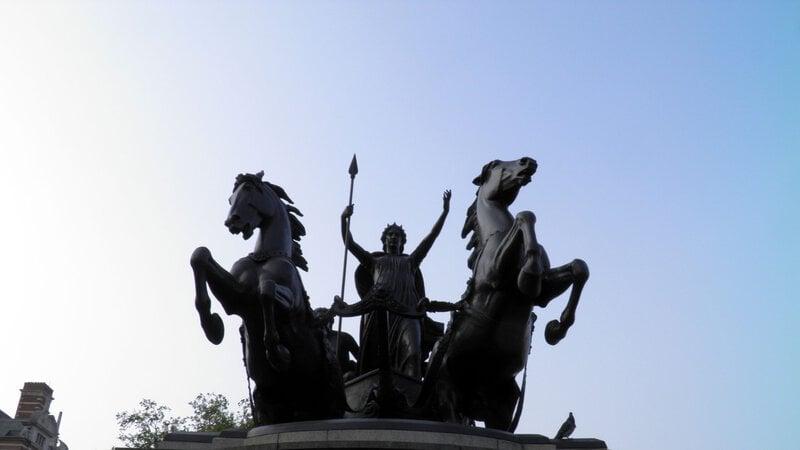
She stayed buried, historically speaking, for roughly fifteen centuries. Tudor England then rediscovered classical texts and found in them a warrior queen who had defied a foreign occupying power on British soil — an irresistible figure for an era actively constructing ideas about English and British identity. The Victorian period completed the transformation: the bronze statue near Westminster Bridge, unveiled in 1902, depicts Boudica in a war chariot with blades on the wheels — a detail unsupported by ancient sources and almost certainly borrowed from later Classical descriptions of Persian and other Near Eastern war chariots rather than anything documented among British tribes. She stands fierce and triumphant, positioned directly across the Thames from Parliament. The irony is almost too complete — a rebel against empire recast as one of its symbols, standing guard over the very imperial capital she once burned to the ground.
Modern historians and archaeologists have worked steadily to recover a more grounded picture: less mythic warrior goddess, more pragmatic coalition leader who responded rationally and devastatingly to genuine colonial violence. The Iceni queen’s story has been filtered through so many successive political lenses — Roman, Tudor, Victorian, modern nationalist — that separating the historical person from the accumulated symbol requires persistent critical effort and a willingness to sit with uncertainty.
What the Ash Layer Tells Us That Written History Cannot
The burned horizon beneath London is, in one important sense, more reliable than any of the texts. It carries no political agenda. It does not embellish or simplify. It sits in the reddish clay, precisely dated to the mid-first century AD, corresponding with the literary accounts in one of those relatively rare moments when physical archaeology and ancient historical writing align with genuine clarity. Charred grain, melted samian ware, the carbonized remnants of a trading town caught entirely unprepared: the destruction is material and inarguable.
Everything else about Boudica — her precise appearance, the exact words of the speeches attributed to her by Tacitus and Dio, the manner of her death, the location of whatever burial she may have received — is filtered through the writing of Roman men composing their accounts decades or more than a century after the events, working within literary traditions that had established conventions for depicting conquered peoples and their leaders.
She burned her name into the geological record of a city that still stands, still hums with commerce, still digs downward into its own layered past. The reddish-brown destruction horizon is hers, and it is certain. What happened to her body, her daughters, her final hours — these remain among the most enduring and humanizing mysteries of Roman Britain. The silence around her end speaks nearly as loudly, in its way, as the destruction she left behind.

 English
 Arabic
 French
 Spanish
 Portuguese
 Deutsch
 Turkish
 Italiano
 Russian
 Romaian
 Portuguese (Brazil)
 Greek
Greek