


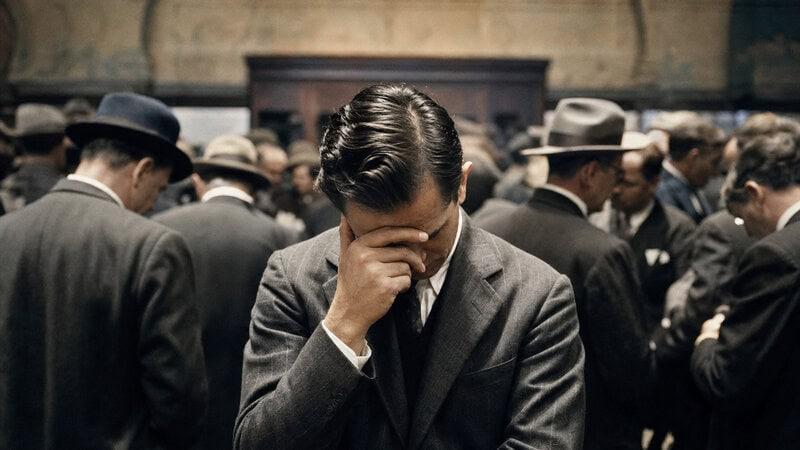

On the morning of October 24, 1929, a stockbroker stepping onto the floor of the New York Stock Exchange would have found everything exactly as it should be — the ticker tape chattering its familiar rhythm, the smell of coffee cutting through the October air, the easy confidence of men who had watched the market climb, almost without interruption, for the better part of a decade. He could not have known that before the afternoon was out, he would be standing in the opening hours of the worst economic catastrophe the industrialized world had ever seen.
Black Thursday and Black Tuesday: The 1929 Stock Market Crash

October 24, 1929 — a date that would become known as Black Thursday — began with the kind of nervous tremor that had flickered through the markets before, only to settle. It did not settle. Within hours, sell orders were overwhelming the exchange in cascading waves. Prices fell, which triggered more panic selling, which drove prices further down. On Broad Street outside, crowds gathered on the sidewalk, straining to understand what the commotion inside meant. Even people who had never owned a single share of stock understood, from the expressions on the faces streaming out of the building, that something had broken.
A consortium of powerful bankers — including representatives from J.P. Morgan and Chase National Bank — pooled their resources to buy shares at above-market prices, injecting a measure of confidence back into the room. For a brief moment, it seemed to work. Prices stabilized. Men exhaled. But the intervention was a thumb pressed against a dam that had already begun to give way. The following Tuesday — October 29, branded into American memory as Black Tuesday — the market collapsed again, this time with a violence that erased any illusion of recovery. In the ten weeks following the initial crash, stocks on the New York Stock Exchange lost roughly half their value — a staggering erasure of wealth that moved far faster and reached far further than almost anyone had imagined possible.
The human consequences were immediate and brutal. Across the country, ordinary workers — teachers, shopkeepers, factory hands — had borrowed money during the boom years to buy stocks on margin, betting that the good times would roll long enough to pay off their loans. When prices collapsed, those debts did not collapse with them. Men and women who had believed they were building something solid discovered overnight that they owed more than everything they owned combined.
Why the Crash Alone Does Not Explain the Great Depression

Historians mark the formal beginning of the Great Depression at 1929, the year the crash ignited the crisis. But the fire had fuel waiting for it long before that October morning. The 1920s looked, on the surface, like an era of prosperity — and in some ways they were. Beneath the gleaming veneer of new automobiles, jazz clubs, and rising stock portfolios, however, the structure was riddled with weakness.
The causes of the Great Depression had been accumulating for years. Reckless speculation on borrowed money had inflated asset prices far beyond any reasonable connection to underlying value. Banking regulation was weak enough to be nearly fictional — thousands of small, undercapitalized banks operated with almost no safety net beneath them. American farmers, far from sharing in the decade’s prosperity, had been quietly suffering through their own depression since the early 1920s, ground down by falling commodity prices and mounting debt. And the global economy, still sutured together after the wounds of World War I, was fragile in ways that policymakers either could not see or chose not to address.
When the crash came, the policy response made everything worse. The U.S. Federal Reserve, rather than flooding the financial system with liquidity to ease the panic, tightened credit — a decision that, as Federal Reserve historians have documented, transformed a severe downturn into an epic catastrophe. Banks failed by the hundreds, then the thousands, wiping out the savings of depositors who had done nothing riskier than trust a local institution with their wages. Congress, in a moment of spectacular misjudgment, passed the Smoot-Hawley Tariff Act in June 1930, erecting trade barriers that triggered retaliatory measures from trading partners worldwide and effectively strangled the arteries of the global economy. What began as an American crisis became, within months, a worldwide disaster.
How Long Did the Great Depression Last?

The Great Depression ran from 1929 to 1939 — a full decade, making it the longest and most severe economic downturn of its kind in modern history. To live through it was not to experience a single, prolonged moment of uniform suffering. It was to watch the world disassemble itself, layer by layer, year by year, with no clear bottom in sight.
Banks shuttered in 1930 and 1931, taking depositors’ savings with them. Factories that had run three shifts through the 1920s went dark. Farms were foreclosed and families were forced off land their grandparents had worked. By 1932, breadlines snaked around city blocks from New York to Chicago to Los Angeles, and makeshift shantytowns — sardonically nicknamed Hoovervilles, after President Herbert Hoover — had sprung up on the outskirts of prosperous cities. Families who had considered themselves solidly middle class found themselves sleeping under corrugated iron and cardboard.
By 1933, the Depression’s most devastating year, unemployment had reached approximately 25 percent and key economic indicators had fallen to roughly one-third of their 1929 levels. In the agricultural heartland, nature added catastrophe to catastrophe: severe drought and decades of poor farming practices turned the Great Plains into a wasteland of choking dust storms throughout the mid-1930s. The resulting Dust Bowl forced tens of thousands of families — many from Oklahoma, Texas, and surrounding states — to load everything they owned into battered vehicles and join a long, desperate migration toward California, only to find that desperation had arrived there before them.
The Human Toll: Unemployment, Collapse, and Global Consequences

The numbers from this period carry a weight that is easy to recite and hard to truly absorb. At the Depression’s peak, roughly one in four American workers had no job — a ratio that did not simply strain family finances but shattered the social fabric of entire communities. A steelworker in Pittsburgh who had, by 1928, bought a modest house, a secondhand car, and a few shares of stock could, by 1932, lose all three in a single season: the house to foreclosure, the car to repossession, the shares to worthlessness — and then the job itself.
The suffering was not contained within American borders. Industrial production plummeted across Europe as well. Germany, already economically fragile after the punishing terms of the Versailles Treaty and the hyperinflation of the early 1920s, was particularly devastated. Unemployment there reached catastrophic levels, hollowing out the German middle class and creating the kind of political desperation in which extreme movements find their oxygen. The economic misery of the Depression years contributed materially to the conditions that helped fuel the rise of the Nazi Party — a reminder, carved in the most terrible terms history offers, that economic collapse does not stay economic for long.
For African Americans and other marginalized groups, the Depression arrived as an intensification of hardships that already existed. Black workers were disproportionately the first to be dismissed when factories cut staff, and many New Deal relief programs — administered at the state and local level — excluded them in practice if not always in law. Women who entered the workforce to keep families afloat frequently faced hostility from employers who argued that jobs should go to men first. The Depression exposed and deepened every fault line already present in American society.
The New Deal: Relief, Recovery, and Reform

When Franklin D. Roosevelt took office in March 1933, the United States was in free fall. Banks were closing across the country and public confidence had nearly collapsed entirely. Roosevelt’s response — a sweeping legislative program he called the New Deal — arrived as a psychological turning point as much as an economic one. Within days of his inauguration, he declared a national bank holiday, temporarily closing all banks to halt the panic while federal examiners assessed their solvency. Only banks judged sound were allowed to reopen.
Over the following years, the New Deal reshaped the relationship between the federal government and American economic life. The Federal Emergency Relief Administration provided direct aid to the unemployed. The Civilian Conservation Corps put young men to work in national parks and forests. The Public Works Administration funded the construction of bridges, hospitals, and schools. The Agricultural Adjustment Act paid farmers to reduce production in order to stabilize commodity prices. The FDR Presidential Library documents how these programs, taken together, stabilized the banking system and restored a measure of confidence to ordinary Americans who had begun to wonder whether their government was capable of responding at all.
But the New Deal, transformative as it was, did not end the Depression. Unemployment remained stubbornly high through the mid-1930s, and when the Roosevelt administration pulled back on federal spending in 1937 — convinced the worst was over — a sharp relapse quickly proved that it was not. The economy contracted again. Unemployment surged back toward 19 percent. The lesson was painful and clear: the hole dug by the crash and its aftermath was simply too deep for peacetime policy, however ambitious, to fully fill.
What Finally Ended the Great Depression

What finally ended the Depression was not a program or a policy but a war. When the United States entered World War II following the attack on Pearl Harbor in December 1941, the federal government embarked on a mobilization so vast and so rapid that it essentially employed every idle worker and every silent machine in the country almost simultaneously. Defense contracts poured into factories that had been shuttered for years; those factories suddenly ran around the clock. Unemployment, which had still hovered around 15 percent as late as 1940, collapsed toward zero as military service and war production absorbed the workforce.
The Library of Congress frames it plainly: it was the massive demands of wartime production, working in combination with the institutional reforms of the New Deal era, that finally closed the wound the crash had opened. It took the largest war in human history to fully undo the damage of a single October afternoon.
The Great Depression’s Lasting Legacy
The legacy of those ten years is written into the architecture of modern economic life in ways most people never stop to consider. The Federal Deposit Insurance Corporation — the FDIC, established in 1933 — was created directly in response to the bank failures of the Depression, so that ordinary depositors would never again watch their savings evaporate because a bank made bad decisions. Social Security, signed into law in 1935, was built to ensure that old age and disability would not mean destitution for those who had spent a lifetime working. The Securities Exchange Act of 1934 created the Securities and Exchange Commission to regulate the financial markets that had run so dangerously unchecked in the 1920s.
These were not abstract policy choices. They were lessons written in a decade of suffering, codified into law so that future generations might be spared the same education. And when the 2008 financial crisis arrived, economists and policymakers turned explicitly to the history of 1929 and the years that followed, studying the Federal Reserve’s earlier mistakes and the policy missteps of the Hoover administration with the urgency of people who understood they were living inside a story they had read before. The Federal Reserve’s decision in 2008 to act as an aggressive lender of last resort — the precise opposite of what it had done in 1930 and 1931 — was a direct application of that history.
But perhaps the most enduring truth about the Great Depression is the simplest one: it was not an abstraction. It was lived — in breadlines and Hoovervilles, in foreclosure notices and empty factory floors, in children who grew up understanding in their bones that security is never guaranteed and that the distance between comfort and ruin can be crossed in an afternoon. Think again of that broker stepping onto the Exchange floor on the morning of October 24, 1929 — coffee in hand, ticker tape singing, the future stretching out before him like a sure thing. The systems we build can feel, from the inside, like permanent structures. The Depression reminds us how quickly they can come apart, and how very long the wreckage of a single afternoon can last.

 English
 Arabic
 French
 Spanish
 Portuguese
 Deutsch
 Dutch
Dutch
 Italiano
 Russian
 Romaian
 Portuguese (Brazil)
 Greek
Greek