


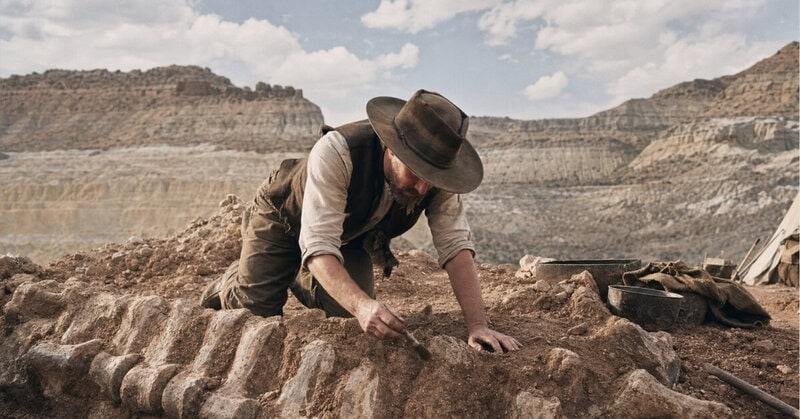
The sun had already baked the Wyoming badlands to the color of old bone when the pickaxe finally rang against something that wasn’t rock. The laborer stopped, dropped to his knees, and began brushing away the rust-red soil with his hands — and slowly, impossibly, the curve of a vertebra the size of a wagon wheel emerged from the earth, belonging to a creature that had walked this same ground a hundred and fifty million years before any human being had ever drawn breath.
A Desert Full of Giants

It was the 1870s, and America was ravenous. The Civil War had ended, the transcontinental railroad had been driven home with a golden spike, and an entire nation was pressing westward looking for something — land, gold, cattle, destiny. What almost nobody expected to find, buried beneath the sun-cracked badlands of Colorado, Wyoming, and Utah, were monsters. Ancient, colossal, magnificent monsters, locked in stone for geological ages and waiting to be argued over by two men who hated each other with a passion that would have impressed a Shakespearean villain.
The rivalry between Edward Drinker Cope and Othniel Charles Marsh — the so-called Bone Wars — is one of the strangest and most consequential feuds in the history of American science. It was petty and spectacular in equal measure. It involved bribery, dynamite, espionage, and at least one very embarrassing backward skull. And when it was finally over, both men were ruined. But the world had Stegosaurus, Triceratops, Allosaurus, Diplodocus, and dozens of other creatures that now anchor our entire understanding of the age of dinosaurs. The paradox at the heart of the Bone Wars is that so much beauty was dragged out of such ugliness.
Cope and Marsh Before the War

Edward Drinker Cope arrived into the world in 1840 with two considerable advantages: a brilliant mind and a wealthy Philadelphia Quaker family. He was publishing scientific papers as a teenager, and by his twenties he had established himself as a genuine prodigy in natural history. He was also impulsive, thin-skinned, and possessed of the unshakeable conviction that he was the smartest person in any room he entered. He was often right, which made him insufferable to everyone who occasionally wasn’t wrong.
Othniel Charles Marsh, born in 1831, was cut from different cloth. Yale-trained, methodical, and politically canny, he lacked Cope’s raw intellectual electricity but compensated with patience and institutional power. His greatest stroke of fortune was familial: his uncle was George Peabody, the enormously wealthy financier and philanthropist, who funded Marsh’s career and endowed the Peabody Museum of Natural History at Yale in his nephew’s honor. Marsh understood, in a way Cope never quite did, that science is also a game of resources and relationships.
The remarkable thing — the detail that makes their eventual hatred so operatic — is that they began as friends. The two men visited each other’s homes, corresponded with genuine warmth, and even named species after one another in collegial tribute. They were, for a brief window, two ambitious young scientists who recognized in each other a rare and kindred fire. What they also shared, though neither would have admitted it, was an absolute inability to tolerate being second.
The Spark: A Backward Skull and a Public Humiliation

The rupture, when it came, arrived in the form of a long-necked marine reptile called Elasmosaurus. Cope had reconstructed the skeleton from fossils found in Kansas and published his findings with considerable fanfare — only to have Marsh point out, with what witnesses described as poorly concealed delight, that Cope had placed the skull on the wrong end. The neck, which was extraordinarily long, had been attached at the tail. The creature Cope had proudly unveiled to the scientific world was, in a literal sense, backward.
Cope’s response revealed everything about his character. He did not quietly correct the error and move on. He attempted to purchase and destroy every copy of the journal in which his blundered reconstruction appeared — a frantic, ultimately futile effort to erase the evidence of his humiliation. The story circulated anyway. Marsh made sure of it.
In nineteenth-century science, reputation was the only currency that truly mattered, and Marsh had just publicly devalued Cope’s with surgical precision. Cope never forgave him. What had been a friendship curdled into something corrosive and permanent, and the two men would spend the next two decades pouring that corrosion across the fossil beds of the American West.
The Badlands Become a Battlefield

The arena for their war was one of the most extraordinary geological formations on Earth. The Morrison Formation — a vast deposit of Late Jurassic sediment stretching across modern Colorado, Wyoming, and Utah — had been slowly exposed by millions of years of erosion, and what it contained was staggering. Enormous bones, preserved in sandstone and mudstone, waited just beneath a landscape that looked, to the men who first saw it, like the surface of another planet: twisted hoodoos, painted badlands banded in ochre and gray, silence broken only by wind and the distant crack of a pickaxe.
Both Cope and Marsh dispatched teams of field workers into this terrain, and the competition quickly abandoned any pretense of scientific decorum. Workers were bribed to switch sides and report on the rival’s discoveries. Sites were dynamited when a team was forced to retreat, to deny the enemy access to remaining fossils. There are accounts of rival crews confronting each other at gunpoint — not metaphorical standoffs, but actual armed men squaring off over dinosaur bones in a landscape where the rule of law was more suggestion than fact. Fossil hunters operated alongside genuine outlaws and across lands belonging to Indigenous communities who were simultaneously being dispossessed by the same westward expansion that had brought these scientists here in the first place.
The pace of discovery that this mania produced was, by any measure, astonishing. Between roughly 1877 and 1892, Cope and Marsh between them described well over a hundred new dinosaur species. They were rewriting the history of life on Earth, and they were doing it out of spite.
The cultural moment around their work has fascinated storytellers ever since. The collision of prehistoric giants with the mythology of the American frontier feels almost too vivid to be real, and projects like the Dinosaurs of the Wild West series by Sparke Films and the Dinosaurs of the Wild West TV series have returned to this setting, exploring just how naturally the two mythologies — ancient monsters and the Wild West — intertwine.
The Monsters They Found: Science Born from Spite

Marsh’s teams gave the world Stegosaurus, its back plated in bony armor that paleontologists still debate in purpose and arrangement; Diplodocus, stretching longer than a tennis court; and Triceratops, the three-horned giant that would become one of the most recognizable animals in the history of life. Cope’s teams contributed Camarasaurus and Coelophysis, among many others. Together they populated an entire lost world and handed it to a public that received it with something approaching mania. Newspaper coverage of the Bone Wars made dinosaurs household names for the first time in American history, transforming paleontology from a gentlemanly curiosity into a subject of national obsession.
The speed of their work carried a steep cost measured in errors. Marsh’s team famously assembled a skeleton under the name Brontosaurus — actually an Apatosaurus fitted with the wrong skull — and the mistake persisted in museums and in popular imagination for over a century before being formally addressed. When rivalry sets the pace, accuracy tends to finish second. Artists and scientists working to reconstruct these creatures today still grapple with the legacy of rushed, competitive publication. Work like the paleontological art of Shaun Keenan reflects the ongoing effort to get these animals right — to honor what the fossils actually tell us rather than what ambition once wanted them to say.
How the War Consumed Both Men

The Bone Wars did not end with a treaty or a reconciliation. They ended, as most wars of attrition do, with exhaustion and wreckage on both sides.
Cope’s financial collapse was the more spectacular of the two. He had poured his inherited fortune into expeditions, collectors, and the relentless machinery of competitive discovery. By the end of his life he was reportedly living amid his specimen crates in a house that had become more museum than home, having sold off almost everything else. He died in 1897, not yet sixty, his wealth gone but his scientific output still extraordinary: he had described more new species of vertebrates than almost anyone in the history of natural history.
Marsh’s unraveling was slower and arguably more humiliating because it was institutional. His extensive use of government funding through the U.S. Geological Survey had made him powerful, but it also made him vulnerable. A Congressional investigation in the early 1890s scrutinized his expenditure and found it difficult to justify, damaging his standing and severing the financial pipeline that had sustained his operations. The man who had leveraged Yale and Washington to dominate American paleontology found both pillars cracking simultaneously.
Cope had one final move. In 1890, he gave an extended interview to the New York Herald in which he accused Marsh of plagiarism, theft of credit, scientific incompetence, and the systematic suppression of rivals. It was a scorched-earth assault, airing twenty years of accumulated grievances before a national audience, and it damaged Marsh even as it confirmed every suspicion people held about Cope’s capacity for restraint. The interview read less like journalism than like a man setting fire to a building while still inside it.
The postscript is almost too perfect: Cope allegedly arranged for his brain to be preserved after his death and measured, hoping to be proven scientifically superior to Marsh by the one metric he had not yet deployed in their war — the physical size of his intellect. Marsh never accepted the implied challenge. The brain, by most accounts, was eventually transferred to a university collection. The competition it was meant to settle remained, as ever, unresolved.
What the Bone Wars Left Behind
The Morrison Formation sites that Cope and Marsh opened in the 1870s and 1880s are still being excavated today. New species continue to emerge from the same badlands that once rang with rival pickaxes, and many of the core discoveries made during the Bone Wars remain foundational to our understanding of Mesozoic life in North America. The raw scientific inheritance is genuinely extraordinary — a gift delivered by two men too consumed by hatred to fully appreciate what they were giving the world.
The Bone Wars also introduced a set of practices that the scientific community would spend generations trying to unlearn: the suppression of rivals, the rush to publish before work was complete, the deliberate destruction of evidence to deny access to competitors. These were not incidental to the rivalry; they were expressions of it, and they left lasting marks on the culture of paleontology.
It is worth remembering, too, that the Bone Wars unfolded against the broader story of westward expansion — the same forces that were displacing Indigenous communities, stripping landscapes of resources, and transforming a continent in the name of American ambition. The fossils were one more thing to be extracted, claimed, and fought over. The badlands did not care who won. They had been patient for a hundred and fifty million years.
The dinosaurs of the wild west survived all of that time locked in stone, preserved against the day when human beings would find them. They survived, in the end, even Cope and Marsh — and because of those two brilliant, ruinous, impossible men, the rest of us get to meet them. That, for all its chaos and cruelty, may be the most remarkable thing about the Bone Wars: the science outlasted the scientists, and the giants endured.
For those drawn to explore this collision of prehistoric life and frontier mythology further, this conversation with artist Shaun Keenan on bringing dinosaurs of the wild west to life offers a vivid window into how the era continues to capture creative imaginations — and the ongoing appetite for stories blending Jurassic spectacle with Wild West atmosphere suggests the legend of these ancient badlands is far from finished.

 Arabic
 French
 Spanish
 Portuguese
 Deutsch
 Turkish
 Dutch
Dutch
 Italiano
 Russian
 Romaian
 Portuguese (Brazil)
 Greek
Greek