


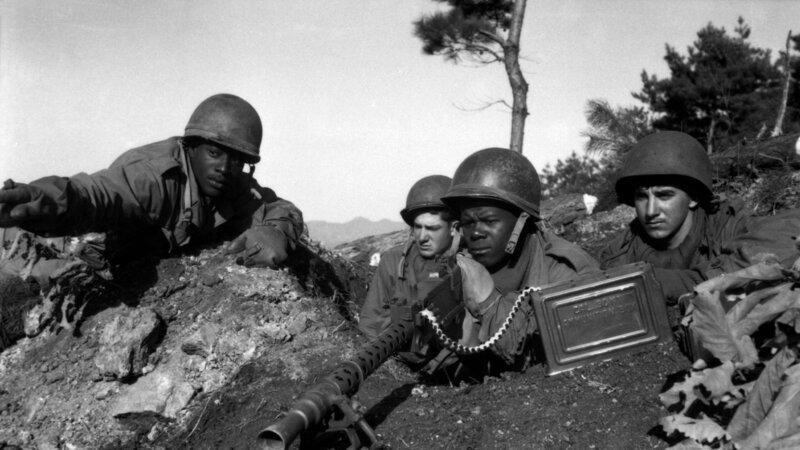

The date is July 1953. On a barren ridge above the Imjin River called Pork Chop Hill, a twenty-year-old American soldier crouches in a frozen trench — outnumbered, low on ammunition, fighting for a piece of ground his own generals privately admit they may abandon by morning. Back home in Ohio, Georgia, and California, his family is watching television, and the war he is fighting barely makes the evening news. America has already begun to forget him, and the guns haven’t even gone quiet yet.
The War That Hollywood Forgot

Within a decade of World War II ending, Hollywood had produced hundreds of films celebrating that conflict — from the sweeping grandeur of Twelve O’Clock High to the intimate heroism of Sands of Iwo Jima. The studio system understood WWII instinctively. It had a beginning, a middle, a triumphant end, and a villain so unambiguous he might as well have been drawn by a cartoonist. The Korean War, which killed approximately 36,000 Americans between 1950 and 1953 and wounded more than 100,000 others, offered none of those narrative conveniences. It ended not in victory but in an armistice — a negotiated stalemate that satisfied no one and resolved nothing. The peninsula it was fought over remains technically at war to this day.
The result was one of the strangest gaps in American popular culture. Film historians and ordinary moviegoers have long noted the conspicuous scarcity of Korean War cinema. Threads on Reddit asking for Korean War movie recommendations fill up quickly with the same observation: compared to the avalanche of World War II films, the Vietnam wave of the late 1970s and 1980s, and the post-9/11 surge of Middle Eastern conflict films, Korean War movies are so rare that listing them doesn’t take long. The gap became its own cultural phenomenon — a silence louder than most films.
Was Hollywood’s neglect about politics, profit, shame — or something deeper about how a nation chooses what to remember?
The First Wave: When Studios Did Try

The surprise, if you dig into the history, is that Hollywood actually moved quickly at first. A cluster of films hit screens while the war was still being fought. The Steel Helmet, Fixed Bayonets!, A Yank in Korea, Korea Patrol, I Want You, and Submarine Command all appeared in 1951 and 1952 — a burst of production suggesting the studios initially saw Korea the way they had seen every American conflict since Pearl Harbor: as material.
Watch these films now and you feel the uncertainty baked into them. They are hurried, often shot on studio backlots with borrowed World War II stock footage, patriotic in a rote way that suggests a country going through the motions of a response it hasn’t fully felt. The tone is neither pride nor grief — it’s more like obligation, a civic duty performed without conviction. Audiences sensed it. Box office returns were soft. People who had spent the previous decade watching John Wayne win wars clearly and decisively didn’t know what to do with a conflict that was, by the time these films reached theaters, already grinding into a costly stalemate.
The one early exception worth singling out is Fixed Bayonets! (1951), directed by Samuel Fuller. Fuller had served as an infantryman in World War II and brought a claustrophobic, psychologically tense authenticity to the material — a small unit, a frozen Korean hillside, the specific dread of being the last man standing. It is a genuinely uncomfortable film, and service members and veterans have consistently ranked Fixed Bayonets! among the best Korean War movies ever made. That it stands out so sharply says less about Fuller’s considerable talent and more about how thin the field around it is.
When the armistice came in July 1953, it removed even the last rationale for urgency. The first wave dried up almost immediately. Hollywood moved on.
The Forgotten War Effect: Why America Looked Away

Understanding why requires understanding what Korea meant, culturally and psychologically, in the America of the 1950s. The entire postwar American identity had been constructed around the idea of unconditional triumph — the Greatest Generation, the Arsenal of Democracy, the nation that saved the world. Korea did not fit that story. It ended with a line on a map rather than a surrender ceremony on a battleship. The soldiers who came home returned to no ticker-tape parades, no national relief, no home-front mobilization that had made their absence feel meaningful. They came home to a country that had barely noticed they’d left.
The war also had the misfortune of timing. It was sandwiched between the cultural weight of World War II and the gathering dread of Vietnam, competing for emotional real estate in a Cold War America that preferred to frame its anxieties as existential — nuclear annihilation, communist infiltration — rather than tactical. A frozen Korean peninsula was the wrong kind of scary. It was simply costly and inconclusive, which is the hardest kind of war to mythologize through the conventional hero’s journey that Hollywood had perfected.
Veterans who came home from Korea eventually gave the conflict its enduring nickname: the Forgotten War. It was not a designation they chose with pride. It described what they had experienced — the particular invisibility of men who fought hard and came back to silence. Hollywood, which makes films about wars that audiences feel something about, read the room with its usual mercenary accuracy. For decades, the industry collectively understood that America had agreed, without quite saying so, to move on.
The Exceptions That Proved the Rule

A thin but significant trickle of films kept the war barely alive on screen through the late 1950s and early 1960s. Men in War (1957), Pork Chop Hill (1959), War Hunt (1962), and The Hook (1963) form a small canon that veterans and military historians have since elevated as some of the finest work in the genre — precisely because these films refused cheap sentimentality and easy resolution. Critics ranking the best Korean War films return to these titles consistently, and the reason is the same: they were, in some sense, anti-war films before the culture had a vocabulary for that genre.
Pork Chop Hill (1959) is the era’s most ambitious attempt. Gregory Peck leads a grimly realistic assault on a hill of almost no strategic value. The film’s bitter, anti-heroic logic was so far out of step with late-Eisenhower optimism that it underperformed at the box office despite being, by almost any measure, a serious and honest piece of filmmaking. The assault it depicts is costly, the victory hollow, the purpose debatable. Veterans would later identify it as one of the most truthful Korean War movies Hollywood ever produced. It made little money.
Men in War and War Hunt are perhaps even more striking in retrospect — psychologically complex, morally ambiguous portraits of soldiers under pressure that would have fit naturally in the post-Vietnam New Hollywood era, but arrived a decade too early. Audiences conditioned by World War II’s clean moral architecture didn’t know what to do with soldiers who weren’t clearly heroic, villains who weren’t clearly evil, and endings that felt less like resolution than exhaustion. These were films ahead of their time, and the culture punished them commercially for it.
M*A*S*H and the Vietnam Loophole

Then came 1970, and one of the most consequential sleights of hand in Hollywood history.
Robert Altman’s M*A*S*H is set in Korea, uses the Korean War as its explicit backdrop, and has been recognized by service members and veterans as one of the most resonant Korean War films. But everyone in 1970 understood, without needing to be told, that the movie was about Vietnam. The anarchic energy, the contempt for authority, the black comedy of men trying to stay sane inside an insane institution — this was the language of a generation watching the evening news from Southeast Asia, not a meditation on a conflict twenty years past.
The strategy was brilliant in its cynicism. The Korean War setting gave the production political cover at a moment when Vietnam films were commercially and politically volatile. It was not technically a Vietnam film. It was a Korean War movie — a genre so obscure it carried no political freight at all. The film became a phenomenon and launched an eleven-season television series that ran until 1983. For an entire generation, M*A*S*H essentially was Korean War culture.
The irony is sharp and a little sad. M*A*S*H‘s enormous success did not open the floodgates for genuine Korean War films. If anything, it gave Hollywood permission to keep using Korea as metaphor rather than subject — to borrow the war’s geography and period setting as a backdrop for other conversations while the actual history of the conflict, and the actual men who fought it, remained as invisible as ever. The most famous Korean War film ever made was never really about Korea at all.
What Finally Changed

The shift, when it came, was slow and arrived from unexpected directions. As Vietnam’s cinematic reckoning played out through the late 1970s and 1980s — Apocalypse Now, Platoon, Full Metal Jacket — filmmakers and audiences gradually developed the emotional vocabulary needed to revisit unresolved wars without demanding triumphant endings. Those films proved that American audiences could sit with ambiguity, moral failure, and the specific grief of wars that left no clean answers. That was a vocabulary Korea had always needed and never been given.
By the 1990s, a generational clock was running out. Korean War veterans were aging, their stories at risk of disappearing entirely. The dedication of the Korean War Veterans Memorial in Washington in 1995 signaled, quietly but clearly, that the culture was finally ready to acknowledge what it had spent decades suppressing.
And then there was the dimension American studios had missed entirely. South Korean cinema, operating with no ambivalence about the war’s significance — it had, after all, been fought on South Korean soil at catastrophic cost to the civilian population — produced films that engaged with the conflict as a defining national trauma rather than an inconvenient footnote. The Front Line (2011), a sweeping and historically detailed epic about the brutal final days of the war, became a major domestic hit in South Korea and earned significant international attention. When you examine the full list of Korean War films, it is far more substantial on the Korean side of the ledger than the American one. One country’s forgotten war was another country’s central national story.
Why the Silence Matters — and Why Now Is the Moment
The thin American canon of Korean War cinema — Fixed Bayonets!, Pork Chop Hill, Men in War, War Hunt, The Hook, and the films that followed — is not evidence of an uncinematic war. It is evidence of an underexplored one, a conflict rich with stories that the streaming era and the global co-production market are, for the first time, genuinely positioned to tell. The appetite for morally complex, psychologically honest war storytelling — demonstrated by the success of prestige productions like Band of Brothers and The Pacific — is exactly the appetite the best Korean War films have always satisfied, quietly and in relative obscurity.
The stakes are not merely cinematic. Approximately 36,000 Americans died in Korea. Millions of Korean civilians were killed or displaced. A peninsula promised peace in 1953 remains divided and technically at war more than seventy years later. The Korean War is not a historical footnote. It is an unresolved present, which gives its stories an urgency that purely historical war films cannot match.
The history of Korean War movies is ultimately a history of how nations choose what to mourn and what to suppress — and how cinema, for all its power, is less a leader of culture than a follower of it, filling in the silences only after society has finally given itself permission to look back. Hollywood ignored Korea for decades not because the stories weren’t there. They were always there, in every frozen trench, every pointless assault, every soldier who came home to a country that had moved on without him.
If you have never seen Pork Chop Hill, tracked down Men in War, or watched The Front Line, you have been missing one of cinema’s most honest and least-crowded conversations about what war costs — and what forgetting costs even more. The silence Hollywood kept for so long makes finding these films feel less like homework and more like discovery. Start there.

 English
 Arabic
 French
 Portuguese
 Deutsch
 Turkish
 Dutch
Dutch
 Italiano
 Russian
 Romaian
 Portuguese (Brazil)
 Greek
Greek