


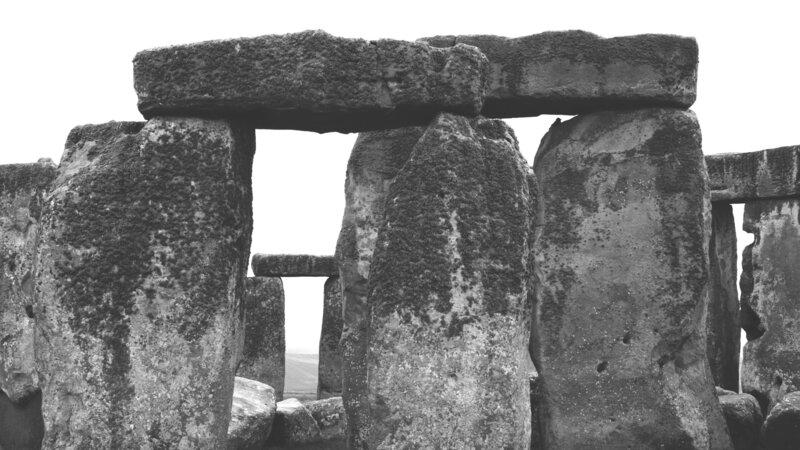

Picture the scene: somewhere on the ancient trackways of Britain, around 2500 BC, a boulder the weight of a small car inches forward on wooden rollers, hauled by hundreds of straining bodies, ropes biting into calloused hands, the Welsh hills already a hundred miles behind them and the Salisbury Plain still ahead. Nobody ordered these people to do this. Nobody paid them in coin. And yet, somehow, they did it — again, and again, and again, until a circle of foreign stone rose on a chalk plain in what is now Wiltshire, England, and became one of the most enduring mysteries in human history.
The Stone That Shouldn’t Be There

The central puzzle of Stonehenge is not the one most visitors assume. Yes, the sheer scale of the monument is staggering — those great sarsen trilithons, paired uprights capped with horizontal lintels, each weighing up to 25 tons, raised without metal tools, without the wheel, without a written engineering manual. But the deeper mystery belongs to a humbler set of stones: the bluestones.
Smaller than the famous sarsens and rougher in appearance, the bluestones occupy the inner horseshoe and outer circle of the monument. For centuries they were assumed to be local. They are not. Composed of dolerite, rhyolite, and related rock types, they have no geological business being on the chalk plains of southern England. Modern geochemical fingerprinting — matching the precise mineral signature of each stone to its source outcrop — has confirmed that the primary bluestone quarries were in the Preseli Hills of Pembrokeshire, Wales. Specific outcrops, including Carn Goedog and Rhosyfelin, bear the unmistakable signature of Stonehenge’s inner stones. The distance from those quarries to Salisbury Plain: between 150 and 200 miles, depending on the route taken.
Scientists now know, with confidence, where the bluestones came from. How they arrived in Wiltshire remains, gloriously and stubbornly, unanswered.
Before the Stones: A Sacred Landscape 9,000 Years in the Making

The story of Stonehenge does not begin with stone. The origins of this patch of Salisbury Plain as a deliberately used, meaningful landscape stretch back roughly 9,000 years, to the Mesolithic period, when hunter-gatherers erected large pine posts on the site. Not a monument in any recognisable sense, but a marker — a sign that this particular ground mattered. Whatever drew those early people here, the impulse would prove extraordinarily durable.
By around 3100 BC, Neolithic farming communities began shaping the landscape with deliberate intent. They dug a circular ditch and bank — a structure archaeologists call a henge — physically setting this ground apart from the world around it. That enclosed space was not an empty gesture. Cremated human remains found at the site date to this earliest phase, making Stonehenge one of the oldest known cemeteries in Britain. People brought their dead here. They gathered here. They oriented their most significant communal acts toward this particular circle of sky.
To place this in context: Stonehenge predates the Great Pyramids of Giza and was already ancient when the Roman Empire was founded. It belongs to a chapter of human civilisation that most of us struggle to imagine — a world without writing, without metal tools, without cities in any modern sense, yet clearly not without profound social organisation, spiritual ambition, or the ability to move mountains, sometimes literally.
Six Stages, 1,500 Years: The Monument That Never Stopped Becoming

One of the most important things to understand about Stonehenge’s development is that it was never simply built. It was becoming. The monument we see today is the accumulated product of roughly six distinct construction phases, stretching from approximately 3000 BC to around 1520 BC — a span longer than the entire history of Christianity. Each generation of builders inherited what had come before and chose, deliberately, to add to it, rearrange it, and reimagine its meaning.
The earliest phase established the circular earthwork and the first timber and stone placements. Later phases — particularly around 2500 BC — introduced the iconic sarsen trilithons, positioned with a precision that still confounds structural engineers. The sarsens came from the Marlborough Downs, roughly 25 miles to the north: a formidable journey, but a manageable one compared to what the bluestones demanded.
The bluestones were first erected around 2400-2200 BC and were subsequently rearranged across multiple later phases — moved, reset, and repositioned in ways that suggest their significance was not fixed but evolved with each generation that inherited them. Construction activity continued until approximately 1600 BC, meaning Stonehenge was a live, changing, and contested sacred space for well over a millennium. It was never finished because, for its builders, it was never meant to be.
The Bluestones: Stonehenge’s Deepest Mystery

To understand why the bluestone origin discovery matters, you have to appreciate what archaeologists found at the Welsh end of the story. At Carn Goedog and Rhosyfelin in the Preseli Hills, excavations have revealed what appear to be actual Neolithic quarry sites — places where rock faces were deliberately split, stones were shaped and prepared for transport, and the evidence of human activity aligns chronologically with Stonehenge’s construction phases. These were not accidental deposits. People went to these specific outcrops, in these specific hills, and did deliberate, skilled work.
The Preseli Hills were not simply a convenient source of rock. They were themselves a sacred landscape, likely revered for qualities we can only reconstruct from inference. Some outcrops of the local dolerite produce a ringing sound when struck — an acoustic quality that may have carried ritual or religious significance. The builders of Stonehenge may not have been simply moving heavy rocks across Wales. They may have been transplanting the spiritual authority of one sacred place into the body of another — carrying the essence of those Welsh hills to the Salisbury Plain and embedding it, physically and symbolically, in the ground.
This reframing changes how we read the entire monument. The bluestones are not the smaller, less impressive stones at Stonehenge. Judged by the effort invested in acquiring them, they may be its most meaningful ones.
The 200-Mile Question: What Nobody Has Proven

Moving a stone weighing between two and four tons from the Preseli Hills to Wiltshire requires crossing the Cambrian Mountains, navigating multiple river valleys, negotiating the Bristol Channel or the Severn Estuary, and continuing overland across the English countryside. By any measure — ancient or modern — this is a staggering logistical and physical undertaking.
The leading theories for how it was accomplished fall into two broad camps. The first is overland transport: sledges, log rollers, ropes, and the coordinated effort of large numbers of people moving stones across a prepared track, one agonising length at a time. Experimental archaeology has demonstrated this is physically possible — teams of volunteers have moved replica stones using period-appropriate technology. Possible, yes. But exhausting, slow, and requiring extraordinary social coordination across communities that may have shared no common language.
The second theory involves water: rafts or log boats carrying stones along Wales’s network of rivers and around the Welsh coast, using the sea or the Severn Estuary to reduce the overland distance substantially. The estuary is tidal and dangerous, but the route is plausible, and again, experiments suggest it could have worked. Again, nobody has proven it did.
A third hypothesis — that glaciers transported the bluestones partway during an earlier ice age, leaving Neolithic people only a shorter final journey — attracted supporters for some years but has been largely set aside by the absence of bluestone deposits along the expected glacial paths and by the evidence of deliberate quarrying activity at the Welsh source sites. If the ice moved them, it left almost no trace of having done so.
The honest position, the one most archaeologists hold today, is that we do not know which method was used, or whether it was some combination of all of them. This is not a failure of science. It is an invitation to sit with the reality that people five thousand years ago accomplished something that still defeats our complete understanding, using means they never recorded in any form we can read.
Who Built Stonehenge — and What They Were Reaching For

The question of who built Stonehenge carries the weight of centuries of mythology. Medieval chroniclers credited Merlin. Later romantics credited the Druids — a persistent and popular misconception, despite the fact that the Druids as a distinct priestly class emerged roughly 2,000 years after the main construction phases were complete. Over the centuries, the Romans, the Danes, and various lost civilisations have all been proposed. The actual answer is both more mundane and more remarkable than any of those theories.
Stonehenge was built by Neolithic and then Bronze Age farming communities — ordinary people, by the standards of their time, who organised themselves into something extraordinary. Isotopic analysis of skeletal remains found near the monument indicates that people came from across Britain, and possibly from continental Europe, to participate in rituals here or to be buried in its sacred ground. This was not a purely local project. It functioned, in some meaningful sense, as a shared national endeavour in a world that had no nations.
The monument’s alignment with the midsummer sunrise and the midwinter sunset was precise and deliberate. Stand at the centre of Stonehenge on the summer solstice and the sun rises directly over the Heel Stone, framed by the great trilithons. On the winter solstice, the setting sun aligns with the monument’s axis in the opposing direction. This was not coincidence or approximation. It was careful, repeated observation translated into engineering — a calendar written in stone that integrated the rhythms of the sky with the agricultural and ceremonial rhythms of the people who depended on it.
As detailed accounts of the monument’s history make clear, the question “who built Stonehenge” admits no single answer. Many peoples built it. Many generations added to it, amended it, and redirected its meaning. Many different purposes animated its construction at different moments across fifteen centuries of continuous use. That layered, cumulative human investment is part of what makes the monument so resistant to easy summary and so resistant to being fully understood.
What Modern Science Has Found — and What Remains Open
Modern archaeology is not done with Stonehenge. Ground-penetrating radar surveys and LiDAR imaging — technologies that reveal buried features without disturbing the ground — continue to uncover pits, postholes, processional routes, and enclosures across the wider landscape. The stones themselves are the visible tip of a much larger and more complex sacred geography that extended across several square miles of Salisbury Plain.
The confirmed identification of the Welsh quarry sites has done something important beyond solving a geological puzzle. It reframes Neolithic Britain as a genuinely connected world. These were not isolated communities scratching subsistence from reluctant soil. They were societies capable of coordinating effort across vast distances, maintaining knowledge of specific rock outcrops hundreds of miles away, and sustaining multi-generational projects of enormous ambition and scale. The bluestone journey — whatever form it took — is evidence of a network, a relationship, and a world in purposeful motion.
The how of it remains the single greatest open question in British prehistory. And it is precisely that irreducible mystery that keeps Stonehenge alive as a cultural and intellectual obsession, rather than a closed chapter in an archaeology textbook. The stones that Neolithic hands quarried in the Preseli Hills, shaped with antler picks and stone hammers, and transported across a landscape they considered sacred still stand on Salisbury Plain. They still align, after five thousand years, with the same solstice sun. They still draw more than a million visitors a year to stand before them and feel, in some inarticulate way, the full weight of everything that brought them there.
Science has narrowed the mystery considerably. It has not — and perhaps cannot — extinguish it. Some questions are too large for final answers. And some stones were always meant to outlast our understanding of them.

 English
 Arabic
 French
 Spanish
 Portuguese
 Deutsch
 Turkish
 Dutch
Dutch
 Italiano
 Russian
 Romaian
 Greek
Greek