


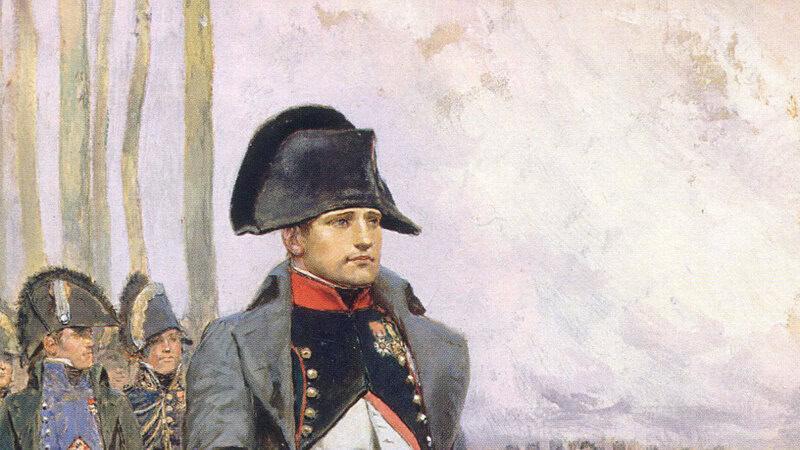

On a smoke-filled ridge somewhere in northern Italy in the late 1790s, a soldier squinting through the chaos of battle didn’t need to see a face or hear a name. He just needed to catch that silhouette — two points running ear-to-ear across a head, broad and unmistakable against the sky — and he knew exactly where his commander stood. That sideways hat was not an accident of fashion. It was a decision that would outlast an empire.
The Hat That Stopped a Battlefield
Napoleon Bonaparte commissioned roughly 120 bicorne hats over the course of his career. That number alone tells you something about the man: a relationship with a single object so sustained, so deliberate, that it borders on obsession. Of those 120 hats, only 19 survive today, each one a relic of specific campaigns, specific decisions, specific mornings when the fate of Europe hung in the air like cannon smoke. One sold at a Paris auction for €1.9 million. Another had been quietly forgotten in a French museum archive for what appeared to be the better part of a century before archivists rediscovered it. Even now, Napoleon’s hats are still making headlines.
But before the auction rooms and the museum vaults, there is the central mystery that anyone who has ever looked at a portrait of Napoleon eventually notices: every other officer of his era wore the bicorne front-to-back, with one point jutting over the nose and the other over the spine. Napoleon wore his sideways — points ear-to-ear, the wide lateral spread of the hat visible from hundreds of yards away. This was not vanity. It was not eccentricity. It was, in the clearest sense, a calculated act of command psychology, and it remains one of the most quietly brilliant pieces of personal branding in military history.
What Exactly Is a Bicorne? A Brief History of the Hat Itself

The bicorne did not arrive in the world fully formed as a symbol of Napoleonic power. It began life as something considerably more humble: an ordinary wide-brimmed round felt hat, practical and unremarkable, the kind of thing a gentleman or a soldier might wear without anyone attaching much significance to it. In the late 18th century, military fashion across Europe began folding the brim upward on two opposite sides and stitching or pinning the edges together, creating the distinctive two-horned silhouette that gave the hat its name — from the Latin for “two horns.”
The result was both functional and socially versatile. A collapsible version, the chapeau claque, could be flattened under an officer’s arm at a court function and snapped back into shape for the field — a piece of headgear that moved as fluidly between ballroom and battlefield as its wearers did. By the time Napoleon was rising through the ranks of the Revolutionary French Army in the 1790s, the bicorne was the standard officer’s hat across most of Europe. What Napoleon did with it, however, was entirely his own.
His specific version was notable above all for what it lacked. Napoleon’s bicorne was black beaver felt, unadorned by the plumes, gold braid, and elaborate trim that festooned the hats of his marshals and generals. His sole concession to decoration was the tricolor cockade — red, white, and blue — pinned to the front, a Revolutionary emblem that tied the Emperor to the republic he had, technically, inherited. The hat worn at the Battle of Waterloo is described in exactly these terms: black bicorne, red, blue and white circular badge on the front, nothing else. The plainness was the point.
In an army where rank announced itself through ever-more-elaborate ornamentation, Napoleon’s minimalism made him paradoxically unmistakable. You could identify every other officer by what his hat had on it. You could identify Napoleon by what his hat did not.
En Bataille: The Sideways Turn That Made History

Military historians of Napoleonic dress recognize two formal styles for wearing the bicorne. En colonne placed the points forward and back — one peak over the nose, one over the back of the neck — the conventional style worn by virtually every officer from London to St. Petersburg. En bataille, the battle position, placed the points ear-to-ear, the hat’s wide profile running laterally across the head. Napoleon adopted the en bataille style consistently from at least the Italian campaigns of the 1790s onward and never abandoned it.
Consider the geometry. A commander on horseback, riding toward or across a battle line, presents his face to the men watching him. Worn en colonne, a bicorne in that position reads as a narrow shape — one peak pointing skyward, the profile thin and easy to miss in the confusion of smoke and movement. Worn en bataille, the same hat suddenly presents its full width: a broad horizontal silhouette that registers instantly at distance, the way a flag registers before you can read its colors. Napoleon was, in the most literal sense, making himself into a flag.
This mattered especially because Napoleon was not physically imposing in the way many of his generals were. His marshals were frequently taller, broader, and more naturally commanding in the visual sense. They also wore hats bristling with plumes and shining with gold trim. Against that backdrop, a short man in a plain gray overcoat and a plain black hat could easily be overlooked — unless that plain black hat was oriented in a way no one else’s was. The sideways hat was a signature as legible as a monogram, and it worked at ranges a monogram never could.
The command psychology runs deeper still. Troops who could see their emperor — and identify him instantly, without a moment’s uncertain squinting — fought with a different quality of confidence than troops who could not. The hat was not decoration. It was a leadership instrument, a piece of battlefield communication in an era when battlefield communication was everything, and it cost nothing but the willingness to be different.
One Hundred and Twenty Hats: The Man Behind the Obsession

One hundred and twenty hats over roughly two decades of power works out to approximately six hats per year. The rate reflects something real about how Napoleon treated his headgear. He was famously hard on hats — not through carelessness exactly, but through a particular habit of rolling and crushing them absentmindedly while thinking, pacing through his tent or his study, working through a strategic problem, destroying the felt structure without noticing he was doing it. His imperial hatter, known as Poupard, held the prestigious commission to supply these hats and crafted each one to Napoleon’s exacting specifications: precise weight, precise stiffness of felt, precise dimensions.
Napoleon was also known to break in each new hat over a period of weeks before trusting it on campaign. He would wear it around his quarters, letting the felt soften and conform to the shape of his head, until the hat felt less like headgear and more like an extension of himself. A man who commanded the Grande Armée and redrew the map of Europe was particular — even finicky — about the comfort of his hat. This is one of those human details that makes Napoleon’s hat history feel less like artifact study and more like biography.
What happened to the hats after he was done with them explains why any survive at all. Close aides, marshals, and allied sovereigns received worn Napoleon hats as gifts of extraordinary political and personal weight. A hat that had been on the Emperor’s head carried the force of a relic; recipients understood this implicitly and preserved their gifts accordingly. The 19 survivors are distributed across museums and private collections in several countries, each one the end point of its own long, strange journey through royal gift-giving, auction houses, and archival oblivion.
The Survivors: From Marengo to the Auction Block

Of all the surviving hats, the one with perhaps the clearest documentary biography is the bicorne held at the Musée de l’Armée in Paris, identified as the hat Napoleon wore at the Battle of Marengo in June 1800. Marengo was the surprise victory in northern Italy — initially appearing to be a French defeat before a late-afternoon reversal turned it into a triumph — that cemented Napoleon’s political grip on France as First Consul and announced to a watching Europe that this particular figure was not going to be a temporary phenomenon. The hat was on his head through that reversal.
Then there is the story that surfaced more recently: archivists at the Condé Museum north of Paris discovered one of Napoleon’s bicornes that had effectively been sleeping in storage, its significance unrecognized or simply forgotten over the course of the institution’s long history. That a hat worn by one of the most documented figures in Western history could drift into archival invisibility for decades is a remarkable fact about how objects move through time — and a reminder that the count of 19 survivors may not be final.
A Napoleon bicorne sold in Paris for €1.9 million — roughly $2.1 million at the time — a figure that surprised even seasoned collectors and confirmed that the hat’s cultural gravity has not weakened in two centuries. What the buyer was actually purchasing is worth naming precisely: not a piece of felt, but the most personal surviving article of the most written-about military commander in Western history. An object that was physically present — on his head, touching his hair, absorbing the weather of his campaigns — at moments that changed the boundaries of nations.
One hat with a particularly vivid recent profile is the bicorne associated with the Battle of Waterloo, held at the Grimaldi Forum museum in Monaco. Its provenance connects it directly to Napoleon’s final campaign — the last morning, June 18, 1815, before everything collapsed. The hat’s documented chain of custody, from Napoleon’s household to the Grimaldi collection, gives it a biographical specificity that purely stylistic analysis cannot match. It is not merely a bicorne. It is a bicorne from that day.
Symbol, Shorthand, and the Strange Afterlife of a Hat

The bicorne became Napoleon’s synecdoche so quickly and so completely that it happened within his own lifetime. British satirical cartoonists of the Napoleonic era discovered that two curved lines above a small, imperious figure were sufficient to conjure him — no face required, no uniform detail necessary. The hat did the work a portrait would normally do, which is an extraordinary thing for any object to achieve. It means the hat had already, by the early 19th century, become more recognizable than the face beneath it.
That symbolic compression has proven extraordinarily durable. Every Halloween costume that places a black bicorne above a hand tucked into a coat is drawing on the same visual logic the cartoonists discovered. Every caricature, every film prop, every museum display that wants to invoke Napoleon in a single object reaches for the hat. The gray overcoat is associated with him. The riding boots are associated with him. But the hat is him — the one element that carries the full charge of the identity without any supporting context.
There is an irony worth pausing on here. Napoleon’s military dress was, by the standards of his era, notably understated. The famous gray overcoat, the plain green jacket of the Chasseurs de la Garde, unornamented boots — while his marshals gleamed with gold and glittered with decoration, Napoleon dressed with a restraint that bordered on the deliberately drab. The hat was the one element doing all the visual work, which perhaps explains both why he needed 120 of them and why he was so precise about how he wore each one.
The orientation remains the key to everything. Worn en colonne like every other officer, the bicorne reads as a period military hat — an artifact of its era, historically interesting, visually unremarkable. Worn en bataille, points ear-to-ear, it reads as Napoleon. The angle is the identity. The turn of a hat, held constant across twenty years and a hundred campaigns, is what makes the symbol work — then and now.
Why the Hat Still Matters
Return, at the end, to that auction room in Paris: a collector paying €1.9 million for a battered piece of black felt. The transaction is puzzling if you think of it as the purchase of a hat. It makes complete sense if you think of it as the purchase of a presence — the closest any living person can come to standing in the same physical space as a figure who has been dead for two centuries but who has never quite left the room.
The 19 surviving hats function as a kind of distributed biography. Each one was present at specific moments — specific battlefields, specific decisions, specific mornings that bent the arc of history. Each one then traveled its own strange path: gifted to a marshal, passed to a descendant, sold at auction, donated to a museum, forgotten in an archive, rediscovered by a startled archivist. They have careers, these hats, almost as eventful as the career of the man who wore them.
Napoleon made thousands of decisions that shaped what we recognize as the modern world — in law, in administration, in the redrawing of European boundaries. But the decision to turn his hat sideways, to wear it en bataille when everyone else wore theirs en colonne, may be his most durably visible legacy. It was a single gesture of distinction that outlasted his empire, his dynasty, every treaty he ever signed, and every army he ever commanded.
Somewhere in a climate-controlled museum room, or in a collector’s private display behind glass, one of those 19 hats sits in the dark right now — black beaver felt, tricolor cockade at the front, points running exactly ear-to-ear — still oriented precisely as he wore it, still waiting to be recognized across a distance.

 English
 Arabic
 French
 Spanish
 Portuguese
 Turkish
 Dutch
Dutch
 Italiano
 Russian
 Romaian
 Portuguese (Brazil)
 Greek
Greek