


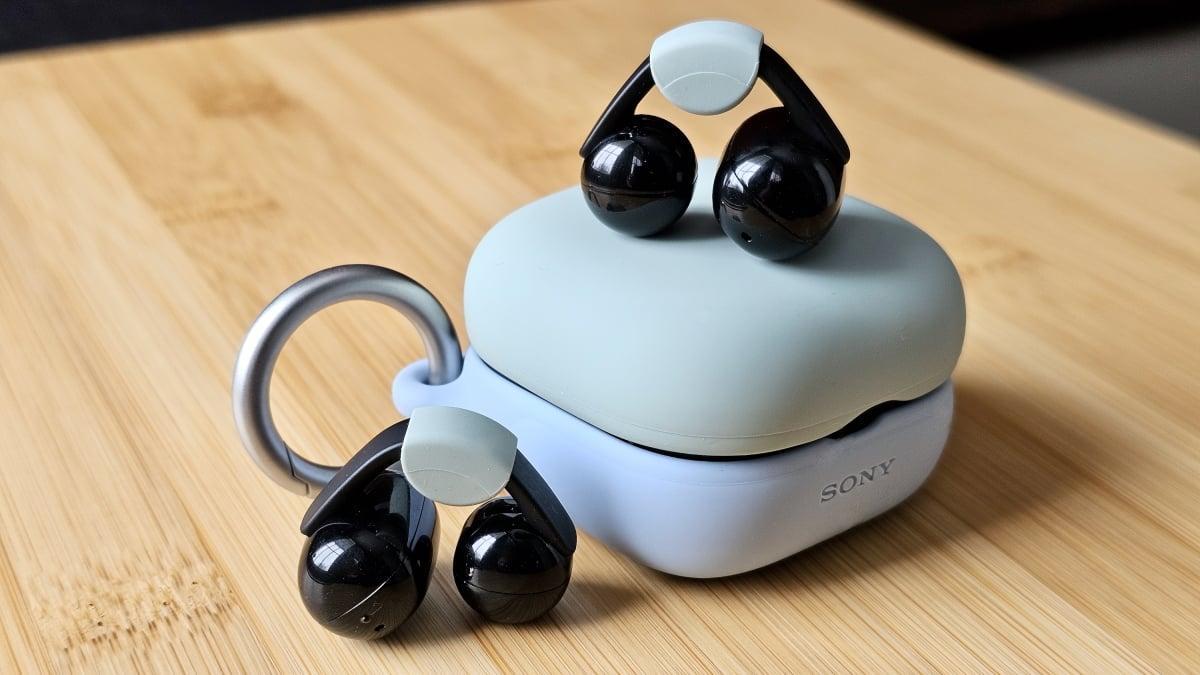
Sony’s no stranger to the open-ear category — its original LinkBuds were one of the first you could buy — and yet the company remained content to stick with an in-ear shape, even while brands like Shokz and Soundcore were enjoying success with earhook and clip-style designs. The LinkBuds Clip are, finally, recognition that maybe one size (or shape) doesn’t fit all.
They’re still not perfect — or priced as low as the competition — yet the LinkBuds Clip make a compelling choice in the still-evolving open-ear category.
Here’s what you need to know.
Sony LinkBuds Clip: Just the specs
Microphones: 2
Connectivity: Bluetooth 5.3 (AAC/SBC codecs) with Multipoint
Battery: 9 hours per charge (37 hours total)
Quick charge: One hour of extra play time after three minutes of charging
Charging: USB-C only (cable not included)
Noise cancellation: N/A
Spatial audio: N/A
Colors: Lavender, black, green, and greige
Materials: Plastic
Clips that actually make sense
In terms of design, the LinkBuds Clip follow the same formula as most clip-style open-ear earbuds: a small speaker pod sits just inside your ear’s concha (yet, importantly, it doesn’t sit in front of your ear canal), which is connected via a flexible cuff to a battery capsule that sits just behind your ear.
The result is a device that ends up looking more like jewelry than an earbud. Some, like the Bose Ultra Open Earbuds, play this to the hilt, with glitzy color options that up the bling factor, but Sony has chosen a more demure path, with three pastels (lavender, green, and greige) plus basic black.
Where Sony ups the style ante is its optional silicone skins for the LinkBuds Clip charging case. These are available in five complementary colors, and you can order the top and bottom skins separately ($12.50 each), creating a wide variety of possible combos. The skins provide a welcome layer of protection — plus a carabiner — though the bottom skin covers the case’s rear pairing button, so you may need to remove it.

Credit: Simon Cohen / Mashable
Looks aside, the biggest benefits of the clip shape are comfort and glasses compatibility. I’ve been able to wear the Clip for up to four hours at a shot, and only needed to adjust them a few times to maintain comfort. They don’t interfere with my prescription eyeglasses at all (or my sunglasses), which, along with their comfortable fit, makes me forget I’m even wearing them. Sony includes a set of small, color-matched silicone “air fitting cushions” to help users with smaller ears get a secure fit. My ears are, apparently, big enough not to need them.
The buds sport an IPX4 rating for water resistance — not bad for rain/sweat — which is the minimum we should expect from wireless earbuds today. Most other models, e.g. Soundcore AeroClip ($170), Shokz OpenDots One ($199), and Soundpeats Pearl Clip Pro ($60) offer more protection, like IP54 or IP55.
The charging case, with its clamshell opening, makes it easy to grab the earbuds and put them back again, but it’s a little boxier and thicker than alternatives like the OpenDots One or Pearl Clip Pro, and therefore a little less pocketable. My bigger criticism is the lack of wireless charging. The less expensive OpenDots One, for instance, include it despite their smaller case size. And without wireless charging, you may object to the lack of an included charging cable (or not, after all, I’m guessing you already have a few lying around).
Tap controls (with strings attached)
The LinkBuds Clip are controlled via tap gestures, either on the cuff or the battery capsule. The good news is that taps are sensed via an accelerometer (as opposed to a touch sensor), so they’ll work with gloved hands (handy for cold weather), and, if you tap forcefully enough, you can even tap the area of your cheek just in front of your ear. The earbuds generally recognized and responded to my taps instantly.
The bad news is that Sony heavily restricts how these taps work. Instead of being able to assign any function to any tap sequence (single, double, triple, etc.), each earbud can only work with a single function “group,” which you pick inside the Sony Sound Connect app. Your choices are Playback, Select Song, Voice Assist, Quick Access, or Listening Mode.

Credit: Simon Cohen / Mashable
Playback lets you play/pause (double-tap) and skip forward a song (triple-tap). If you want to skip back a song, you need to choose the Select Song group instead. But this replaces play/pause with skip forward, while the triple becomes skip back. You’ll face a similar dilemma if you want to be able to access your voice assistant. That’s totally doable, but now you have to choose which function should be on your other earbud. Since that’s almost certainly going to be Playback, you can’t have skip backward, quick access, or sound mode selection.
A saving grace is that call answer/end and volume up/down are always available, regardless of the groups you’ve chosen.
The sound is the real star
It should probably come as no surprise that the LinkBuds Clip sound great. After all, Sony rarely lets us down in this area. But what did surprise me was the level of clarity, openness, and frequency balance these buds produced. I’ve tested a lot of open-ear earbuds, in all three styles: earhook, clip, and in-ear. With the possible exception of Bose’s Ultra Open Earbuds ($299), the LinkBuds Clip are the best I’ve heard.
Open-ear earbuds are, as the name suggests, naturally good at creating an open, spacious sound, because the audio isn’t sealed off from the outside world. It blends, and when your surroundings are quiet, this creates a very natural sound that we tend to describe as “open.” The LinkBuds Clip seem especially adept at creating this effect. So much so that when playing back regular stereo tracks back to back with their Dolby Atmos Music versions, as I did with Dire Straits’ Sultans of Swing, INXS’ New Sensation, and Elton John’s Rocket Man, the stereo version sounded almost as spacious (and far more detailed).
Bass response — typically the weakest link for open-ear listening — while not as powerful as on closed earbuds, doesn’t feel lacking in the least. And unlike on some open-ears, which attempt to overcome the bass problem with pure power, the LinkBuds Clip deliver a smooth and even frequency response that lets the mids and highs ring true.

Credit: Simon Cohen / Mashable
You can adjust the tuning in the Sound Connect app via several presets or your own custom EQ recipe (which I encourage you to try), but I found myself spending most of my time with the EQ adjustment turned off. When I was outside, I found Sony’s “Hard” preset helpful for boosting lows and highs.
My one critique is that I don’t think they get loud enough. Even in quiet indoor listening, I needed a minimum of 80% volume to get a sufficient level of fidelity. Outdoors, or in noisy situations, 100% was barely enough. You can engage Sony’s optional Voice Boost mode, but as the name suggests, it’s a tweak best reserved for phone calls and podcasts. It definitely makes everything louder, but not in a way that improves the sound of music.
There really aren’t any open-ear earbuds that thrive in noisy environments, but if that’s where you want to use them, Shokz’s OpenDots One are loud enough to cut through most of the clutter.
Built for talking
I’ve said it many times: Open-ear earbuds are fabulous for calls of all kinds, whether they’re video or voice-only. The secret is their inherent transparency. The ability to hear your own voice as naturally as you do when having a face-to-face talk eliminates the discomfort and fatigue we typically experience when using earbuds for calling. The LinkBuds Clip are no exception.
They also do a very good job of blocking out background sounds on your end so that your callers can hear you (almost) as clearly as you hear yourself. They deal with wind exceptionally well. They’re not perfect, however. While walking down a very busy street, the mics and their algorithms struggled to find that balance, occasionally making my voice quite distorted. There’s also a tendency toward sibilance (that raspy ess-sound). Still, for most people, in all but very noisy settings, the Clips are a great set of buds for calls.
Battery life: Manage your expectations
Sony pegs battery life on the LinkBuds Clip at 9 hours per charge, which is likely enough for a full day of use, and it compares well to other clip-style buds, like the OpenDots One, which gets 10 hours. However, manufacturers’ battery life estimates are based on average use. Sony doesn’t say what volume level it used for these estimates, but the industry standard is between 50%-60%. Given my concerns about loudness, I don’t think this is realistic.
Playing at 75% (still not as loud as I like), I got just under 6 hours of playtime. That’s still decent, especially given the quick charge feature (an extra hour for three minutes of charging), but not quite what you may be expecting.
Are the Sony LinkBuds Clip worth it?
They’re comfy, sound great, and have very good call quality, all of which are important traits for any open-ear earbuds you may be considering. But in typical Sony fashion, the company charges a premium price for the LinkBuds Clip, and in this case, I’m not sure it’s entirely justified.
There are a lot of great clip-style earbuds — I’ve mentioned several throughout this review — and with the exception of the Bose Ultra Open Earbuds, they’re all less expensive (sometimes far less) than the LinkBuds Clip. There’s no doubt in my mind that the Clip offer noticeably better sound than these alternatives, yet their limited control options and lack of wireless charging diminish the value equation.


 English
 French
 Spanish
 Portuguese
 Deutsch
 Turkish
 Dutch
Dutch
 Italiano
 Russian
 Romaian
 Portuguese (Brazil)
 Greek
Greek