


Newly Discovered "Bone-Digesting" Cells Help Burmese Pythons Consume Every Last Bit Of Their Prey
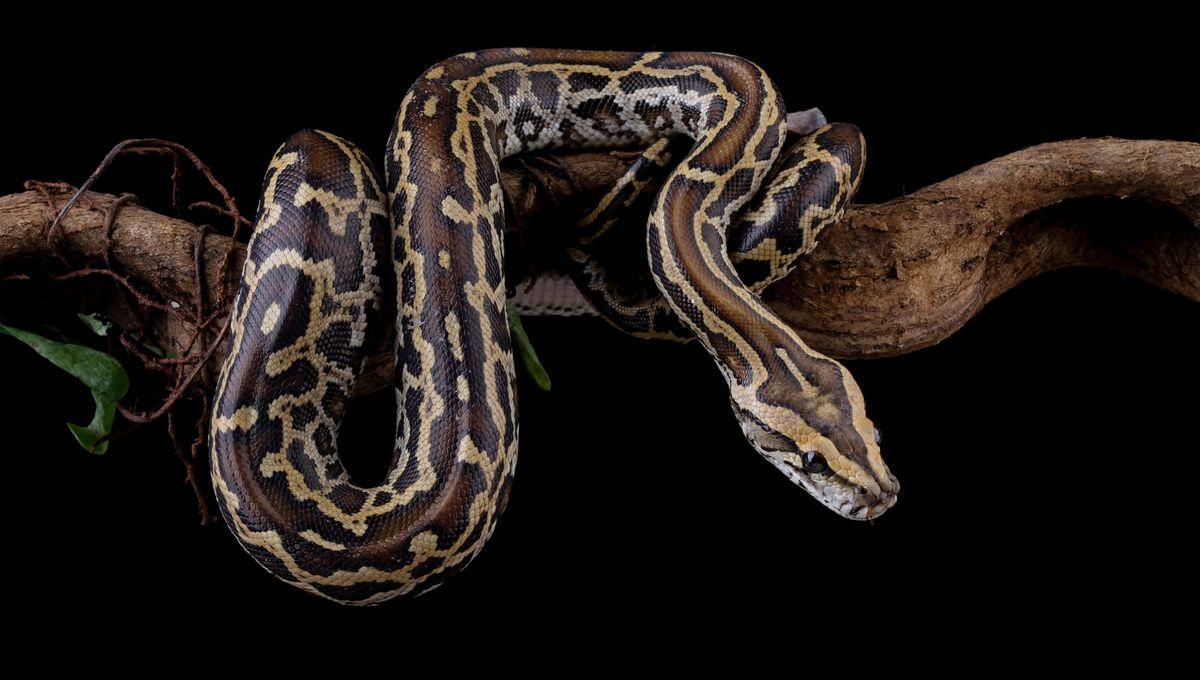
Newly Discovered "Bone-Digesting" Cells Help Burmese Pythons Consume Every Last Bit Of Their Prey
Burmese pythons (Python bivittatus) don’t believe in waste, digesting not only the muscle and fat of their prey, but the bones as well. Where other predators might eat the flesh off the bone, or regurgitate up the parts they can’t digest, these snakes use the whole creature – and now we know how.
The fact that snakes and some other reptiles eat their prey whole is likely obvious to anyone who has seen a nature documentary. Maybe it’s one reason we are so scared of them; it just doesn’t seem natural, at least for a land creature. The absence of excreted bones, such as those owls vomit up, proves that the skeleton must be digested somehow, but the mechanism has been a mystery. Now, a team led by Professor Jehan-Hervé Lignot of the University of Montpellier appears to have found the answer. They studied the intestinal lining cells (enterocytes) of Burmese pythons, the world’s longest snake, and an invasive species taking over the Florida Everglades. They found a type of cell never previously identified that produces spheroidal particles built of layers of calcium and phosphorus that have formed around an iron seed. “Unlike normal absorbing enterocytes, these cells are very narrow, have short microvilli [membrane protrusions], and have an apical [located at the top] fold that forms a crypt,” Lignot said in a statement. The discovery occurred after Lignot and colleagues fed pythons on three diets: whole rodents, “boneless prey” (de-boned rat meat), and the same boneless rats but supplemented with calcium carbonate injections. The pythons on the ordinary diet, and those with supplements produced the particles, which were found stored in the crypts of a minority of their enterocytes. Those given the boneless diet, however, had no such spheroids. Like other snakes, Burmese pythons can go for long periods between meals, and during those times, the cells empty of particles. Since other snakes also consume their prey bones and all, and leave no bony trace in their droppings, an ancient origin for the cells seemed likely. The team subsequently identified the same cells in other python species, and also in their near relatives, boas. They’ve even found them in Gila monsters, lizards whose last common ancestor with snakes is a long way back. Even if this is an adaptation present in all squamates (snakes and lizards), however, it raises the question of what other animals do with all that calcium. “Marine predators that eat bony fish or aquatic mammals must face the same problem,” said Lignot. “Birds that eat mostly bones, such as the bearded vulture, would be fascinating candidates too.” The findings are published in the Journal of Experimental Biology and are being presented at the Society for Experimental Biology Annual Conference.

 English
 Arabic
 French
 Spanish
 Portuguese
 Deutsch
 Turkish
 Dutch
Dutch
 Italiano
 Russian
 Romaian
 Portuguese (Brazil)