


Gold Can Be Made By Scientists In A Lab – There's Just One Problem
Gold Can Be Made In A Lab – There's Just One Problem
Alchemists, you’ll be overjoyed to hear that you can create gold in a lab. All you need is a nuclear reaction, a particle accelerator, or the blast of a supernova.
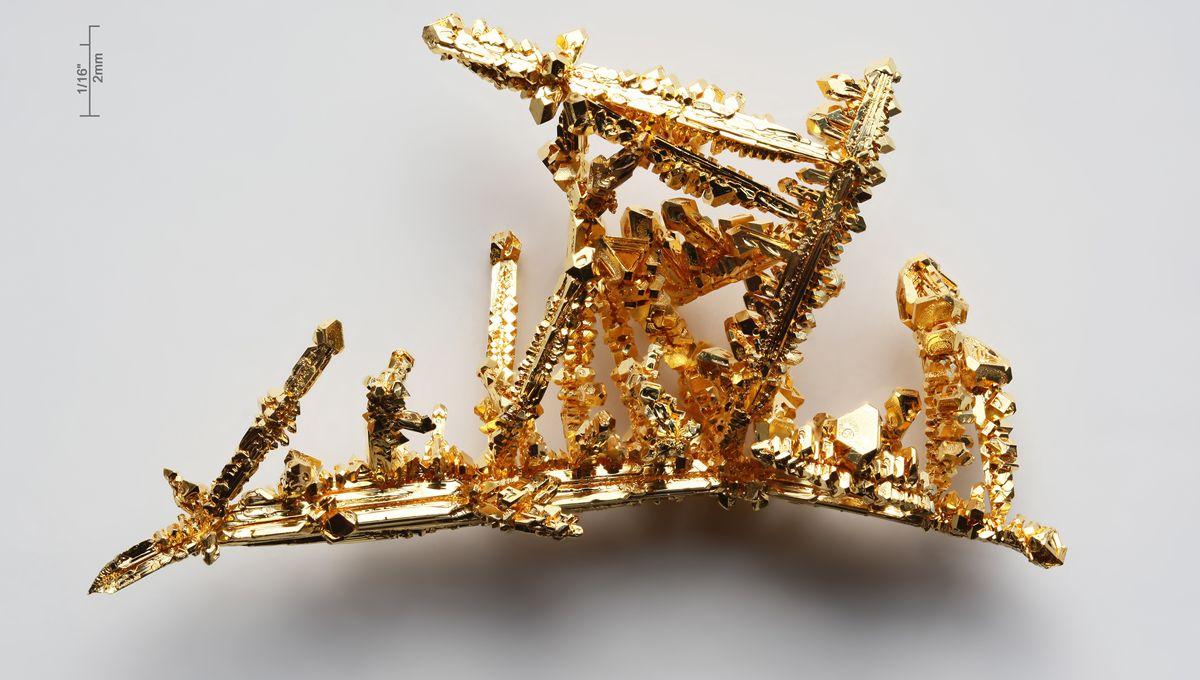
Most of the gold on Earth came from outer space. When massive stars exploded in supernovae or neutron stars collided, they unleashed staggering energy that fused lighter elements into heavy metals like gold. This atomic gold was sprinkled across the cosmos, trapped in the forming Earth, and later emerged at the surface, ready to shine. Thanks to modern technological wizardry, it’s possible to produce a similar effect back in the lab, allowing scientists to make gold out of other elements. However, it requires such colossal quantities of energy that it's highly inefficient and essentially pointless as an enterprise. Each atom of gold has a nucleus in the middle with 79 protons (hence its atomic number, 79). In theory, it’s possible to remove one of these protons to make platinum (atomic number 78) or add one to make mercury (atomic number 80). Unfortunately, this is easier said than done. Gold is almost chemically inert and one of the least reactive chemical elements. Its highly stable atoms will stand strong against most forces that attempt to change it. One way to find its Achilles' heel is by using nuclear reactions, which are processes that change the atomic nuclei by adding or removing protons. As shown by an experiment in 1941, if you blast mercury with neutrons in the right way, it will ping off a proton and create gold. Granted, it's radioactive gold isotopes, but it's still gold. Likewise, a similar effect can be achieved through nuclear reactions of platinum that cause it to gain a proton and create radioactive gold. Another method of making gold involves meddling with atoms in a particle accelerator. At CERN’s Large Hadron Collider, physicists have created gold by smashing lead (atomic number 82) nuclei into each other. Extremely high-energy collisions between lead nuclei result in a quark–gluon plasma, a hot and dense state of matter that is thought to have filled the universe around a millionth of a second after the Big Bang. The colliding nuclei narrowly avoid each other without “touching”, sending out an intense ripple in the electromagnetic field that rips off three protons, creating gold. Just like the nuclear reactions, this process is intensely demanding and will only create a “fleeting” amount of gold, despite the heaps of energy going into it. In short, it would require millions of dollars of energy and equipment to create a few measly dollars of synthetic gold. For some methods, the costs are likely to be even higher. Nobel Prize-winning chemist Glenn Seaborg converted atoms of bismuth (atomic number 83) into gold at the Lawrence Berkeley Laboratory in a famous set of experiments during the 1980s. He did so by bombarding bismuth with carbon nuclei using a particle accelerator, chipping off enough protons that some nuclei were transmuted to gold. Seaborg's experiment proved a point, but it certainly wasn’t a get-rich-quick scheme. Seaborg reportedly commented to the Associated Press: “It would cost more than one quadrillion dollars per ounce to produce gold by this experiment.”

 English
 Arabic
 French
 Portuguese
 Deutsch
 Turkish
 Dutch
Dutch
 Italiano
 Russian
 Romaian
 Portuguese (Brazil)
 Greek
Greek