


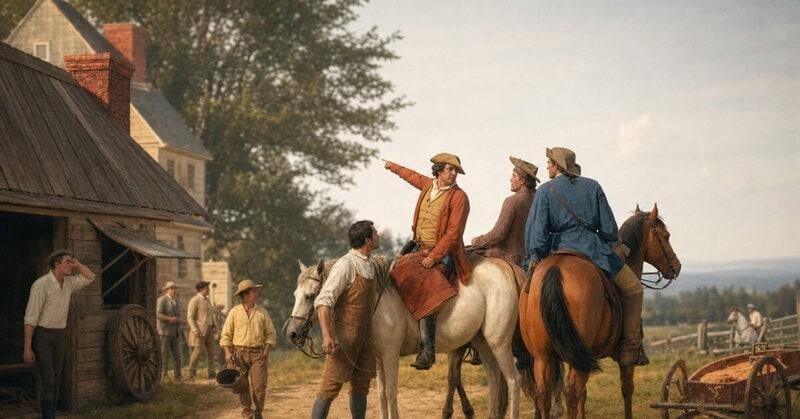
In the autumn of 1775, a British officer stationed in Boston wrote home with breezy confidence: the colonial rebellion, he assured his family, would be finished before the year was out. He wasn’t deluded — he was representative. Almost every informed observer on both sides of the Atlantic believed the Continental forces would collapse under the weight of their own disorganization, their empty war chest, and the simple arithmetic of taking on the most powerful military empire on earth. That officer was catastrophically wrong, of course. But understanding why he was wrong — and why the Revolution nearly proved him right on half a dozen separate occasions — is exactly what two landmark documentary productions are now making possible for mainstream audiences.
Two Documentaries Bringing Revisionist Scholarship to Living Rooms

Two major productions are bringing decades of serious historical scholarship to general audiences in 2025. Ken Burns, Sarah Botstein, and David Schmidt’s PBS miniseries The American Revolution applies the signature Burns documentary architecture — layered archival imagery, first-person readings, expert testimony — to a story that hasn’t received this level of treatment in over a generation. It traces how thirteen fractious colonies united in rebellion, survived a war they almost certainly should have lost, and attempted to build a nation from scratch. On Netflix, The American Experiment extends the story past the battlefield and into the constitutional crises and first presidential terms that determined what the Revolution would actually mean in practice, drawing on a deliberately diverse range of voices and perspectives.
Together, these productions surface facts that academic historians have accepted for decades but that standard K-12 textbooks — shaped by political compromise, regional sensitivities, and brutal word-count limits — still routinely minimize. Getting this history wrong doesn’t merely fail students. It distorts how Americans understand democracy, race, and political legitimacy today. Below are ten historical realities the new documentaries take seriously that most Americans were never taught in school.
The Founders Were Not United — and Most Colonists Weren’t Even Sure They Wanted Independence

The phrase “the Founding Fathers decided” is one of the most misleading constructions in American civic life. Historians have long estimated that roughly one-third of colonists were committed Patriots, one-third were Loyalists, and one-third were largely uncommitted, waiting to see which way events moved. The Revolution was a civil war as much as a war of liberation — neighbors informing on neighbors, families split along ideological lines, Loyalist militias fighting Patriot ones in the Carolina backcountry with a ferocity that made British regulars almost secondary to the conflict. The Ken Burns miniseries foregrounds this internal fracture in its early episodes rather than papering over it with the warm glow of retrospective unity.
The Founders themselves were no band of brothers. John Adams and Benjamin Franklin clashed repeatedly over diplomatic strategy in Paris. Thomas Jefferson and Alexander Hamilton were ideological adversaries whose rivalry helped produce the republic’s first political parties. The American Experiment on Netflix deliberately showcases these fractures rather than smoothing them into a patriotic highlight reel. Worth noting too: Jefferson’s original draft of the Declaration of Independence included a passage condemning the slave trade that was removed under pressure from Southern delegates — a deletion with consequences that haunted the republic for nearly another century.
Enslaved People Were Active Agents — and Britain Offered Them Freedom First

In November 1775, Virginia’s royal governor Lord Dunmore issued a proclamation promising freedom to enslaved people who escaped Patriot masters and joined British forces. This document — largely absent from standard textbook narratives — immediately complicated the Patriots’ moral position in ways they never fully resolved. Thousands of enslaved people made the dangerous decision to flee toward British lines, becoming a significant military and moral force that the Revolution was forced to reckon with throughout the war.
The uncomfortable historical reality is that for many enslaved Americans, a British victory would have represented a more immediate path to liberty than a Patriot one. The men writing “all men are created equal” were simultaneously suppressing the largest freedom movement on the continent. The American Experiment’s commitment to including a diverse range of voices allows this storyline to receive sustained attention rather than being compressed into a footnote. The Ken Burns production, by covering the full arc from rebellion through the founding of the republic, holds the founding ideals and the founding betrayals within the same frame — an uncomfortable but essential act of historical honesty.
Heroism Didn’t Win the War — Finance, Diplomacy, and French Military Power Did

Valley Forge has become the canonical image of Continental Army suffering: Washington’s ragged soldiers, frozen feet, iron resolve. What popular culture has largely forgotten is that a second, severe crisis hit in the winter of 1779 to 1780, when the army came within weeks of complete dissolution due to collapsed supply lines and worthless Continental currency. Mutinies broke out — not once, but repeatedly. The revolution that textbooks present as an upward arc of sacrifice and triumph was, on the ground, a lurching near-disaster held together by improvisation and contingency as much as courage.
France didn’t merely assist the American cause — France was decisive. The Siege of Yorktown in 1781, the engagement that effectively ended the war, was won in significant part by a French naval blockade that cut off Cornwallis’s avenue of retreat, with French forces playing a major role on the ground as well. Meanwhile, financier Robert Morris essentially constructed American public credit from scratch, putting his personal resources behind loans that kept Washington’s army solvent long enough to march south to Virginia. The Ken Burns miniseries, with the room that a multi-episode format allows, gives these slow-burn structural stories the attention that action-focused textbook chapters habitually deny them.
Indigenous Nations Were Strategic Players — and the Revolution Devastated Them

The Iroquois Confederacy, or Haudenosaunee, was one of the most sophisticated and durable political alliances in North American history — and the Revolution tore it apart. Different Haudenosaunee nations backed different sides, setting community against community in a fracture that proved irreparable. This was not passivity; it reflected active strategic choices made under impossible conditions, mirroring the miscalculations of every other faction in the war.
What most Americans were never taught is what happened next. In 1779, George Washington ordered the Sullivan-Clinton Campaign: a systematic military operation aimed at destroying Iroquois villages, orchards, and food stores across what is now upstate New York. The Haudenosaunee remembered. They gave Washington a name in their oral tradition — sometimes translated as “town destroyer” — that persisted for generations. This is the revolutionary war history that rarely survives into textbooks, and it is central to understanding what the Revolution’s victory actually meant for the continent’s original inhabitants. The American Experiment’s inclusive approach to sourcing and storytelling is what allows this narrative to receive feature-length attention rather than vanishing between paragraphs about more conventionally celebrated events.
The Constitution Almost Didn’t Happen — and 1783 Was Not the Finish Line

One of the most startling facts about the founding era involves what came immediately after the war ended. The Articles of Confederation, the country’s first governing framework, proved so dysfunctional that by the mid-1780s the national government could barely function. When Shays’ Rebellion — an uprising of debt-burdened Massachusetts farmers — erupted in 1786, the national government lacked the authority, the funds, or the troops to respond effectively. It was this crisis, more than any principled vision of stronger governance, that alarmed enough prominent figures into convening the Constitutional Convention in Philadelphia in 1787.
What emerged from that convention was not a document of noble consensus. The three-fifths compromise, the structure of the Electoral College, and the principle of equal Senate representation regardless of population were last-resort bargains hammered out with delegates repeatedly threatening to abandon the proceedings entirely. The Constitution that Americans treat as a sacred founding text was, in its moment, a contested improvisation designed above all to prevent the convention from collapsing in failure. The American Experiment covers the Revolution through the drafting of the Constitution and the first American presidency for exactly this reason — because the filmmakers understand that 1783 was not the finish line. The Revolution was an ongoing argument about what self-governance actually meant, and that argument has never fully concluded.
Why These Two Documentaries Matter Right Now
The arrival of two serious, well-resourced documentary productions about the founding era in the same year is not a coincidence. It reflects something real happening in American culture: a mainstream audience increasingly ready for the complicated version of the founding story, and platforms with the reach to deliver rigorous historical scholarship to large audiences. The Ken Burns, Sarah Botstein, and David Schmidt miniseries on PBS and Netflix’s The American Experiment are valuable not simply because they are more cinematic than textbooks — though they are — but because they restore three qualities that formal education has systematically drained from revolutionary war history: contingency, diversity, and moral complexity.
The Revolution was not inevitable. It was not clean. It was not experienced the same way by a New England merchant, a Haudenosaunee diplomat, an enslaved woman in Virginia, or a Loyalist farmer in the Carolinas. It produced a republic that its own architects doubted would survive a generation. The next time someone confidently invokes the unified wisdom of the Founding Fathers, or describes the Revolution as an unambiguous triumph for human liberty, these ten realities — drawn from the same body of scholarship these filmmakers consulted — are ready to tell the fuller, stranger, more human story of how a ragged rebellion against the world’s most powerful empire somehow, against all reasonable expectation, managed not to fail.

 English
 Arabic
 French
 Spanish
 Portuguese
 Deutsch
 Turkish
 Italiano
 Russian
 Romaian
 Portuguese (Brazil)
 Greek
Greek