




Rick Kern/Getty Images
When it comes to European travel advice, Rick Steves sets the gold standard. While he's particularly known for his excellent tips about traveling on a budget while still experiencing authenticity, there are instances when the longtime travel expert opts for top-quality over low-cost. For example, when Steves goes to Spain, he doesn't opt for Serrano ham, which is famous in the Mediterranean country; instead, he spends extra euros on jamón Ibérico.
While speaking at a travel festival in early 2026, Steves explained, "In Europe, it's really important to focus on good ingredients. Europeans love top quality ingredients. If I'm going to Spain and I want a plate of ham, I'll pay $5 for jamón Serrano, it's just the mediocre ham; whereas if you pay $12, you get a plate of jamón Ibérico. Now, that's a huge difference. Life's too short to eat mediocre ham when you're in Spain," on YouTube.
Ham production has been an important aspect of Spanish culture for thousands of years. The Roman Empire first introduced the country to pigs, with people quickly learning to expertly cure the meat. Jamón Serrano and jamón Ibérico are made similarly, however Ibérico hams are aged for up to three years, while Serrano hams age for about a year and a half.
Iberico ham versus Serrano ham
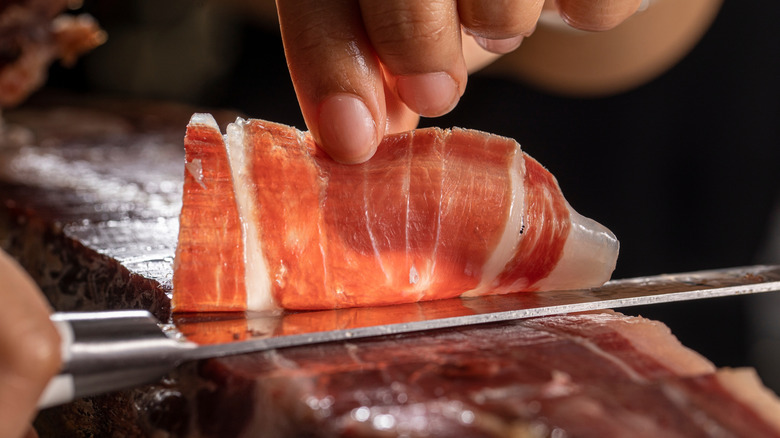
Studio Nut/Shutterstock
As Rick Steves explained, Ibérico ham is more than double the price of Serrano ham, which suggests there's a substantial difference between the two. Jamón Serrano means "mountain ham," and refers to the common type of ham in Spain that's generally made from the legs and shoulders of a white breed of pig called Landrace, or a breed that's a mix of Large White, Duroc, and Landrace. The last two breeds are also used to make Italian prosciutto, but the overlooked difference between the two hams is that prosciutto-bred pigs are fed more corn and Parmigiano-Reggiano cheese whey. Serrano ham is cured with sea salt, hung up to be air dried, and aged in warm, dry conditions. It's then finished in a cool temperature before it's ready to be eaten or sold. Serrano ham is not a bad ham, in fact, it's a common, widely enjoyed ingredient in many Spanish households and eateries.
There are several reasons why Ibérico ham is so expensive, including the fact that the pigs used to make it are an entirely different and rarer breed than those used to make Serrano ham. Iberian pig breeds, including one called "pata negra" meaning "black feet," are raised in a free-range style in oak forests in southwest Spain. Overall, raising these types of pigs is an expensive venture.
They forage for grass, roots, seeds, and acorns, giving the meat a mild and prized sweetness. Acorns also impart a marbled fat into the meat, lending it a tender texture. Incidentally, acorns are incredibly nutritious for humans, which is why you should start eating them, although they must be properly prepared. The most expensive type of Ibérico ham is called Iberico de Bellota. Its generous fat content makes the ham practically melt in your mouth, and is celebrated by foodies worldwide.

 Arabic
 French
 Spanish
 Portuguese
 Deutsch
 Turkish
 Dutch
Dutch
 Italiano
 Russian
 Romaian
 Portuguese (Brazil)
 Greek
Greek