


On a moonlit night along the Nile, somewhere around 2500 BCE, a lean animal with black-tipped ears picks its way between the limestone edges of a necropolis. It moves without hurry, nose skimming the pale desert sand, entirely at ease in a place that would send most living creatures bolting in the other direction. The ancient Egyptians watched this animal for centuries — and then they made it a god.
The Dog at the Edge of the Cemetery

The creature haunting those ancient burial grounds was not a wolf, and it was not quite a domestic dog. It was a golden jackal — Canis aureus — slender-muzzled, short-tailed, built by evolution for versatility rather than spectacle. Night after night, it worked the boundary between the world of the living and the world of the buried dead. It was, in the most literal ecological sense, a creature of the threshold.
That is the central irony, and the central brilliance, of one of history’s most enduring religious decisions. When ancient Egyptians reached for an image to represent death, judgment, and the care of souls, they chose the animal they had been watching do exactly that work for generations. Long before modern ecology had a Latin binomial for the species, long before any naturalist had written a field note, Egyptian observers had catalogued the jackal’s habits with enough precision to encode them into theology.
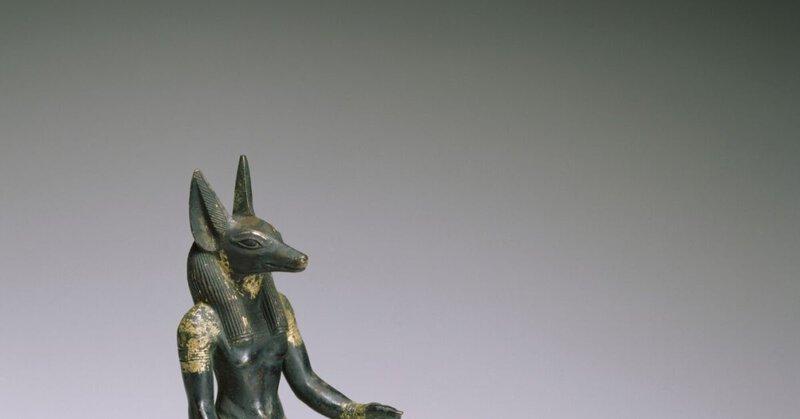
The god they created was Anubis — jackal-headed, vigilant, often shown crouching atop a shrine with the stillness of something that has seen everything and fears nothing. He was the god of embalming and mummification, the escort of souls through the Duat (the Egyptian underworld), and the divine figure who steadied the scales during the Weighing of the Heart ceremony, in which a dead person’s heart was measured against the feather of Ma’at — the principle of truth and cosmic order. The question his myth raises is deceptively simple: why a jackal? The answer turns out to be more scientifically grounded than most people expect.
What a Jackal Actually Is

To understand what the Egyptians saw, it helps to understand what a jackal actually is — which requires setting aside roughly two thousand years of accumulated bad reputation. Jackals are members of the genus Canis and the family Canidae, the same taxonomic family that includes wolves and domestic dogs. They are not some lesser, skulking offshoot of the canine line, but legitimate members of one of nature’s most successful predator groups, sharing a closer evolutionary relationship with wolves and coyotes than is often appreciated.
There are three recognized jackal species: the golden jackal (Canis aureus), found across North Africa, southeastern Europe, and South Asia; the black-backed jackal (Canis mesomelas), native to eastern and southern Africa; and the side-striped jackal (Canis adustus), also found in sub-Saharan Africa. A fourth canid, the Ethiopian wolf, was once grouped with jackals but is now classified separately. It is the golden jackal — the species present in ancient Egypt — that concerns us here.
The golden jackal is a medium-sized animal, physically slimmer than a wolf, with a narrow muzzle built for probing into crevices and a short, bushy tail. Its build reflects its strategy: this is not a creature designed for the brute-force ambush of large prey, but for something more sophisticated — opportunistic omnivory at its most refined. Jackals cooperatively hunt small antelopes and ground-dwelling birds, working in coordinated pairs with a tactical intelligence that consistently surprises researchers. They also consume reptiles, insects, wild fruits, and carrion — dietary flexibility that makes them among the most ecologically resilient canids on the planet.
That flexibility is central to understanding their ecological role. Jackals occupy a niche as both predator and scavenger, which places them at a crucial intersection in arid and semi-arid ecosystems. Remove them and the effects ripple outward through the food web in ways science is still documenting. That scavenging behavior, though, is precisely what generated their cultural reputation for cowardice and uncleanness across many societies — a reputation the Egyptians, notably, did not share.
The Necropolis Shift: What Egyptians Actually Observed

Egyptian cemeteries were not tucked away in remote wilderness. They occupied the desert edge — the boundary between the black, fertile floodplain of the Nile and the pale, lifeless sands beyond. This geography was deliberate: the dead were placed at the margin of the living world, in ground too dry and too poor for agriculture. And that margin, night after night, belonged to the jackals.
The animals were drawn to these sites for reasons that have nothing to do with the supernatural and everything to do with ecology. Desert-edge cemeteries offered foraging opportunities in ground that was regularly disturbed, in a zone where human activity left persistent organic traces. The jackals were not intruding on sacred space. They were doing what Canis aureus has always done: working the edge between habitation and wilderness, between life and its aftermath.
Egyptian religion was, at its core, deeply naturalistic in its imagery. Animal-headed gods almost universally reflected genuine behavioral or ecological observations about the species chosen. Thoth, the god of wisdom and writing, wore the head of an ibis — a bird Egyptians observed standing in motionless contemplation at the water’s edge. Sobek, the crocodile god, embodied the Nile’s simultaneous capacity for destruction and renewal. These were not arbitrary choices. They represented a civilization thinking carefully about the natural world and encoding what it found into myth.
Against that backdrop, Anubis reads less like a theological invention and more like a sustained field observation. A creature that moved through burial grounds every night, crossing the threshold between the world of the living and the domain of the dead — that creature was the obvious candidate for guardian of that border. Anubis may represent one of history’s earliest examples of a deity built on careful ecological attention rather than abstract imagination.
Anubis: The Making of a God

Anubis is among Egypt’s oldest deities, appearing in funerary texts and tomb art from the Old Kingdom period, roughly 2686 to 2181 BCE — predating, by some scholarly accounts, even Osiris as the primary god of the dead. His antiquity is significant: this was not a late mythological flourish but a foundational figure, present at the very beginning of Egypt’s recorded religious imagination.
His iconography is precise and consistent across thousands of years of Egyptian art. He appears as a sleek black jackal, or as a man with a jackal’s head, typically crouching atop a shrine in an attitude of watchful readiness. The black coat deserves attention. Most golden jackals are not black — their coats run toward tawny gold and gray. The Egyptians chose black deliberately, loading the color with layered symbolic meaning: black evoked the dark alluvial soil of the Nile floodplain, source of all fertility and life, and also the darkened skin of mummified bodies. In Egyptian symbolic thought, the color of death and the color of renewal were the same color — a compression of meaning that the jackal’s form made possible.
His functions mapped closely onto what a careful observer would expect from the jackal’s actual behavior. He presided over embalming because the real jackal was already associated with the handling of the dead. He escorted souls through the underworld because the real jackal moved between the worlds of the living and the dead nightly. And he weighed hearts on the scales of divine judgment — a role requiring precision and impartiality — because the Egyptians intuited in the jackal’s coordinated, strategic social behavior something fitting for a function that demanded exactitude rather than passion.
Anubis worship persisted across roughly three millennia of Egyptian civilization, and his imagery filtered into Greek and Roman funerary traditions as those cultures absorbed Egyptian religious influence. He became one of antiquity’s most enduring figures of death — a jackal-headed god who traveled further through time than most of the empires that encountered him.
Where Ancient Myth and Modern Ecology Converge

Modern wildlife science, without intending to, has spent decades confirming what Egyptian observers worked out through centuries of watching. Jackals play a significant role in scavenging and decomposition cycles, functioning as ecological regulators in arid and semi-arid landscapes of precisely the kind where Egyptians built their necropolises. They are not peripheral figures in desert ecosystems but structurally important ones, whose presence shapes the distribution and behavior of other species.
The cooperative hunting detail is particularly striking when held against Anubis’s role as weigher of fates. A god of precise judgment, who steadies scales and measures the worth of a soul — and the real jackal is not a lone opportunist but a socially intelligent animal capable of coordinated strategy, long-term pair bonding, and cooperative pup-rearing in which older offspring from previous litters sometimes assist their parents. The Egyptians appear to have encoded the jackal’s actual social sophistication into their death god’s most defining ritual act.
Even the black coat carries an unexpected ecological resonance. Most jackals are not black, but they are primarily nocturnal. A golden jackal moving through pale desert sand under moonlight, seen at a distance by human eyes adjusted to firelight, would appear considerably darker than it does in daylight photographs. The Egyptians may have been painting what they actually saw at night — not a stylized theological symbol, but a visual field observation translated into iconography.
The larger point is this: the Egyptians got the animal right not through accident, and not through mystical revelation, but through something more methodical — millennia of close, attentive observation of the natural world, conducted before science and theology had been sorted into separate disciplines. They watched the jackal. They understood the jackal. And then they made it into a god that matched what they understood.
The Jackal’s Reputation Problem — Then and Now

The same animal that Egypt elevated to divine status was dismissed as cowardly and ritually unclean in neighboring and later cultures. That gap in reputation is revealing — and it says considerably more about human relationships with death than it does about jackals.
In cultures that treated corpses and burial grounds as sources of pollution, the jackal’s comfort in those spaces read as depravity. Its scavenging behavior, filtered through that lens, became evidence of moral failure rather than ecological function. The same behavioral traits that made the animal sacred in one cultural context made it shameful in another. The jackal didn’t change. The mythology surrounding it did.
Egypt’s relationship with death was different in kind, not merely in degree. Death was not an ending to be avoided in thought and ritual but a passage to be navigated with care — embalmed, prayed over, escorted, judged, and ultimately survived in another form. In that framework, an animal comfortable in the presence of death was not unclean. It was authoritative. It inhabited a territory the living could not, and it moved through that territory with apparent ease. That ease, for the Egyptians, was not a moral deficiency. It was a qualification.
Contemporary wildlife science has been quietly conducting its own rehabilitation of the species. The golden jackal’s range is expanding across parts of central and northern Europe — an ecologist’s benchmark for a resilient, adaptable species successfully exploiting changing conditions. Populations have been documented in countries including Poland, the Netherlands, and Denmark, in some cases establishing themselves without human assistance. The scientific portrait that is emerging looks considerably closer to the Egyptian understanding than to the medieval slur that displaced it.
What a Jackal Knows That We Forgot
Return, for a moment, to that moonlit necropolis on the Nile’s edge. The lean figure moving between the tombs, unhurried and unbothered, nose working the pale sand. See it now not as a scavenger sneaking through someone else’s sacred space, but as the original custodian — the creature that was working that boundary long before the first stone was cut, and that would be working it long after the last priest had gone home.
What the Egyptians built around that image was not superstition dressed in animal form. It was ecological observation translated into the only language available to them — mythology, iconography, ritual. They noticed which animal lived at the edge of the human world and the world beyond it. They watched how it moved, how it worked, how it seemed entirely unburdened by the weight of what surrounded it. And they concluded, reasonably, that such a creature must understand something about death that the living do not.
In an era that treats science and mythology as natural opposites — one the province of evidence, the other of imagination — ancient Egypt offers a different model: a culture that watched the natural world carefully enough that its gods made biological sense. A theology cross-referenced, animal by animal and behavior by behavior, against the Nile ecosystem.
The jackal is still out there, slender-muzzled and unhurried, working the edge between worlds — as it always has, and as the Egyptians, watching from the firelight, always knew.

 English
 Arabic
 French
 Portuguese
 Deutsch
 Turkish
 Dutch
Dutch
 Italiano
 Russian
 Romaian
 Portuguese (Brazil)
 Greek
Greek