


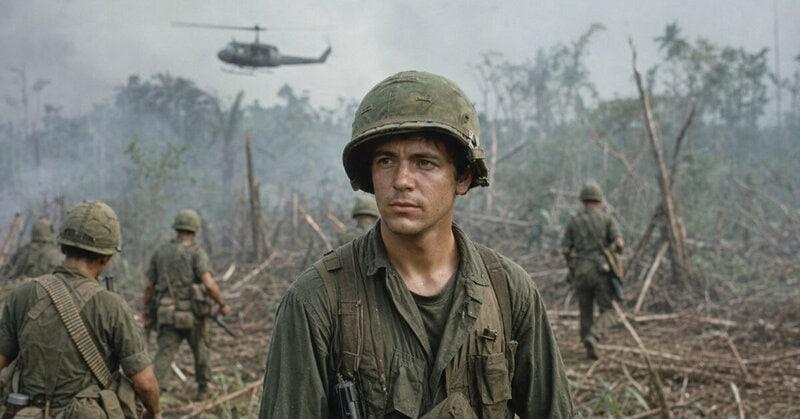
Fifty years after the last American helicopters lifted off from Saigon, the shelves groaning with Vietnam War books can feel impossible to navigate — too many memoirs, too much myth, too little honest reckoning. These nine titles, drawn from Five Books’ Vietnam War recommendations by Karl Marlantes, the Vietnam Veterans Memorial Fund’s 40-book essential reading list, and other trusted sources, are the ones historians and veterans actually stand behind — books that get the war right, from the jungle floor to the halls of Hanoi.
1. A Rumor of War by Philip Caputo (1977) — The Memoir That Set the Standard for Honest Reckoning
In March 1965, Philip Caputo landed in Vietnam as a Marine lieutenant with one of the first U.S. combat units to enter the country. He arrived believing in the mission. By the time he left, he had been charged with murder after ordering a killing he would spend the rest of his life questioning. That arc — from idealism to culpability — is the spine of his 1977 memoir, published before American culture had found a comfortable language for self-examination about the war.
What makes historians return to it is Caputo’s refusal to excuse himself. He does not present the war’s atrocities as the work of monsters; he shows how ordinary institutional pressure, fear, and exhaustion can corrupt ordinary men. Marlantes, in his Five Books interview, ranks it first on his Vietnam War list precisely for that unflinching quality — rare in 1977 and still rare now. A Rumor of War functions less as memoir than as moral case study, and it remains the essential starting point for any serious Vietnam War reading list.
2. A Bright Shining Lie by Neil Sheehan (1988) — The One Book That Explains How America Lost
Neil Sheehan spent sixteen years on this book, and it shows. His biography of Lieutenant Colonel John Paul Vann — a man who identified catastrophic failures in U.S. strategy as early as the Battle of Ap Bac in January 1963 and tried desperately to warn Washington — is also a full autopsy of American self-delusion. Drawing on classified documents, Pentagon records, and hundreds of interviews, Sheehan reconstructs how Vann’s warnings were dismissed, buried, and eventually forgotten, and how the war’s architects convinced themselves, year after year, that the next escalation would be the one that worked.
The book won both the Pulitzer Prize and the National Book Award in 1988 and appears on the Vietnam Veterans Memorial Fund’s essential reading list. Historians prize it because Vann’s career functions as a diagnostic instrument: every moment where the system failed to absorb the truth is documented, sourced, and placed in institutional context. If you want to understand not just what happened but why American institutions were structurally incapable of learning from the war, this is the book.
3. The Sorrow of War by Bao Ninh (1990, translated 1993) — The North Vietnamese Soldier’s Voice the West Almost Never Heard

Of the five hundred young men in the Glorious 27th Youth Brigade, Bao Ninh was among the handful who survived the war. His novel, published in Vietnam in 1990 and translated into English in 1993, follows a North Vietnamese soldier through fragmented, non-linear memories of combat in the Central Highlands — the same jungles where American units fought, but seen from entirely the other side of the tree line. It is the only major literary account from the North Vietnamese front lines to reach a global audience, and its existence alone is a corrective to decades of American-centric storytelling.
Featured on Five Books’ Vietnam War list, The Sorrow of War is not a political book — it is a grief book. Bao Ninh’s soldiers call it “the American War,” and they suffer from the same survivor’s guilt, moral injury, and psychological fracture that American veterans describe in their own accounts. Historians recommend it not as an exotic counterpoint but as a necessary reminder that the war’s human cost was not a uniquely American experience.
4. Matterhorn by Karl Marlantes (2010) — The Novel That Took 35 Years to Get Right
Karl Marlantes began drafting Matterhorn while the war was still being fought. A decorated Marine officer and Rhodes Scholar, he knew immediately that what he had witnessed — a Marine rifle company in 1969, hacking through jungle near the Demilitarized Zone, fighting the North Vietnamese Army and their own military’s bureaucratic dysfunction with equal desperation — deserved the full weight of literary form. It took him thirty-five years of revision to achieve it. When the novel was finally published in 2010, military historians noted with some surprise that its tactical and logistical detail was unusually accurate for fiction.
What gives Matterhorn its particular historical sting is its portrait of a specific strategic absurdity: Marines fighting and dying for hilltops that were immediately abandoned once taken. This was not invented for dramatic effect — after-action reports of the period document exactly this pattern, the one that eroded unit morale and public trust simultaneously. Listed among the essential Vietnam War novels and featured on Five Books’ Vietnam War selections, it stands as the most rigorously researched work of fiction the war has produced.
5. Dispatches by Michael Herr (1977) — The Book That Invented a New Language for War Reporting
By the time Michael Herr arrived in Vietnam as an Esquire correspondent, the official language of the war — body counts, pacification metrics, light at the end of the tunnel — had become almost entirely detached from conditions on the ground. His 1977 account covering the years 1967 and 1968, including the Tet Offensive and the siege of Khe Sanh, broke from conventional journalism entirely. The prose is fractured and hallucinatory because the soldiers’ experience was fractured and hallucinatory; Herr understood that a calm, orderly sentence was itself a kind of lie about what the war felt like.
The book’s influence traveled far beyond literature: Herr went on to co-write the narration for Apocalypse Now and the screenplay for Full Metal Jacket, meaning his particular vision of the war shaped the imagination of an entire generation. Historians value Dispatches for a more documentary reason — Herr embedded with enlisted men, not generals, and his granular detail about the psychological state of American troops in 1967-68 corroborates oral histories in the Library of Congress Veterans History Project. Recommended consistently in veteran and reader communities, it remains the essential account of what the war felt like from inside the wire.
6. The Things They Carried by Tim O’Brien (1990) — Fiction That Tells More Truth Than Most Nonfiction

Tim O’Brien served with the 23rd Infantry Division in Quảng Ngãi Province in 1969 and 1970, and he has spent his literary career wrestling with a question that straight history cannot fully answer: what is the relationship between what happened and what it meant? His 1990 linked story collection blurs those lines deliberately and openly — O’Brien tells the reader when he is inventing, then asks whether the invented version might be truer than the factual one. It is a formal move that historians and veterans alike have recognized as the most psychologically honest account of a combat soldier’s inner life that the war has produced.
The book appears on the Vietnam Veterans Memorial Fund’s official reading list alongside straight history and documentary memoir — an unusual honor for a work of fiction. Where Neil Sheehan explains the strategic failure from the top down, O’Brien explains what that failure felt like from the ground up: the weight of the dead, the guilt of survival, the impossibility of leaving the war behind. It is the one title that almost every historian and veteran agrees belongs on the shelf.
7. Embers of War by Frederick Logevall (2012) — The Pulitzer-Winning History of How the War Was Born

Most Vietnam War histories begin in 1964, with the Gulf of Tonkin incident, or in 1965, with the Marines landing at Da Nang. Frederick Logevall begins in 1919, and the difference is everything. His Pulitzer Prize-winning 2012 history covers the decades of French colonialism, the First Indochina War, and the critical decisions made in Washington and Paris that made American escalation feel, by the time it arrived, nearly inevitable. Drawing on archives in France, the United States, and Vietnam, Logevall reconstructs the full backstory that American-centric accounts routinely skip — and without it, the war makes far less sense.
Featured on Literary Hub’s Vietnam War 50th anniversary reading list, the book’s central argument — that multiple American presidents had genuine opportunities to avoid deep involvement and chose, for reasons of domestic politics and Cold War ideology, not to take them — is grounded in declassified NSC and State Department records. That evidentiary foundation distinguishes it from revisionist polemic. For readers who want to understand why the war happened before asking what happened during it, Embers of War is indispensable.
8. Hanoi’s War by Lien-Hang T. Nguyen (2012) — The Archival History That Changes Everything You Thought You Knew

For decades, North Vietnam appeared in American-authored histories as a monolithic, implacable enemy — disciplined, unified, and strategically opaque. Lien-Hang T. Nguyen’s 2012 history, drawing on Vietnamese Communist Party archives that were briefly accessible to outside researchers in the 1990s and 2000s, dismantles that image entirely. What she found was a Hanoi riven by factional power struggles, internal disagreements about strategy, and leaders who made significant miscalculations of their own. The decision to launch the 1968 Tet Offensive, she demonstrates, was as much a product of internal Hanoi politics as of any battlefield calculation about defeating American forces.
Also featured on Literary Hub’s Vietnam War 50th anniversary reading list, Hanoi’s War is considered a landmark by historians because it treats North Vietnam as a full historical actor — one with its own debates, factions, ambitions, and errors — rather than as a background force against which American decisions play out. For anyone who has read widely in Vietnam War history and still feels that one half of the story is missing, this is the book that fills the gap.
9. The Sympathizer by Viet Thanh Nguyen (2015) — The Pulitzer Winner That Indicts Every Side at Once

The narrator of Viet Thanh Nguyen’s 2015 Pulitzer Prize-winning novel is a communist spy embedded in the South Vietnamese military who flees to America after the fall of Saigon on April 30, 1975. It is a structural choice of devastating efficiency: because he belongs fully to no side, he can scrutinize every side. American imperialism, South Vietnamese corruption, and North Vietnamese dogma all come under the same cold, clear-eyed gaze, and none emerge flattered. The novel fictionalizes episodes drawn from the documented history of South Vietnamese refugees and engages with the CIA’s Phoenix Program with a precision that scholars of the period have noted.
Nguyen, born in Vietnam and raised in the United States, has written and spoken at length about the book as a corrective to a specific problem in the literature: the American tendency to treat Vietnam as a backdrop for stories about American identity, guilt, and redemption, with the Vietnamese themselves reduced to atmosphere. The Sympathizer dramatizes that problem directly — and refuses it on every page. Listed among the most recommended Vietnam War novels on multiple reading lists and highlighted by The Economist’s guide to understanding the Vietnam War, it is the book that asks the question no other entry on this list quite manages: whose war story is this, and who gets to tell it?
Taken together, these nine books — memoir, history, and fiction in roughly equal measure — form what historians would recognize as a rigorous and genuinely complete Vietnam War reading list: works that, read in combination, show the war whole, from every side of the wire and in every register of truth.

 English
 Arabic
 French
 Portuguese
 Deutsch
 Turkish
 Dutch
Dutch
 Italiano
 Russian
 Romaian
 Portuguese (Brazil)
 Greek
Greek