


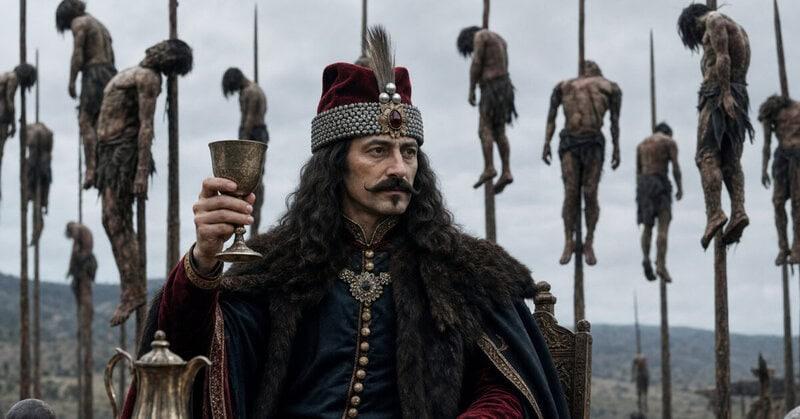
In the winter of 1462, a woodcut image began circulating through the print shops of German-speaking Europe: a nobleman seated calmly at a banquet table, cup raised, while all around him human bodies writhed on wooden stakes. The man in the picture looked serene. That was the point. The image was not reporting history — it was making a monster.
The Scene His Enemies Wanted You to See
The pamphlets spread fast, carried by merchants along the Rhine and the Danube, passed between courts and clergy, read aloud in taverns. They described a Wallachian prince who dined among the dying, who boiled men alive, who forced mothers to consume their own children. The stories grew more baroque with every retelling, as stories tend to when no one can contradict them. And few in Western Europe could contradict them, because few had ever set foot in Wallachia — a small, embattled principality wedged between the Ottoman Empire to the south and the Kingdom of Hungary to the north, a place most Western Europeans could barely locate on a map.
The man at the centre of those pamphlets was Vlad III, Prince of Wallachia, born around 1431 and dead by late 1476. His reign was so violent and so contested that six centuries later historians are still arguing about what he actually did. In the German-speaking west he was a sadist. Across Romania and the Orthodox Christian lands he was something closer to a saviour. How a single fifteenth-century warlord became both history’s most infamous torturer and a beloved national hero is a story about politics, printing presses, and the oldest lesson in statecraft: the people who control the narrative control the legacy.
Born Into a World That Did Not Reward the Gentle

Vlad was born into a family already shaped by violence and precarious power. His father, Vlad Dracul, took his surname from the Order of the Dragon — a chivalric brotherhood dedicated to defending Christendom against the Ottomans — though dracul in Romanian carries an ever-present secondary meaning: devil. Vlad Dracul seized the Wallachian throne in 1436, and the principality he ruled was less a stable kingdom than a pressure point, perpetually squeezed between two enormous powers. Allegiances shifted there not from cowardice but from necessity. A ruler who picked the wrong side did not lose an election. He lost his head.
Around 1442, Vlad Dracul made one of the most painful calculations a father could make: he sent two of his sons to the Ottoman court as political hostages. Vlad, then perhaps eleven or twelve, and his younger brother Radu spent years inside the empire of Sultan Murad II, learning Turkish, absorbing Ottoman military strategy, and watching at close range how an imperial superpower sustained its dominance. It was a common enough diplomatic practice of the age — a guarantee of a vassal ruler’s good behaviour — but for Vlad it was also a psychological crucible. He returned to Wallachia understanding the Ottomans from the inside: their tactics, their command structures, their pressure points. His enemies would later use this period as evidence of contamination or depravity. The more honest interpretation is that it made him a formidably informed adversary.
Three Reigns, Three Near-Deaths

Vlad ruled Wallachia three separate times: briefly in 1448, then through his defining second reign from 1456 to 1462, and finally for a matter of weeks in 1476, at the very end of his life. Each reign was bookended by exile, imprisonment, or violent displacement. His father and his older brother Mircea had both been murdered — his father by political rivals, Mircea buried alive by the boyars of Târgoviște. The boyars were the powerful landholding nobility whose shifting loyalties made stable governance in Wallachia essentially impossible, and Vlad had watched them destroy his family.
During his second reign, he moved against them with a ferocity that was calculated as much as it was personal. He executed those he considered disloyal, dismantled the patronage networks that had kept Wallachia in a state of perpetual noble infighting, and imposed a severe order on a principality accustomed to chaos. Impalement — a slow, agonising method of public execution in which a sharpened stake was driven through the body — became his signature deterrent, visible and theatrical in exactly the way a ruler with limited resources and a principality full of potential enemies needed his punishments to be. It was brutal by any measure. It was also, in the context of fifteenth-century statecraft, not entirely without precedent: impalement was a known punishment across the medieval world and the Ottoman sphere alike. What distinguished Vlad was the reported scale, and the powerful enemies who then ensured that all of Europe heard about it.
The Night Raid and the Forest of the Dead

His 1462 campaign against the Ottomans produced the moment that defined his military reputation. In a daring night cavalry raid, Vlad struck directly at the camp of Sultan Mehmed II — the conqueror of Constantinople — attempting to reach and kill the Sultan himself. The raid failed to find Mehmed, but it inflicted serious casualties and demonstrated a tactical audacity that few European commanders of the era could match. When the Ottoman army subsequently advanced on Vlad’s capital of Târgoviște, they reportedly encountered a sight that halted their momentum: a field of impaled Ottoman prisoners, thousands of bodies arranged in deliberate, horrifying order, functioning as a psychological weapon on an almost unprecedented scale. Contemporary accounts suggest that even Mehmed — the man who had broken the walls of Constantinople nine years earlier — found the spectacle deeply unsettling, and he eventually withdrew his forces.
Whether that withdrawal owed more to the psychological shock of the impaled dead or to the genuine difficulty of supplying a large army through hostile terrain is a question historians continue to examine closely. What is not seriously disputed is that Vlad’s anti-Ottoman resistance was real, costly for the Ottomans, and militarily significant in a region where most local rulers quickly capitulated.
Propaganda Machine: Who Really Wrote the Monster

The most lurid accounts of Vlad’s cruelty — the boiling, the flaying, the feasts held among forests of dying men — come overwhelmingly from two groups with precise and traceable reasons to destroy his reputation.
The first were the Saxon German merchants of Transylvania. Vlad had curtailed their trade privileges and subjected them to the same legal obligations he imposed on every other group within his sphere of influence. They had money, connections to Western European courts, and, crucially, access to the printing press — making them among the first people in European history to exploit mass-printed political propaganda at scale. Their pamphlets about Vlad were not journalism. They were retaliation, and they found a receptive audience in a Western Europe that knew almost nothing about Wallachia and was already primed by crusading rhetoric to believe the worst of anyone operating on the Ottoman frontier.
The second source was the Hungarian court of King Matthias Corvinus. This is where the politics become particularly pointed. Corvinus had accepted substantial funds from the Pope specifically to finance a crusade against the Ottomans. Instead of deploying those funds, he imprisoned Vlad — Wallachia’s most effective anti-Ottoman commander — for approximately twelve years, beginning in 1462. He needed a story that made this politically defensible. Portraying Vlad as a homicidal lunatic was not merely convenient; it was politically essential. The chronicles produced under Corvinus’s patronage are among the most damning accounts of Vlad’s behaviour, and for that very reason they are among the least trustworthy, composed under the patronage of a man with every incentive to justify an indefensible decision.
As Britannica notes in its account of Vlad’s life, much of what circulated as established fact about his cruelty originated with his direct political enemies. For modern historians, this is not a minor caveat. It is a fundamental credibility problem for the monster narrative.
The Romanian Tradition: A Prince Who Made the Streets Safe

While German print shops churned out horror pamphlets, a very different portrait of Vlad was circulating in Romanian oral tradition and Orthodox Slavic manuscripts. In these accounts he was severe — even terrifying — but essentially just. He crushed corruption among the boyars who had made ordinary Wallachian life a grinding misery for decades. He enforced obligations on the powerful as readily as on the poor, and he was said to have imposed a law and order that the principality had not known for years.
The most famous legend in this tradition involves a golden cup. Vlad allegedly placed one at a public fountain and left it there throughout his reign, openly available, and no one dared steal it. The story is almost certainly apocryphal, but its function is telling: it circulated as a compliment, a testament to order and accountability, not as a horror story. For ordinary Wallachians living through decades of noble infighting and Ottoman raiding, a prince who punished the powerful was not automatically a monster. He might be, in the most literal sense, a relief.
Today, Vlad’s face appears on Romanian postcards and in museum exhibitions. Politicians invoke him as a symbol of resistance to foreign domination. The moral ambivalence is broadly acknowledged and, for the most part, consciously embraced: he was not a saint, but he was Wallachia’s, and that carries its own weight in a country whose modern identity was forged partly through centuries of resisting outside powers.
What the History Actually Shows
Modern historians broadly agree that Vlad did use impalement, and used it extensively. The practice is corroborated by enough independent sources — including Ottoman accounts written from the other side of the conflict — to be considered historically reliable. The genuine scholarly debate, as researchers and historians have outlined, is not about whether Vlad was innocent of cruelty. It is about the scale and the more grotesque specific details, which are filtered almost entirely through sources with obvious political motives and a clear incentive to exaggerate for a Western audience that had no way to verify what it was reading.
The death tolls of 40,000 to 100,000 sometimes attached to his name appear only in the most hostile accounts and strain credulity when measured against the actual population of fifteenth-century Wallachia and the six-year span of his most active reign. What is documentarily and militarily clear is that Vlad was an effective commander — effective enough that Mehmed II, the most powerful ruler in the Near East and the man who had shattered Byzantine Constantinople in 1453, found his Wallachian campaign costly, inconclusive, and ultimately not worth pressing to its conclusion. That is not the record of a chaotic sadist ruling through random terror. That is the record of a serious political and military operator working in one of medieval Europe’s most dangerous theatres with the limited tools available to him.
From Impaler to Dracula: The Final Victory of His Enemies
The cruel irony of Vlad’s afterlife is that he ended up not merely demonised but literally transformed into a demon. When Bram Stoker wrote his 1897 Gothic novel, he borrowed the name — Dracula, meaning son of Dracul — and the broad Transylvanian geography, but the vampire Count owed far more to Eastern European folklore and Victorian anxieties about sexuality, disease, and foreign corruption than to anything Vlad III actually did. Stoker’s surviving research notes indicate he drew heavily on a Carpathian travel guide and on general vampire mythology circulating in the nineteenth century; the historical prince was largely incidental to the Gothic machinery Stoker was building.
And yet the fusion stuck with extraordinary tenacity. Vlad, who died in late 1476 fighting to keep Ottoman forces out of a Christian principality, who spent years as a political hostage mastering the language and tactics of his captors, who ruled a buffer state between two empires and held it together through methods that were brutal by any honest accounting but not aberrant by the standards of his age — that man became, in the global imagination, a blood-drinking creature of eternal night. It is, in a grim way, the ultimate and delayed triumph of his enemies’ propaganda, delivered four centuries later by a Dublin civil servant with a flair for Gothic horror and no particular interest in Wallachian political history.
The real history of Vlad the Impaler is messier than either the monster or the hero version permits. He was a brilliant, violent, politically astute ruler in an impossibly constrained position, whose reputation was then systematically dismantled by people with printing presses, clear political motives, and no credible opposition to their account. In an age before fact-checking, the narrative belonged to whoever could print it fastest and distribute it most widely. Vlad’s enemies printed faster. The argument about what he actually was — and what he genuinely deserves to be remembered as — remains very much alive, which may, in the end, be a more fitting and more honest immortality than any vampire legend could offer.

 Arabic
 French
 Spanish
 Portuguese
 Deutsch
 Turkish
 Dutch
Dutch
 Italiano
 Russian
 Romaian
 Portuguese (Brazil)
 Greek
Greek