


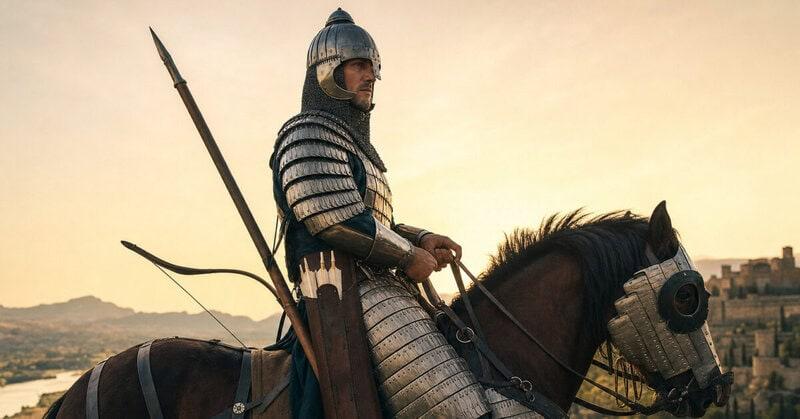
Most wars end with a battle, a treaty, or a catastrophic defeat — but the longest war in history ended with a set of keys, a palace handover, and, if legend is to be believed, a ruler weeping on a hillside. The Reconquista stretched across 781 years, outlasting dynasties, languages, and entire civilizations, making every other extended conflict look like a brief disagreement by comparison.
What Is the Longest War in History?

The answer is the Reconquista — the centuries-long campaign by Christian kingdoms to reclaim the Iberian Peninsula from Muslim rule — which ran from 711 AD to 1492 AD, a span of 781 years. No other documented conflict comes close. For context, that duration exceeds the entire gap between the Norman Conquest of England in 1066 and today. It outlasted the Roman Empire’s western half, the entire Mongol Empire, and the Renaissance from start to finish. Calling it a “war” in the conventional sense is almost misleading: it was, in practice, dozens of wars, hundreds of truces, shifting alliances between enemies, and long stretches of uneasy coexistence — all moving, generation by generation, toward a single January morning in 1492.
711 AD: The Muslim Conquest That Set the Clock Running

In the summer of 711 AD, Umayyad forces crossed the Strait of Gibraltar and tore through the Iberian Peninsula with a speed that stunned the continent. The Visigothic kingdom, which had dominated the region for centuries, collapsed within a few years — not slowly, but like a structure whose foundations had already rotted through. Within a decade, Muslim rulers controlled most of what is now Spain and Portugal, reshaping the peninsula’s politics, culture, and faith in ways that would echo for nearly eight hundred years.
This conquest is the true starting point of the longest war in history — the Reconquista — even before a single Christian army had organized a coherent response. The invaders had not just won territory; they had set a clock running that would not stop until 1492.
718-722 AD: The Battle of Covadonga and the First Act of Defiance

In the rugged Cantabrian Mountains of northern Iberia, a Christian nobleman named Pelayo gathered a small, fierce band of fighters and refused to yield. At the Battle of Covadonga — dated somewhere between 718 and 722 AD — his forces defeated a Muslim contingent in a skirmish that, militarily speaking, changed almost nothing about the balance of power on the peninsula. Symbolically, it changed everything. Historians mark Covadonga as the Reconquista’s opening blow, the moment when Christian resistance shifted from flight to defiance.
The victory was less a turning of the tide than a declaration of intent: the Christian communities clinging to the northern mountains would not dissolve into the new order. That declaration, made by a handful of fighters in a mountain pass, launched what would become the longest war ever fought — one that would not find its conclusion for another 770-plus years.
The 9th-10th Centuries: Frontier Raids, Shifting Alliances, and Uncomfortable Coexistence

For roughly two hundred years after Covadonga, the Reconquista looked nothing like the grand religious crusade it would later be romanticized as. It was, instead, a grinding, unglamorous series of frontier raids, border skirmishes, and shifting alliances between Christian kingdoms — Asturias, León, Navarre, and later Castile and Aragon — and the Muslim taifas, the small principalities that ruled the south. Territory changed hands, was lost, recaptured, and lost again in a slow, uneven southward drift.
What makes this period so striking is how thoroughly it defies any simple narrative of holy war. Periods of genuine coexistence, cultural exchange, shared scholarship, and even intermarriage punctuated the violence. Christian kings sometimes allied with Muslim rulers against rival Christians. Mercenaries crossed religious lines without apology — the most famous being Rodrigo Díaz de Vivar, El Cid, who fought at different points for both Christian and Muslim patrons. The Reconquista was never one thing; it was centuries of complicated humanity, with warfare as the persistent, ugly undertow.
1085: The Fall of Toledo and the Arrival of New Forces from Africa

When King Alfonso VI of Castile and León rode into Toledo in 1085, he claimed the most symbolically and strategically significant city yet taken from Muslim rule. Toledo had been a center of learning, culture, and administration — its fall sent a shockwave through the fractured taifas of the south. Alarmed and suddenly aware that no single principality could hold off the Christian kingdoms alone, the taifas made a fateful decision: they invited the Almoravid dynasty from North Africa to intervene, importing a fresh and formidable military force onto the peninsula.
The episode perfectly illustrates the defining rhythm of this 781-year conflict — Christian advance, Muslim reinforcement, stalemate, and then the slow grinding forward again. The Reconquista did not move like a wave; it pulsed, contracted, and expanded over generations, with each breakthrough eventually meeting a new countervailing force. The Almoravids would themselves be superseded by an even more powerful North African dynasty, the Almohads, in the twelfth century, resetting the balance yet again.
1212: The Battle of Las Navas de Tolosa Breaks Almohad Power

On a summer day in 1212, at a mountain pass in southern Spain called Las Navas de Tolosa, something genuinely decisive finally happened. A coalition of Christian kings — from Castile, Aragon, Navarre, and Portugal — united long enough to confront the Almohad Caliphate’s army and crush it in one of the most consequential battles of the medieval world. The Almohads, who had replaced the Almoravids as the dominant Muslim military power in Iberia, never recovered from the blow.
The consequences cascaded through the following decades with remarkable speed. Córdoba fell to Christian forces in 1236, Valencia in 1238, and Seville in 1248 — great cities that had stood under Muslim rule for five centuries changing hands within a single generation. By the mid-thirteenth century, only the Emirate of Granada in the far south remained under Muslim governance. The Reconquista was entering its endgame, though that endgame would still demand another two and a half centuries and the rise of an entirely new political entity to complete it.
1469: The Marriage That Unified Command of the Final Campaign
In October 1469, Isabella of Castile and Ferdinand of Aragon were married in Valladolid in a union that was as much strategic calculation as personal alliance. Two of the Iberian Peninsula’s most powerful Christian kingdoms now shared a crown, a treasury, and — crucially — a unified command structure. For most of its history, the Reconquista had been hampered by exactly the rivalries and fragmentation that this marriage dissolved: Christian kings fighting each other as often as their Muslim neighbors, resources divided, campaigns abandoned half-finished.
Ferdinand and Isabella gave the centuries-old conflict something it had almost never possessed: sustained, centralized direction. Their joint reign would be the instrument by which 750 years of intermittent struggle were brought, at last, to a conclusion — and the question of what is the longest war ever fought was about to receive its definitive answer.
1482-1491: The Decade-Long Dismantling of Granada
By the late fifteenth century, all that remained of Muslim Iberia was the Emirate of Granada, pressed into the mountainous southern tip of the peninsula and surrounded on every side. Ferdinand and Isabella did not attempt a single dramatic assault. Instead, they methodically dismantled the emirate over a decade, castle by castle, town by town, using sieges, negotiated surrenders, and relentless economic strangulation. It was war conducted less like a battle and more like the slow, deliberate closing of a fist.
Internal dynastic conflict within Granada — a bitter struggle between the emir Muhammad XII, known to the Spanish as Boabdil, and his own father and uncle — weakened the emirate’s ability to mount a coherent defense and, at times, made Boabdil an unwilling instrument of Castilian strategy. By the autumn of 1491, his supply lines were cut, his allies exhausted, and his territory reduced to the city itself and its magnificent palace complex, the Alhambra. The final act of the longest war in history was not going to be decided on a battlefield.
January 2, 1492: The Surrender of Granada Ends 781 Years of War
On the second day of January 1492, Muhammad XII rode out of Granada and handed over the keys to the Alhambra. No final charge, no last stand — just a formal handover and the quiet transfer of a palace that had stood for two centuries as the jewel of Moorish civilization in Europe. The Reconquista, spanning 781 years from the Muslim conquest of 711 to this moment, was over — concluded not with a roar but with the soft sound of a door closing on an era.
Legend holds that as Muhammad XII paused on a hilltop south of the city to look back at the Alhambra for the last time, he wept, and that his mother offered a devastating rebuke: “You weep like a woman for what you could not defend as a man.” The site is still called the Pass of the Moor’s Sigh. Whether the story is entirely true or a later embellishment, it has persisted for centuries because it captures something real about the weight of that ending — the grief of a civilization’s final exile in Europe, and the strange, anticlimactic texture of history’s longest war reaching its last day.
The Contrast That Sharpens the Scale: A War That Lasted 40 Minutes
To feel the full, almost incomprehensible scale of 781 years of conflict, it helps to stand it next to its opposite. The Anglo-Zanzibar War of 1896 — the shortest war in recorded history — lasted approximately 40 minutes before Zanzibar surrendered to British naval bombardment. From the first shot to the raising of a white flag, it was over before a long lunch.
The two conflicts together bookend the entire spectrum of human warfare, and the contrast is not merely numerical — it is philosophical. One war ended before most of its participants had time to feel afraid. The other consumed the entire working lives of roughly thirty consecutive human generations, reshaping a continent’s language, religion, and architecture in the process. They share the same word — “war” — and almost nothing else.
Why Historians Debate Whether the Reconquista Was One War at All
Serious historians are careful to note what the 781-year figure obscures. The Reconquista was not a single, continuous military campaign with a unified command and a consistent political objective. It was a retrospective label applied to centuries of activity that, in the moment, looked more like ordinary medieval politics — regional kingdoms pursuing territorial and dynastic ambitions, sometimes framing those ambitions in religious terms and sometimes not bothering. The explicitly religious crusading ideology that modern audiences associate with the Reconquista became more pronounced after the twelfth century, partly as Iberian rulers sought to attract crusaders from across Europe and legitimize their campaigns in terms Rome would reward with indulgences and recognition.
That historiographical debate does not diminish the 781-year span — the territorial struggle between the Christian kingdoms of the north and the Muslim polities of the south is a documented, continuous historical reality. But it is worth understanding that the Reconquista’s remarkable length is partly a function of the thing being measured: not a single war with a clear beginning and a single chain of command, but a civilizational contest that accumulated, paused, intensified, and accumulated again across nearly eight centuries.
The Legacy: A War Written in Stone, Language, and Policy
Walk through Córdoba’s Mezquita today and you will stand inside a building that is simultaneously a mosque and a cathedral — a physical record of the Reconquista written in stone and horseshoe arches. The Arabic roots embedded in hundreds of everyday Spanish words, the geometric tilework of Andalusian architecture, the agricultural vocabulary that Moorish farming introduced to the peninsula — the 781-year conflict left fingerprints across language, food, faith, and art that no subsequent history has fully erased.
The expulsion of Jews in 1492 and the forced conversion or expulsion of Muslims that followed over the subsequent decades were direct consequences of a war mentality so old it had calcified into state policy, hardening religious identity into something the crown felt entitled to enforce and standardize. The Inquisition, the limpieza de sangre laws requiring proof of “clean blood,” the missionary apparatus exported to the Americas in the same decade Granada fell — all of these emerged from a society that had spent nearly eight centuries defining itself in opposition to the religious other next door.
Meanwhile, conflicts listed among the world’s longest-running today — including insurgencies that have persisted for decades without resolution — remind us that some wars never find their 1492 moment: no surrender ceremony, no keys handed over, no hilltop farewell. That the Reconquista, for all its eight centuries of complexity, managed a definitive and documented ending makes it not just the longest war in history, but one of the strangest and most instructive: a conflict so vast it became a civilization, and yet still, in the end, concluded on a specific morning, in a specific city, with a specific man riding away from a gate he would never pass through again.

 English
 Arabic
 French
 Spanish
 Portuguese
 Deutsch
 Turkish
 Dutch
Dutch
 Italiano
 Russian
 Romaian
 Greek
Greek