


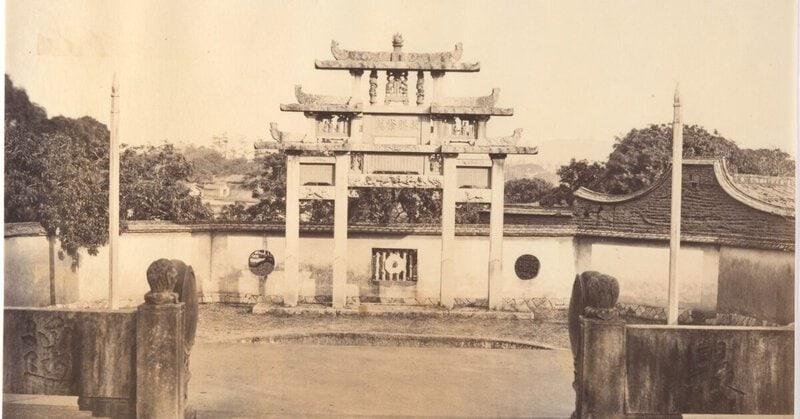
The photographer steadied his tripod on uneven cobblestones, coaxing the heavy glass-plate camera into position while the morning mist rolled through the city gate ahead of him. It was somewhere in the 1870s, somewhere in southern China, and the world he was about to expose onto a silver-coated plate — the robed officials, the sedan-chair bearers, the smoke-threaded temple courtyards — would be unrecognizable within a generation. He pressed the shutter. The empire held its breath. And the image survived everything that followed.
The Moment Before It Vanished: Ancient China’s Visual Legacy

These photographs and illustrations are not mere decoration. They are the last witnesses to dynasties, rituals, faces, and skylines that no longer exist. Every surviving image of ancient China is, in a quiet but undeniable way, a minor miracle — something that escaped wars, floods, the Cultural Revolution’s systematic destruction of historical artifacts, and the slow entropy of damp basements and forgotten trunks.
The visual memory of ancient China stretches from oracle bone inscriptions scratched during the Shang dynasty to hand-colored albumen prints made in the final decades of Qing rule. To look at these pictures carefully is to feel time become unreliable, the distance between then and now collapsing into a single face, a single courtyard, a single wall of crumbling stone.
What follows is a guide to the major collections, the most significant image types, and the human stories behind the pictures — because every photograph of ancient China is ultimately a story about time running out, and about the stubborn effort to hold it still.
What We Mean by ‘Ancient China’: Setting the Visual Timeline

The phrase ‘ancient China’ covers an almost intimidating span of history. At one end sits the Shang dynasty, around 1600 BCE, where scribes pressed questions about harvests and battles into turtle shells and ox bones — oracle bone inscriptions that are themselves a form of picture-making, marks charged with meaning and urgency. Moving forward, Han dynasty tomb art offers painted figures of feasting nobles and acrobatic performers, frozen in motion on lacquered panels more than two thousand years old.
Tang and Song dynasty scroll paintings capture mountains dissolving into mist, scholars bent over calligraphy, and imperial processions winding through stylized landscapes that feel simultaneously precise and dreamlike. Ming and Qing architecture — the Forbidden City’s vermilion walls, the glazed tilework of temple roofs, the carved stone bridges of Suzhou — extends the visual record into something three-dimensional and monumental.
And then, in the 1840s, something unprecedented arrived: the camera. Photography reached China at a peculiarly dramatic moment, when the Qing empire was fracturing under the pressure of the Opium Wars, the Taiping Rebellion, and the forced opening of treaty ports to foreign commerce and residence. The earliest photographs of China are therefore simultaneously historical documents and urgent dispatches — images of a civilization under enormous stress, often taken by outsiders who did not fully understand what they were witnessing. This means that the painted and illustrated records of earlier centuries and the photographic records of the nineteenth century are not competing traditions but complementary ones. Together, they build a picture that neither could construct alone.
What Kinds of Images Survive — and Why It Matters

Before exploring specific archives, it is worth understanding what categories of visual material actually survive and what each type can and cannot tell us.
Painted and illustrated records — court portraits, scroll paintings, woodblock-printed encyclopedias, tomb murals — were produced within Chinese artistic and bureaucratic traditions, according to strict iconographic conventions. They tell us a great deal about how power, cosmology, and social order were meant to appear. What they rarely capture is the unguarded, the unofficial, or the everyday.
Early photography, which arrived with Western traders, diplomats, and missionaries from the 1840s onward, introduced something genuinely new: the unposed detail, the unrehearsed face, the texture of a street market or a river wharf. But these images carry their own distortions. Most early photographers in China were Western men operating within a colonial framework, and their choices about what to photograph — and how — reflect assumptions about China as a place of exotic curiosity rather than complex humanity. The people photographed were rarely consulted and rarely credited.
Archaeological photography, a more recent category, documents excavations from the Terracotta Army at Xi’an to the Han tombs of Mawangdui and the Bronze Age sites of Sanxingdui. These images are produced within scientific frameworks and carry a different kind of authority — but they too are shaped by the choices of the people holding the cameras, and by questions of national heritage politics that are very much alive today.
Understanding these distinctions is not pedantry. It is the foundation of reading these images honestly.
The Great Digital Archives: Where Ancient China Lives Online Today

For most of human history, images of ancient China were locked inside palace collections, missionary trunks, museum storage rooms, and private homes. The digital revolution has changed that profoundly, if imperfectly. Today a curious reader anywhere in the world can browse extraordinary visual archives within seconds.
iStock’s collection of ancient China images spans an enormous range of visual material: terracotta warrior close-ups, Great Wall panoramas photographed in every season and every quality of light, dynastic maps rendered in careful illustration, reconstructed court scenes, and documentary photographs from archaeological sites still yielding discoveries today. With over 277,500 ancient China stock photos and images available, Getty Images holds a substantial library of over 132,075 authentic ancient China photographs and high-resolution images, including rare documentary work from the late Qing period, hand-colored albumen prints of extraordinary delicacy, and editorial coverage of ongoing excavations from Xi’an to the Pearl River Delta.
It is worth pausing on what ‘stock photography’ means in this context. These archives represent a genuine democratization of visual history — images that once required a trip to a specialist archive are now accessible to teachers, journalists, and ordinary readers following a late-night curiosity about the Tang dynasty. That access matters enormously. But a careful reader should also know the caveat: commercial archives blend genuinely historical photographs with modern recreations, artistic impressions, and staged studio imagery. An image labeled ‘ancient China’ may be an 1870s albumen print of the Yangtze waterfront, or it may be a frame from a 2019 costume drama production. Reading the metadata — and asking questions — is not optional. It is part of engaging honestly with this visual world.
The Loewentheil Collection: A Private Visual Memory of a Lost World

Not all of the most important archives are institutional. The Loewentheil Photography of China Collection is one of the most significant private holdings of early Chinese photography in the world, described as a visual memory of ancient China. Assembled over decades through patient hunting at auction houses, estate sales, and specialist dealers, it gathers albumen prints and early photographs from the pioneering era when Western photographers first carried their cumbersome equipment through Chinese city gates and along Chinese river banks.
The images form a social panorama of extraordinary intimacy. Street vendors in Guangzhou photographed at close range, their faces alert and unsentimental. Women in Fujian captured in the kind of unhurried detail that formal court painting never attempted. Scholar-officials posed in ceremonial robes, projecting dignity through the new and unfamiliar medium of the lens. River junks crowding the Yangtze in such numbers that the water is barely visible. Great pagodas photographed before flood, war, and neglect altered them beyond recognition. These are not famous monuments or dynastic symbols but the texture of daily life, surviving because someone cared enough to rescue them from obscurity.
The collection also raises a moral complexity that any honest engagement with this visual history must acknowledge. Most of the photographers who created these images were Western men operating within a colonial framework, treating Chinese subjects as curiosities to be catalogued rather than as individuals with interior lives. The framing of many images reflects those attitudes in ways that are sometimes subtle and sometimes stark. And yet the people photographed — the barbers, the monks, the boatwomen, the scholars — are irreplaceable. The images that condescended to them are now, in many cases, the only evidence that they existed at all. This tension does not resolve neatly. It asks to be held, and thought about, every time one of these photographs is reproduced or admired.
Historical Photographs of China: Bristol’s Century-Spanning Archive

The Historical Photographs of China project at the University of Bristol tells a different kind of story. Built largely from photographs donated by missionary families, diplomats, merchants, and travelers, it covers over a century of modern China’s history across a wide range of places, communities, and themes. Its character is unusually diverse — not the product of a single collector’s taste or a single institution’s agenda, but something closer to a crowd-sourced archive assembled across generations and continents.
The thematic breadth is genuinely staggering. Famine relief efforts in Henan. Village festivals in Guangdong. Flood disasters along the Huai River. Women’s education initiatives in missionary schools. Confucian academies where elderly scholars taught classical texts to boys who would live to see those traditions violently dismantled. The slow creep of railways across a landscape that had moved at the speed of oxen for centuries. These are not the official records of imperial power. They are history as it was actually lived by ordinary people, captured by ordinary observers whose photographs ended up in trunks in spare bedrooms until their grandchildren thought to donate them to an archive.
The Bristol project is actively digitizing and making these images searchable as open-access resources, which means the archive is genuinely alive — new material surfaces regularly as more donations are processed, more metadata is added, and more images are uploaded. The act of preservation here is ongoing and communal, which gives it a different quality from the great institutional collections. It feels less like a finished museum gallery and more like a living conversation across time.
The Most Iconic Types of Ancient China Images — and the Stories Behind Them
The Great Wall is perhaps the most reproduced image in Chinese visual history. But the version most people see — tourist-ready, fully restored, sweeping dramatically across northern ridgelines — looks quite different from the Great Wall photographed by early visitors in the 1870s and 1880s. Those images show a crumbling, vegetation-draped ruin: mortar crumbling between stones, watchtowers missing their roofs, the whole structure returning slowly to the earth it rose from. It is worth knowing that the wall was never a single continuous structure built at one time; it accumulated across centuries under different dynasties, and large sections were built during the Ming dynasty between the fourteenth and seventeenth centuries. The photographs of the ruined wall are in some ways more honest than the manicured monument that greets visitors today, and certainly more haunting.
Imperial court portraits occupy a different register entirely. The formal painted likenesses of emperors and empresses, executed on silk by court artists following strict iconographic conventions, are among the most psychologically compelling images in Chinese visual history. The faces are calibrated to project divine authority — symmetrical, composed, draped in the symbolic colors and patterns of cosmic order. And yet something human persists beneath the protocol. The eyes of the Wanli Emperor, or the painted gaze of the Empress Dowager Cixi, communicate something that the rigid format cannot quite suppress: the weight of a life lived inside a role, the exhaustion of perpetual performance. Cixi, who effectively controlled the Qing government for nearly five decades, also famously embraced photography in her later years, commissioning posed photographic portraits that she distributed to foreign dignitaries — a deliberate exercise in image management that feels strikingly modern.
The Terracotta Army presents yet another kind of visual story. Discovered in 1974 near Xi’an by farmers digging a well, the warriors have generated their own expanding visual archive at extraordinary speed. Photographs charting the excavation decade by decade show not just archaeology but a kind of slow resurrection — an army that stood in complete darkness for approximately 2,200 years, emerging face by individual face into the light of flashbulbs and then digital cameras. Each warrior’s features are distinct, modeled on real soldiers rather than produced from a single template. Knowing this, and then looking at a photograph of one of those faces, collapses the distance between the Qin dynasty and the present in a way that no textbook description can replicate.
Street-level Qing photographs carry an intimacy that grand architectural shots cannot match. A Shanghai barber bent over a customer’s neck with focused concentration. A Beijing water carrier caught mid-stride, the shoulder pole flexing under the weight of full buckets. A Cantonese opera troupe in full costume, their painted faces turned toward the camera with an expression caught somewhere between performance and impatience. These images capture the texture of daily life rather than the performance of imperial power, and they remind us that the past was not populated by symbols and monuments but by people — tired, busy, curious, alive.
Archaeological site photography continues to expand the visual record in ways that earlier generations could not have anticipated. The Sanxingdui site in Sichuan, first excavated in the 1980s and the subject of major new discoveries from 2020 onward, has produced photographs of bronze masks, gold objects, and ritual vessels so visually strange that they have genuinely altered scholarly understanding of Bronze Age China’s cultural diversity. These are not illustrations of a story already known. They are evidence that the story is still being written.
Reading Ancient China Images Critically: A Practical Guide
Visual literacy is not a minor technical skill when it comes to ancient China pictures. It is a form of historical responsibility. Here are the questions worth asking before accepting any image at face value.
Who made this image, and when? A photograph dated to the 1870s carries entirely different evidential weight from a digitally generated scene or a film production still. Check the metadata, the caption, and the source institution whenever possible. Commercial image libraries do not always make this easy, but the information is usually there if you look for it.
What is the image actually showing? ‘Ancient China’ as a label covers everything from Shang dynasty bronze vessels to late Qing street photography to modern reconstructions of Han dynasty palaces. These are not equivalent. Knowing which dynasty, which region, and which social context produced an image dramatically changes what it can tell you.
Whose perspective shaped this image? Early Western photographers in China made choices about framing, subject selection, and presentation that reflected their own assumptions and their audience’s expectations back home. Court painters made choices that reflected imperial requirements. Archaeological photographers work within institutional and national frameworks that shape what gets documented and how. No image is neutral.
Is this a genuine historical photograph or a recreation? As artificial intelligence generates increasingly convincing synthetic imagery of ancient China — courtyard scenes, dynasty portraits, street markets that never existed — the distinction between a genuine albumen print from the 1870s and a persuasive digital fabrication is harder to maintain. The stakes of that confusion are genuinely historical. Misinformation about the past is still misinformation.
Why These Images Still Matter
Ancient China pictures are not passive records sitting quietly in digital libraries. They are actively used in contemporary debates about national identity, cultural heritage claims, architectural reconstruction projects, and the rights of communities to control how their ancestors are represented to the wider world. A photograph of a demolished temple is evidence in an argument about what should be rebuilt, and how, and by whom. A portrait of a minority community from the nineteenth century can be simultaneously a historical treasure and a site of contested meaning. These images have consequences.
Preservation itself remains unfinished and urgent. Many physical negatives, glass plates, and early prints in private and institutional hands are deteriorating — the chemistry of silver-based photography was not designed for eternity, and humidity, light, and time are patient adversaries. The race to digitize is ongoing, and it is not yet won.
But whether you approach these images as a history lover, a researcher, a designer, or simply as a curious person who stumbled across an astonishing face from another century and found yourself unable to look away, you are participating in the oldest human project there is: the stubborn, beautiful refusal to let the past disappear entirely. The photographer on the cobblestones in the 1870s pressed his shutter, and the empire held its breath, and the image survived. That survival was never guaranteed. It still isn’t. Which is precisely why it matters so much to look carefully, and to look honestly, at everything that remains.

 English
 Arabic
 French
 Spanish
 Portuguese
 Deutsch
 Turkish
 Dutch
Dutch
 Italiano
 Russian
 Romaian
 Portuguese (Brazil)