


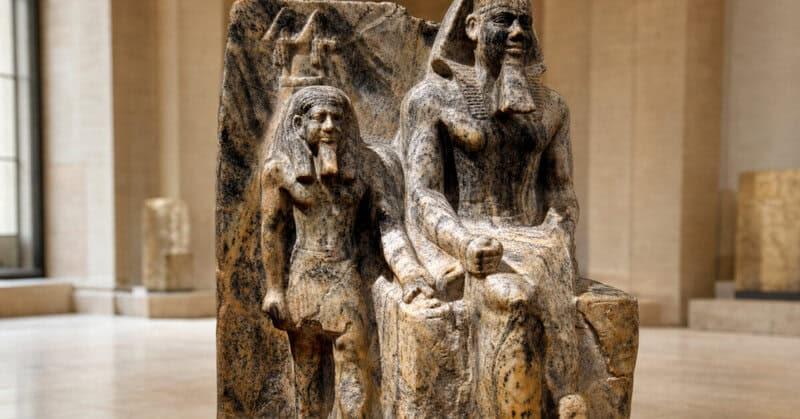
Walk into any museum with an Egyptian collection and you’ll spot him instantly: the falcon-headed figure, regal and remote, staring from painted limestone or hammered gold. Most visitors read the label — Horus — and move on, assuming they understand. They don’t. Because the name “Horus” was never a single deity with a single story. It was a constellation of at least fifteen distinct gods, each with separate temples, separate myths, and separate congregations — and the ancient Egyptians who worshipped them knew exactly which one they were addressing.
At Least Fifteen Distinct Horus Deities Worshipped Simultaneously

Ancient Egyptian religious texts preserve more than fifteen named forms of Horus, and the differences between them run far deeper than variations on a theme. Horus the Elder (Haroeris), Horus the Child (Harpocrates), Horus of Edfu, Horus of Hierakonpolis, and Horus-Ra each had their own cult centers, their own priesthoods, their own festival calendars, and their own mythological biographies. These were not chapters in a single divine biography — they were genuinely separate divine identities, as distinct to an educated Egyptian as Apollo and Hermes were to a Greek.
What makes this remarkable is that the multiplicity was deliberate, not the result of theological drift or historical confusion. Priests serving at different temples were fully aware they were addressing different aspects of a complex divine reality. The coexistence of these many forms of Horus was a feature of Egyptian religious thinking — a sophisticated acknowledgment that a force as vast as the sky could not be collapsed into a single name or a single face.
The Oldest Form of Horus Pre-Dates the Osiris Myth by Centuries

Most people encounter Horus through the story everyone knows: the young avenger, son of Osiris and Isis, locked in eternal struggle with his murderous uncle Seth. But that narrative is a relative latecomer. Horus the Elder — Haroeris — was already being venerated as a sky deity and cosmic power before the Osiris myth had fully crystallized into its famous shape. Archaeological evidence from Hierakonpolis, one of the earliest urban centers in Egypt, places falcon-god worship there no later than around 3100 BCE, making Horus among the oldest attested deities in the Egyptian pantheon.
The “son of Osiris” identity was layered on top of this ancient falcon cult centuries after the bird-god was already entrenched in Egyptian sacred life. Think of it less as a biography and more as a palimpsest — each generation of priests writing new theological meaning over the old without erasing what came before. The original falcon soaring above the prehistoric Nile valley had nothing to do with resurrection myths; he was simply, and terrifyingly, the sky itself.
His Right Eye Was the Sun, His Left Eye Was the Moon

In his role as the great celestial falcon whose wings spanned the heavens, Horus carried the entire visible cosmos in his face. His right eye was identified with the sun or morning star — associated with power and quintessence — while his left eye corresponded to the moon. The symbol known as the wedjat, or Eye of Horus, therefore encoded the complete celestial cycle in a single image, which is why it became one of the most cosmologically significant emblems in Egyptian art and appeared on everything from royal jewelry to coffin lids.
Solar and lunar changes were not treated as mere astronomical events — they were mythologized as the wounds Horus sustained during his battles with Seth. When the moon dimmed, Seth had gouged the eye again. When it recovered its light, the eye had been healed. This fusion of astronomy and mythology gave ordinary Egyptians a narrative framework for understanding the sky that was simultaneously observant and spiritually alive.
Every Living Pharaoh Was Literally Horus on Earth

The oldest and most sacred of a pharaoh’s five royal names was the Horus Name, inscribed inside a serekh — a stylized representation of a palace facade topped by a falcon. Calling this merely symbolic would miss the point entirely. The equation between king and god was not metaphorical in Egyptian theology. The pharaoh was considered an actual earthly embodiment of Horus, governing the land of the living just as his deceased predecessor occupied the role of Osiris in the realm of the dead. Divine kingship was not a claim the king made; it was a theological fact the entire state was organized around.
The mechanism recycled itself with elegant precision across more than three thousand years. When a pharaoh died, he transitioned from Horus to Osiris — the living god become the god of the dead. His successor simultaneously became the new Horus, stepping into the cosmic role the moment the previous king died. No transition period existed in the divine sense: the falcon never left the throne.
The Contendings of Horus and Seth — an Eighty-Year Divine Legal Battle

Around 1150 BCE, an Egyptian scribe committed to papyrus one of the most unexpectedly entertaining documents in ancient religious literature. The Contendings of Horus and Seth narrates an eighty-year tribunal before the assembled gods to determine who should inherit the throne of Osiris. The tone is, to a modern reader, startlingly irreverent: Ra sulks and refuses to engage, Isis outmaneuvers everyone with her cunning, and the divine council bickers with an embarrassing lack of dignity before eventually ruling in Horus’s favor.
The text is a reminder that ancient Egyptian mythology was not always conducted in the register of solemn temple ritual. Humor, legal procedure, and social satire were all legitimate vehicles for engaging with sacred stories. The gods in this papyrus behave badly, and the Egyptians who read it clearly found that funny — which tells us something important about how they related to their own religion. The mythology was alive enough to be laughed at.
Horus-Ra: The Merger That Made the Midday Sun a Warrior King

By the height of the New Kingdom, the theological urge to synthesize had produced one of Egypt’s most powerful composite deities: Re-Horakhty, meaning “Ra-Horus of the Two Horizons.” The merger fused the sun god Ra with Horus to create a figure representing solar power at its most ferocious — the blazing midday sun conceived as a conquering falcon-king. This was not a hostile theological takeover. Both Ra and the independent forms of Horus continued to receive their own worship; Re-Horakhty was an addition, not a replacement, reflecting Egypt’s characteristically additive approach to theology.
The prestige of this composite deity can be measured in stone. Re-Horakhty was one of the four divine figures enshrined in the great rock-cut temple of Abu Simbel, the monument Ramesses II commissioned around 1264 BCE to proclaim his own divinity for eternity. The temple was oriented so that twice a year the dawn light would penetrate the inner sanctuary and illuminate the sacred statues — an astronomical alignment that married the sky-god mythology of Horus to the turning of the earth itself.
Harpocrates: The Toddler God Who Conquered the Greco-Roman World
Of all the forms of Horus, none traveled further from home than the small, naked child with a finger pressed to his lips and a sidelock of youth falling across one cheek. This was Harpocrates — the Greek rendering of Horus the Child — depicted as the vulnerable but fated heir, too young to have claimed his throne but carrying the destiny of the cosmos in his small body. When Alexander the Great’s conquest in 332 BCE opened Egypt to the wider Mediterranean world, Greeks and Romans encountered this figure and immediately embraced him, reinterpreting the finger-to-lips gesture as a sign of secrecy and mystery rather than its original Egyptian meaning, which signified childhood.
What followed was one of the ancient world’s most remarkable instances of religious export. Harpocrates became associated with secrets, luck, and hidden knowledge across the Greco-Roman world, and his figurines — mass-produced in faience, terracotta, and bronze — have been recovered from sites stretching from Roman Britain to Afghanistan. This single form of Horus became one of the most geographically widespread deities the ancient world ever produced, carried by soldiers, merchants, and pilgrims who may have known nothing about the Nile valley religion that had created him thousands of years before.
The Wedjat Eye as a Practical Medical Notation System

The Eye of Horus did more than adorn amulets and coffin panels — it went to work in the physician’s kit. Ancient Egyptian medical scribes used the six components of the wedjat symbol as a notation system for fractions, with each distinct part of the eye’s intricate design corresponding to a specific value: one-half, one-quarter, one-eighth, one-sixteenth, one-thirty-second, and one-sixty-fourth. Physicians measuring the quantities of herbs, minerals, and organic compounds prescribed in Egyptian medical practice used this system as a calculating tool embedded directly within a sacred image.
The six parts together sum to sixty-three sixty-fourths, and Egyptian mythology supplied an explanation for the missing sixty-fourth: Thoth, the god of wisdom and writing, had restored the eye after Seth destroyed it, but the final fragment required a touch of divine magic to complete. The myth and the mathematics were inseparable. Every time a physician calculated a medicine dose using the wedjat fractions, they were enacting, in miniature, the healing of Horus’s eye — turning a prescription into a small act of sacred restoration.
Horus of Edfu: A God Who Fought an Annual Ritual War by Boat

The Temple of Edfu, built between 237 and 57 BCE and the best-preserved ancient Egyptian temple standing today, was home to a local form of Horus whose defining story was his battle with Seth — and whose worshippers did not merely commemorate that battle but re-enacted it every year on the Nile. During the Festival of Victory, priests took to the river in ritual boats, with participants performing the roles of Horus and his adversary. Seth was represented by a hippopotamus-shaped cake, which was ceremonially stabbed and then eaten — a destruction of evil that was also, satisfyingly, a communal feast.
The walls of the Edfu temple are covered in tens of thousands of lines of mythological text, making it one of the most detailed surviving records of ancient Egyptian religious tradition anywhere in the world. These are not abbreviated summaries but full, elaborate narratives — the theological library of a living tradition that had been refining its understanding of Horus for more than three thousand years by the time the last hieroglyph was carved.
The Egyptians who built these temples, wrote these papyri, and carved these walls were not confused about which Horus they meant. They were the inheritors of one of humanity’s longest and most layered theological traditions — one sophisticated enough to hold fifteen gods within a single name and find in that multiplicity not contradiction, but a richer truth about the sky, the throne, and the endlessly renewable power of the divine.

 Arabic
 French
 Spanish
 Portuguese
 Deutsch
 Turkish
 Dutch
Dutch
 Italiano
 Russian
 Romaian
 Portuguese (Brazil)
 Greek
Greek