


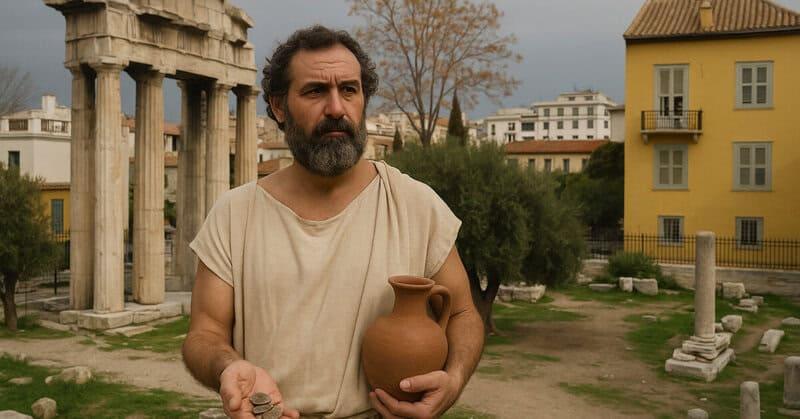
The word economics is so familiar it barely registers as foreign — yet it traces directly to ancient Greek soil, coined by people who were building one of history’s most consequential market systems. Long before modern theorists put names to supply and demand, Greek farmers, traders, and craftsmen were working out the practical logic of exchange, money, and growth in ways that still echo through the global economy today.
The Word ‘Economics’ Started in Ancient Greece

The English word “economics” comes from the ancient Greek oikonomia — a compound of oikos (household) and nomos (management or law). In its original sense, oikonomia described the rational management of material goods and labor, starting at the household level and scaling outward. Xenophon used the term as the title of his practical treatise on household and estate management, written in the fourth century BCE — one of the earliest surviving works devoted to economic reasoning. That definition remains surprisingly close to how economists define their discipline today.
Understanding the economy of ancient Greece reframes how we think about the ancient world entirely. These were not people living in a static, pre-economic haze. They were farmers calculating crop rotations, merchants negotiating prices across the Mediterranean, and city administrators wrestling with revenue and resource allocation. In short, they were doing economics — they just did not call it that yet.
An Economy Built on the Land

Agriculture was the engine at the heart of ancient Greek economic life. Most production took place in the rural countryside, where families worked land through seasons governed by olive harvests, grape harvests, and grain cycles. These three crops — olives, grapes, and wheat — formed the backbone of both local consumption and long-distance trade. Olive oil and wine were particularly valuable exports: both could survive long sea voyages without spoiling, making them ideal commodities for Mediterranean commerce.
Land ownership in ancient Greece carried weight far beyond its economic function. It was bound up with citizenship and social status, meaning that the act of farming was as much a political statement as an economic one. To own land was to belong — to have a stake in the polis, the city-state, in a way that landless laborers and merchants often did not. Even as cities grew more complex and commerce flourished, the agricultural base remained the foundation on which the entire system rested. Scholars estimate that as much as 80 percent of the Greek population was engaged in farming at the height of the classical period, underscoring just how thoroughly agricultural life defined the economic baseline.
The Rise of the Craftsman

Alongside the farmer, a new kind of economic actor was gaining ground: the craftsman. Though agriculture remained paramount in the economy of the city-state, craftsmen had an important and increasingly significant place in ancient Greek economic life. Pottery and metalwork were major industries, and Greek ceramics in particular became recognized commodities across the ancient Mediterranean world. Workshops in cities like Athens and Corinth produced painted vessels and everyday wares that traveled thousands of miles by sea, carried by merchants who understood that a fine pot was also a profitable good. Corinthian pottery dominated Mediterranean markets during the seventh century BCE before Athenian black-figure and later red-figure ware eclipsed it — a competitive dynamic that reflects genuine market pressure between city-states.
This rising prominence of craftsmen reflected something broader: a diversification of economic life that pushed the Greek world beyond pure subsistence farming. When a potter in Athens could sell his work to a buyer in Egypt or along the Black Sea coast, the local economy had extended far beyond its immediate geography. That diversification is part of what made ancient Greek economic development so remarkable — and so different from the static model that older scholarship assumed.
Trading by Sea: Greece’s Economic Lifeline

Geography shaped Greek economics as decisively as any policy or law. Greece’s fragmented coastline — cut by inlets, dotted with hundreds of islands, and never far from the sea — made maritime trade not just possible but essential. Landlocked self-sufficiency was rarely a viable option for most city-states. Instead, Greek merchants exchanged olive oil, wine, pottery, and silver for the grain, timber, and metals that their own territories lacked.
Long-distance trade connected Greek city-states to Egypt, the Black Sea, Italy, and regions even further afield. Scholars studying economics in ancient Greece note that this commerce helped spread Greek culture alongside Greek goods — making trade a civilizational force as much as an economic one. A merchant ship carrying amphorae of wine was also carrying Greek aesthetics, Greek language, and Greek ideas into distant ports. The establishment of colonies from the western Mediterranean to the eastern Black Sea between roughly 750 and 550 BCE was itself partly an economic project, driven by the search for agricultural land and new trading partners.
Money Changes Everything

Perhaps no single development reshaped ancient Greek economics more profoundly than the adoption of coined currency. Greek city-states moved beyond barter and developed sophisticated monetary systems anchored by their own minted coins. Athens produced its famous silver “owls” — coins stamped with the image of Athena on one side and her owl on the other — which became a widely trusted currency across the ancient Mediterranean, partly because Athens controlled the rich silver mines at Laurion in Attica. The consistent silver content of Athenian coins gave them credibility that facilitated trade even with parties who had no political relationship with Athens.
The marketplace, or agora, became the central institution where this monetary economy played out in daily life. Citizens gathered not only to buy and sell but to conduct civic business. Evidence from the ancient Greek economy shows that credit, lending, and early banking practices also emerged during this period — financial innovations that anticipated instruments modern economies take for granted. Maritime loans, in particular, were a sophisticated instrument: lenders advanced funds for trading voyages at high interest rates, with the ship and cargo serving as collateral. The Greeks were not just using money; they were learning to make money work harder.
Slavery and the Limits of Greek Prosperity

Any honest account of ancient Greek economics must confront slavery, which was fundamental to how the system functioned. Enslaved people worked the silver mines at Laurion under brutal conditions, staffed domestic households, labored in workshops alongside free craftsmen, and tilled fields throughout the Greek world. Athens at its classical peak may have had a slave population approaching 30 percent of total inhabitants — a proportion that allowed free citizens the leisure to participate in political and cultural life precisely because others bore the heaviest economic burdens. The prosperity that produced the Parthenon and the philosophy of Plato rested, in significant part, on forced labor. Understanding Greek economic achievement without acknowledging this dimension produces a dangerously incomplete picture.
Remarkable Growth in the Ancient World
From around 800 to 300 BCE, the Greek world experienced economic growth that was remarkable by premodern standards, though paltry by modern standards. Research into economic development in antiquity links this growth to broader developments of the period, including population expansion, colonization of new territories, political development within city-states, and the cultural flowering we still associate with classical Greece. The great monuments, dramas, and philosophical works of the period were not produced in a vacuum — each required resources, labor, patronage, and a functioning economy capable of generating surplus.
By modern standards, the growth rates involved would look modest. But in the context of the ancient world, where most civilizations remained locked in near-static subsistence, the Greek trajectory stood apart. Historians and economists increasingly view this period as evidence that ancient economies were far more dynamic and responsive than scholars once assumed — capable of generating sustained growth, responding to market signals, and innovating in the face of new conditions.
Why Ancient Greek Economics Still Matters
The concepts ancient Greeks put into practice — rational resource management, market exchange, monetary systems, long-distance trade, credit instruments — are foundational to modern economic thinking. The tensions they navigated between agricultural tradition and commercial innovation mirror debates that economies around the world continue to wrestle with. Should a community prioritize self-sufficiency or embrace the interdependencies of trade? How should a society balance the interests of landowners, craftsmen, and merchants? The Greeks did not resolve these questions, but they asked them with unusual rigor and recorded their reasoning in texts that later thinkers, from medieval Islamic scholars to early modern Europeans, directly engaged.
Studying ancient Greek economics also challenges a persistent myth: that serious economic thinking only began in the modern era with figures like Adam Smith. In reality, the Greeks were reasoning carefully about production, exchange, and value centuries earlier. From the olive grove to the agora, ancient Greece laid conceptual and practical groundwork that the global economy — whether its participants know it or not — still stands on today.

 English
 Arabic
 French
 Spanish
 Portuguese
 Deutsch
 Turkish
 Dutch
Dutch
 Italiano
 Russian
 Romaian
 Portuguese (Brazil)