


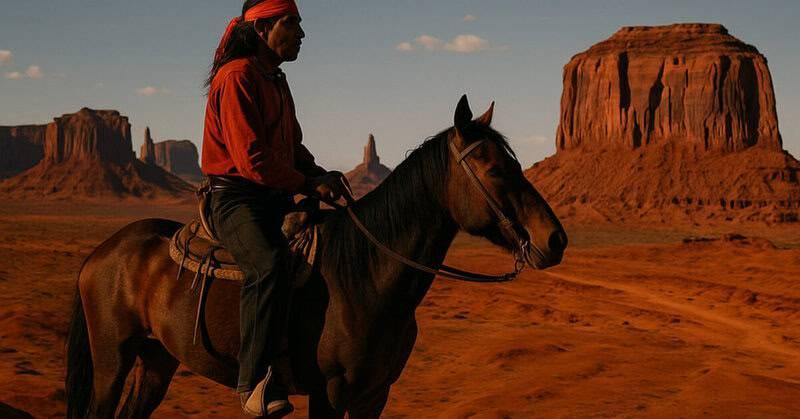
Picture a Navajo warrior on horseback, silhouetted against the rust-red spires of Monument Valley, the sky enormous and indifferent behind him. It is one of the most recognizable images in the American imagination — and someone, long before the shutter clicked or the pen moved, had already decided he was disappearing.
A Word That Did the Work of a Policy

Few adjectives have shaped American history with the quiet ferocity of vanishing. Attached to a people, it does not merely describe — it prescribes. It tells an audience what to feel (elegiac, helpless), what to expect (absence, inevitability), and, most critically, what not to do (intervene, protest, accept responsibility). For more than a century, that single word moved through novels, films, academic papers, and government corridors, doing the work of a policy no politician would have dared write plainly into law.
The central tension across all these texts is this: books, films, and legislation recycled the same fatal assumption — that Native Americans were fading away naturally, like snow in spring, like anything that simply cannot survive the arrival of modernity. That assumption was not an observation. It was a script, written to relieve white America of moral responsibility for the dispossession it was actively engineering. And nowhere was that script more seductively readable than in the pages of a 1925 Western novel that became one of the bestselling and most quietly dangerous books of its era.
Zane Grey’s Monument: The Novel That Put a Face on the Myth

In 1925, post-World War I America was restless and romantically exhausted. It had survived industrialized slaughter in European trenches and returned to a country urbanizing at terrifying speed. The West — already conquered, already fenced, already mythologized — represented something lost, something clean and heroic and irrecoverable. Into that emotional vacuum, Zane Grey dropped The Vanishing American, and it landed like a stone into still water.
The novel’s center is Nophaie, a Navajo warrior of extraordinary dignity and divided loyalty, caught between the Indigenous world that shaped him and the Anglo-American society that will never fully receive him. His love story with Marian Warner, a white schoolteacher, is not simply romance — it is a collision of civilizations rendered in human faces. Their union is impossible not because of personal incompatibility but because Grey has structured his fictional universe to make it so. Nophaie cannot belong fully to either world, and Grey never seriously imagines a third option. The reader is invited to admire this man, mourn this man, and ultimately accept his fate as preordained.
The Zane Grey Writers Society frames The Vanishing American as Grey’s tribute to the Navajo, Hopi, and Paiute peoples — and there is genuine feeling in the book, genuine outrage at the corruption and cruelty of the reservation system. But tribute and elegy are uncomfortable neighbors. To memorialize is often to bury. Grey’s sympathy for Native Americans was real, and yet the novel’s architecture insists on their disappearance with the same certainty a eulogy insists the deceased will not be coming back.
Nophaie’s struggle is framed as doomed by design. Assimilation is presented as both the only possible path forward and a path that leads, inevitably, to self-destruction. Grey did not invent this argument; he inherited it from decades of federal policy and popular sentiment. But by clothing it in vivid landscape, genuine emotion, and a protagonist of uncommon nobility, he made it feel not like ideology but like truth. Readers across generations continue to wrestle with exactly this tension, as the book’s reception history on Goodreads makes plain. The Wikipedia entry for the novel also documents how its serial publication in Ladies’ Home Journal in 1922 preceded the book edition — and how Grey was pressured to revise the ending before publication, softening elements that publishers feared would alienate readers. That editorial pressure is itself part of the story: the myth required maintenance.
From Page to Screen: Hollywood Inherits the Myth

The novel did not stay between covers for long. A film adaptation brought the story of Nophaie and Marian to the screen, and Monument Valley — those cathedral sandstone formations that would later become synonymous with John Ford’s Westerns — provided the visual grammar. Wide-angle reverence for the landscape paired with narrative insistence on the disappearance of its people created a paradox that audiences rarely paused to examine. The land was magnificent. The people who had lived on it for millennia were, the story insisted, already leaving.
The story proved resilient enough to be remade in 1955, starring Scott Brady and Audrey Totter. Updated costumes and cinematography preserved the elegiac assumption at the film’s core. Cold War America, anxious about its own identity and the pace of change, found the “vanishing” narrative as emotionally satisfying as the 1920s had. The Indigenous characters were still noble. Their disappearance was still framed as tragedy rather than crime. The audience was still invited to grieve without being invited to act.
This is what made Hollywood’s treatment of the “vanishing Indian” so effective and so insidious: the emotion it generated was real, but it was routed away from accountability. A film that makes you cry over a people’s disappearance does not necessarily make you question who arranged that disappearance, or whether it was truly inevitable. The camera’s reverence for Indigenous faces and landscapes became, paradoxically, one of the most powerful tools for normalizing their erasure.
The Assumption Examined: Scholarship Fights Back

It took decades for the intellectual reckoning to arrive in force. In 1982, the University of Kansas Press published a landmark academic study tracing the origins of the “vanishing American” assumption and mapping its effects on U.S. policy toward Native peoples. The work was not a literary critique of Zane Grey; it was something larger and more urgent — an excavation of how a narrative becomes policy, how a story told often enough begins to shape the world it claims only to describe.
What the scholarship revealed was damning in its clarity. “Vanishing” was never a neutral observation about demographic reality. It was a self-fulfilling prophecy written into law, land policy, and school curricula. Forced removal, reservation confinement, the suppression of language and ceremony — these were not managed as atrocities but as administrative responses to an inevitable process. If Indigenous peoples were already disappearing, then the government was merely presiding over nature’s own conclusion. The moral ledger, conveniently, stayed balanced.
The 1982 study pulled the “vanishing” myth out of the cultural wallpaper — where it had hung so long that most Americans no longer noticed it — and held it under harsh light. Constructed, weaponized, historically traceable: the assumption did not arise from observation. It was manufactured from anxiety, convenience, and the very human desire to feel blameless for harm one is actively committing. That argument has only grown more difficult to dismiss in the decades since the book appeared.
Wilderness, Race, and Anxiety: When “Vanishing” Turned Inward

By the late nineteenth and early twentieth centuries, the “vanishing” anxiety had migrated — it jumped, like a virus finding a new host, from Indigenous peoples to white Americans themselves. The fear was no longer only about Native disappearance. It was about demographic change, immigration, and the perceived dilution of a particular vision of who “real” Americans were and what their landscape was supposed to look like.
Vanishing America, published by Harvard University Press, traces how wilderness preservation movements became entangled with precisely these racial anxieties. The push to protect wild landscapes was not purely ecological in its impulse; it was partly a coded effort to preserve a particular American identity — rugged, Anglo, frontier-forged — against the forces of change. The “untouched” wilderness that needed saving was, of course, land from which Indigenous peoples had often recently been removed. The preservation movement mourned the absence of one kind of American while quietly ensuring the absence of another.
The through-line is uncomfortable but unavoidable. The same cultural machinery that lamented the vanishing Indian was simultaneously being deployed to police the borders of white American identity. Both were framed as endangered, requiring protection. The deep incoherence at the heart of American national mythology — grieving one disappearance while engineering another — becomes visible only when these two anxieties are placed side by side.
The Vanishing American Adult: A Different Kind of Disappearance

Not every book that reaches for the word “vanishing” is about race or land. Ben Sasse’s The Vanishing American Adult, examined in a careful book review at The Cripplegate, turns the lens entirely inward, exploring the erosion of work ethic, moral seriousness, and the habits of character that Sasse argues are disappearing from American life. It is a different register — personal, generational, concerned with what is lost when young Americans are no longer shaped by hardship, responsibility, and the long view of a human life.
This outlier is worth pausing on, because it asks a question the other “vanishing” texts tend to answer too quickly: what does a society fear losing when it reaches for that word? Indigenous sovereignty. Wild landscape. Demographic identity. Moral character. The word is a vessel, and different eras fill it with different dreads. When “vanishing” is turned inward and privatized — applied to the self, to character, to a generation’s habits of mind — it loses its political sting and becomes something closer to self-help. When the same word is projected outward onto a people or a landscape, it becomes something else entirely: license for harm, administered with a melancholy shrug.
The recurring appearance of “vanishing” in American titles across more than a century reveals a nation chronically anxious about its own continuity, forever writing eulogies for versions of itself it may never have been. That anxiety, when honestly examined, might be generative. When deflected onto others, it becomes a weapon.
What “Vanishing” Really Means — And Why It Still Matters
Return, now, to the Navajo warrior on horseback in the opening image. He did not vanish. Native American nations survived the reservation system, the boarding schools, the allotment acts, the termination policies, and the endless recycling of the “vanishing” narrative itself. They adapted, resisted, endured, and continue to assert sovereignty, culture, and presence in ways that make the elegiac certainty of Grey’s 1925 novel look not merely wrong but actively distorting — a portrait that tells us more about the painter’s wishes than the subject’s reality.
The century-long arc from Grey’s elegy to Hollywood adaptation to policy scholarship to environmental politics reveals a consistent pattern. “Vanishing” has functioned as America’s most versatile tool for managing guilt, projecting fear, and avoiding accountability. It aestheticizes dispossession. It transforms active harm into passive tragedy. It makes the audience feel something genuine — sadness, beauty, loss — while insulating the structures that produced the loss from serious examination.
The challenge for any reader who has followed this story is simple and difficult in equal measure. The next time “vanishing” appears attached to a people, a place, or a way of life, ask who benefits from the declaration of disappearance. Ask who is doing the naming, and what the naming makes possible. To declare something gone is often the first step in making it so — in withdrawing the attention, the resources, and the moral urgency that might have kept it present.
The Vanishing American remains in print a century after Zane Grey first set Nophaie against the Monument Valley sky. Its title still carries the same seductive, dangerous promise that moved millions of readers in 1925 and has never entirely lost its grip: that some losses are natural, inevitable, and no one’s fault. That promise, now as then, deserves to be refused.

 English
 French
 Spanish
 Portuguese
 Deutsch
 Turkish
 Dutch
Dutch
 Italiano
 Russian
 Romaian
 Portuguese (Brazil)
 Greek
Greek