


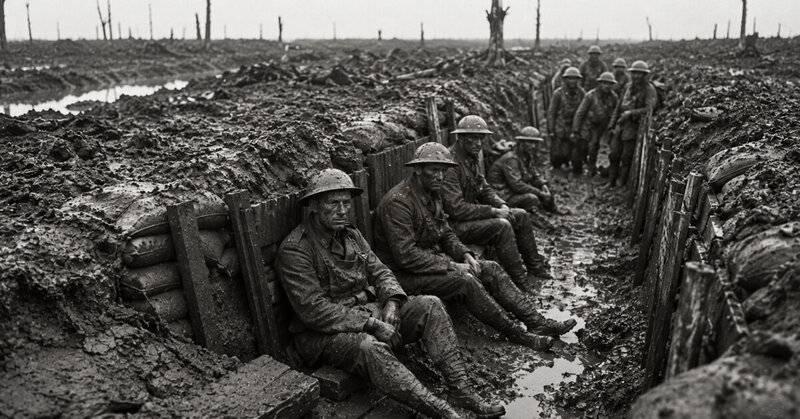
Ask any well-read person to name the essential World War I books and the same titles surface within seconds: Remarque, Sassoon, Wilfred Owen’s poems, perhaps Barbara Tuchman’s The Guns of August. That list is not wrong — but it is dangerously incomplete. The Great War was fought on nine fronts across four continents by soldiers from thirty-odd nations, and the literature that has been allowed to represent it comes almost entirely from one narrow slice of it: the British and German experience on the Western Front. The rest of that war has been waiting, shelf-bound and patient, for someone to go looking.
The Diplomat Who Saw the Catastrophe Coming and Wrote It Down in Real Time
Edward Grey, British Foreign Secretary in August 1914, famously watched the gas lamps being lit on the evening war was declared and remarked that the lights were going out all over Europe. His memoir, Twenty-Five Years, published in 1925, offers something almost no Great War book provides: the view from the room where the decision was actually made. Grey was not a general. He was the man who spent the last seventy-two hours of peace trying to prevent the collapse of a diplomatic order that had held, imperfectly, for nearly a century. His account of those final negotiations has a quality of tragic inevitability — a man watching a mechanism he helped build grind toward destruction while his hands remain technically clean.
Military historians assign it to the diplomatic shelf and leave it there. That is a mistake. Grey writes with the clarity of a man who has had decades to reckon honestly with his own failure, and no book gets closer to the actual gears of catastrophe in 1914.
The Nurse Who Recorded What the Generals Would Not
Vera Brittain’s Testament of Youth, published in 1933, is sometimes included in the standard canon, but rarely taught alongside Remarque or Sassoon — which reveals something telling about which perspectives the “war literature” category was built to include. Brittain lost her fiancé Roland, her brother Edward, and her two closest male friends to the war. She served as a Voluntary Aid Detachment nurse in London, Malta, and France. Her memoir is not a combat narrative. It is something harder — a systematic dismantling of the idea that the war’s suffering was primarily a male experience, written with a precision of grief that the more celebrated male memoirists rarely matched.
The chapters in which she nurses German prisoners — men who killed people she loved — constitute one of the most quietly devastating acts of moral reckoning in twentieth-century English prose. Testament of Youth is indispensable to understanding the war, and the fact that it took fifty years to enter the standard reading list says more about the canon’s architects than about the book’s quality.
The African and Indian Fronts That Most Readers Have Never Encountered
Charles Miller’s Battle for the Bundu, published in 1974, covers the East African campaign of 1914-1918 — a theater in which German General Paul von Lettow-Vorbeck led a force of fewer than 15,000 soldiers, mostly African askari troops, on a guerrilla campaign that tied down nearly 300,000 Allied troops for four years and never formally surrendered. It is one of the most tactically extraordinary stories of the entire war, and almost no popular history of the conflict allocates it more than a paragraph. Miller’s account reads like a thriller constructed from archival documents, and it permanently unsettles the notion that the Great War was essentially a European event fought on European soil.
Equally neglected is David Killingray and David Omissi’s edited collection Soldiers of the British Empire, which compiles accounts from Indian, West African, East African, and Caribbean soldiers whose service was fundamental to the Allied war effort and whose voices were methodically excluded from the commemorative literature that followed victory.
The Tactical History That Changed How Soldiers Are Trained Today
Tim Travers’s The Killing Ground, published in 1987, is academic in its apparatus but devastating in its conclusions. Travers examined the internal culture of the British Army officer class between 1900 and 1918 and argued, with meticulous documentation, that the catastrophic casualties of campaigns like the Somme were not simply the result of new technology overwhelming old tactics — they were the result of a command culture that structurally prevented accurate information from reaching decision-makers. Subordinate officers who reported that attacks had failed were perceived as lacking offensive spirit. The machinery of optimism ate the truth before it could change anything.
The Gap Between the War We Read and the War That Happened
The standard reading list for World War I represents perhaps fifteen percent of the conflict’s actual geographic and human scope. The other eighty-five percent — the Gallipoli campaign told from Ottoman sources, the Macedonian front, the war as experienced by two million African laborers conscripted by the British — exists in books that sit in university library stacks, quietly contradicting everything the popular narrative has calcified into certainty.
The most important thing any serious reader of the Great War can do is treat the famous books not as the complete record but as the opening argument — and then go find the rebuttal.
Every war leaves archives. Most of them are still waiting to be read.

 English
 Arabic
 French
 Spanish
 Portuguese
 Turkish
 Dutch
Dutch
 Italiano
 Russian
 Romaian
 Portuguese (Brazil)
 Greek
Greek