


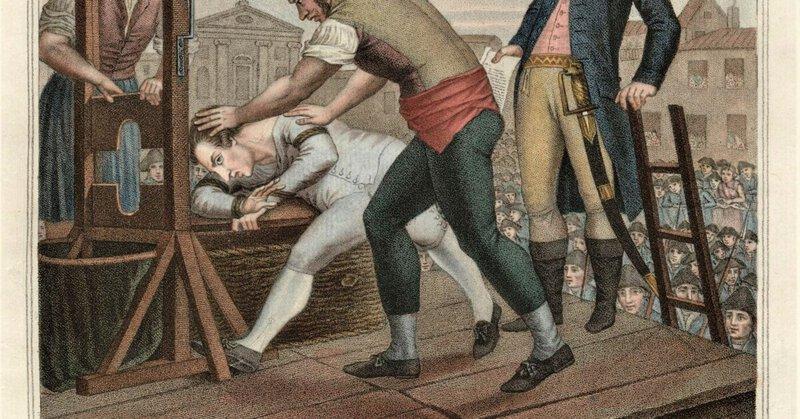
It began as an act of mercy — a physician standing before a revolutionary assembly, pleading that even the condemned deserved a dignified death. Within a few years, that same plea had given its name to the most notorious killing machine in Western history, and the man behind the idea spent the rest of his life trying to forget it.
A Doctor’s Compassionate Proposal That Changed Execution Forever

In 1789, physician Joseph-Ignace Guillotin rose before the French National Assembly with an argument rooted not in cruelty but in compassion. Every condemned person — whether a duke or a ditch-digger — deserved a swift, painless death delivered by a mechanical blade, rather than the prolonged agony of the rope or the grim lottery of an axeman’s aim. Guillotin never designed the device himself; he championed the humanitarian principle, and the machine was engineered by others, including surgeon Antoine Louis, who translated the ideal into iron and timber.
The cruel irony is that Guillotin spent the rest of his life horrified by his association with the killing machine that bore his name. His family reportedly petitioned the French government after his death to have the device renamed — a request that was quietly ignored. The doctor who dreamed of mercy had become, in the public imagination, a herald of the scaffold.
The Core Design Feature: That Angled Blade
Look closely at a guillotine and the first thing you notice is that the blade is not a flat horizontal edge — it is set at a steep diagonal angle. This was a deliberate engineering choice, designed to slice cleanly through a neck in a single stroke rather than driving straight down with blunt, chopping force. The weighted blade drops along grooved wooden rails inside a tall upright frame, combining the relentless pull of gravity with sharp geometry to make each cut both fast and consistent.
That mechanical precision was the entire philosophical point. Remove human error, remove suffering, remove the ghastly spectacle of a swordsman needing two or three attempts before the job was done. The guillotine was, in the language of its inventors, an engineering solution to a moral problem — though history would complicate that vision almost immediately.
Beheading Machines Had Existed for Centuries Before France Adopted One

France did not invent the drop-blade execution device — it simply gave the concept a permanent name. Machines operating on the same basic principle were documented in Ireland, Scotland, and Italy well before the 1790s. Scotland’s so-called “Maiden” was in use as early as the 1560s, and the Halifax Gibbet in England had been beheading convicted thieves with a falling blade since the medieval period. The underlying idea — a weighted blade guided by rails — was old enough to have accumulated its own folklore long before the French Revolution began.
What France did in 1792 was not invent the concept but standardize, name, and scale it. By embedding the guillotine into law as the sole legal method of execution for all citizens, the Revolutionary Assembly transformed a scattered pre-modern practice into a formal institution — and, in doing so, set the stage for what was to come.
France’s Official Adoption in 1792 Was an Equality Argument, Not a Brutality One

Before the guillotine, French law sorted even death by social class. Decapitation — considered relatively swift and dignified — was reserved for the nobility. Commoners faced hanging, or the drawn-out horror of being broken on the wheel. The Revolutionary Assembly’s decision to adopt the guillotine on April 25, 1792, was framed explicitly as the erasure of that distinction: one nation, one death, one standard for all. The rhetoric of equality extended even to the scaffold.
The first person executed under this new law was Nicolas Jacques Pelletier, a highwayman, on that same April date in 1792. The crowd that gathered at the Place de Grève reportedly went away disappointed — the whole thing was over before they had a chance to register it. The machine had done its job too well for spectacle. That disappointment, dark as it was, would not last long.
The Sanson Dynasty: One Family That Executed Revolutionary France

Charles-Henri Sanson came from a line of hereditary executioners who had served Paris for generations. Beheading by sword had been a skilled, physically demanding craft — one that required strength, nerve, and years of practice to perform cleanly. The guillotine fundamentally transformed his role. A single operator could now carry out executions rapidly and without the muscular precision that swordwork demanded, turning an artisan’s craft into something closer to a mechanical process.
During the Reign of Terror, Sanson and his son Henri used the guillotine to execute so many people in a single day that the blade had to be resharpened mid-session — a logistical scale of killing that would have been unimaginable for one family operating with the tools of the previous generation. The machine had not just replaced the sword; it had industrialized the act of state killing.
The Reign of Terror Turned the ‘Humane Equalizer’ Into a Mass-Killing Machine

Between September 1793 and July 1794, approximately 17,000 people were officially executed across France, with the guillotine accounting for the vast majority of deaths in Paris. The condemned were drawn from every stratum of society: aristocrats, priests, foreign nationals, bourgeois merchants, and ordinary peasants accused of counter-revolutionary sympathy. This was, grimly, the cross-class equality the device’s original champions had promised — applied now not to mercy but to mass death.
At the Place de la Révolution, the guillotine became a fixture of public life. Vendors sold programs listing the day’s condemned, and crowds gathered to watch as a matter of routine. The clinical, humanitarian intent that had motivated Guillotin’s 1789 speech had been entirely consumed by the spectacle the machine was supposed to eliminate. The equalizer had become an engine of terror.
The Revolution Eventually Fed Its Own Leaders to the Blade

Perhaps the most devastating judgment history passed on the Terror was delivered by the guillotine itself. Georges Danton, one of the founding architects of the Committee of Public Safety, was guillotined in April 1794 — a man who had helped build the revolutionary machinery of justice now processed through it. Then, on July 28, 1794, Maximilien Robespierre — the figure most responsible for orchestrating the Terror at its most ferocious — was arrested and led to the same blade he had directed against so many others. The machine consumed the ideology that had deployed it.
Marie Antoinette had already been executed by guillotine on October 16, 1793, making the “equalizer” rhetoric concrete in the starkest possible way: the same device, the same drop, for a queen and for a peasant. Whatever the original reformers had intended, the Revolution had found in the guillotine a perfect symbol of its own logic — impartial, mechanical, and utterly without mercy.
The Name ‘Guillotine’ Stuck Precisely Because of the Terror — Not the Idealism

When the device was first built, it circulated under other names. The prototype was sometimes called the “Louisette” or “Louison,” after surgeon Antoine Louis, who had done much of the practical engineering work. For a brief moment, it seemed possible that Guillotin’s name might not attach itself permanently to the machine at all. Then the popular and satirical press of the revolutionary period took hold of the story, and “guillotine” became the word on every pamphlet and broadsheet — cementing the doctor’s name not to reform, but to mass execution.
The branding proved permanent. Despite the machine’s use across Europe under various local names, “guillotine” entered virtually every language as the definitive term for the drop-blade execution device. The word carried with it the shadow of the Terror rather than the memory of the humanitarian reform that had launched it — a linguistic injustice that followed Guillotin’s descendants long after the doctor himself was gone.
France Used the Guillotine for Nearly Two Centuries After the Revolution

The guillotine did not retire with the Terror. It remained France’s sole legal method of execution for nearly two centuries after its introduction, surviving the fall of the monarchy, the rise and fall of Napoleon, two world wars, and the birth of the Fifth Republic. The last public guillotining in France took place on June 17, 1939, when Eugen Weidmann was executed outside the Saint-Pierre prison in Versailles — proof that the appetite for public spectacle the Revolution had nurtured had never entirely disappeared. Disturbing footage of the crowd’s reaction that morning prompted the government to ban public executions immediately afterward. The last execution of all, carried out in private, was that of Hamida Djandoubi on September 10, 1977, making France the last Western country to use the guillotine in practice.
When France abolished the death penalty entirely in 1981, the guillotine passed into history — not as the symbol of enlightened reform its creator had imagined, but as one of the most loaded objects in the modern world’s memory. Nearly two centuries separated Guillotin’s compassionate speech from that last falling blade, and the machine had outlived the meaning he gave it almost from the very beginning.
What the guillotine’s story ultimately reveals is how completely an instrument of mercy can be remade by the hands that use it — that the gap between a humanitarian ideal and a symbol of terror can be measured, in this case, in a matter of months, and in thousands of lives.

 English
 Arabic
 French
 Spanish
 Deutsch
 Turkish
 Dutch
Dutch
 Italiano
 Russian
 Romaian
 Portuguese (Brazil)
 Greek
Greek