


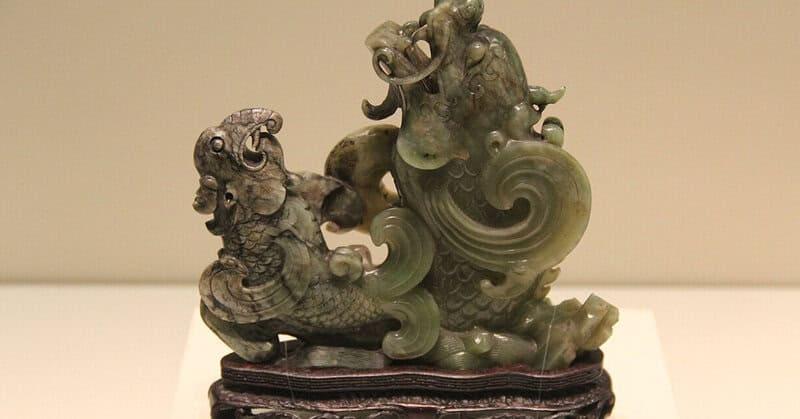
In 6000 BCE, on the shores of what would become northeastern China, people of the Xinglongwa
culture placed polished jade rings around the bodies of their honored dead. They had no writing,
no bronze, no city walls. They had jade, and they treated it with a seriousness that suggests they
understood, at some prelinguistic level, that they were initiating something large. They were
right. What they started would not end for another eight thousand years — and has not ended yet.
Before the Emperors, the Shamans Held the Stone
The earliest Chinese jade artifacts are not ornaments. They are instruments. The Liangzhu
culture, flourishing in the Yangtze Delta between 3300 and 2300 BCE, produced cong —
squared tubes of jade with circular bores running through their centers — whose precise meaning
still eludes scholars but whose ritual function is unmistakable. Liangzhu cong have been
found stacked in burial pits in numbers that suggest they functioned as something between a
currency and a prayer, as if the living were sending the dead into the next world with a stack of
sacred credentials.
They also produced bi discs — flat, circular pieces of jade with central holes —
that later Chinese cosmology would associate with heaven itself. Whether the Liangzhu people
shared that interpretation is unknowable. What is clear is that they invested enormous labor —
weeks or months of grinding with sand and bamboo, without metal tools — to produce objects that
served no practical purpose whatsoever. Impracticality, in this context, was the point. A stone
that demanded everything and offered no utility was the only appropriate material for
communicating with forces larger than the human.
The Philosopher Who Turned a Stone Into an Ethical System
Jade might have remained a ritual curiosity had Confucius, writing in the fifth century BCE,
not done something philosophically audacious: he mapped the cardinal virtues directly onto jade’s
physical properties. Its luster, he argued, represented benevolence. Its translucency, wisdom.
Its hardness without brittleness, courage. The fact that its flaws — and fine jade always has
them — were never hidden but visible within the stone represented integrity. In eleven attributes
catalogued in the Book of Rites, jade became not a symbol of virtue but its
material analogue.
This was not poetry. It was prescription. For the scholar-officials who governed China’s
imperial bureaucracies, wearing jade became an ethical statement. The sound of jade pendants
clinking against each other as a gentleman walked — a sound Confucian texts described with
deliberate precision — was a reminder to move with measured dignity, to govern the body as one
governed the state. A man who wore jade carelessly revealed his character. A man who wore it
well announced his fitness for authority without speaking a word.
The Jade Suit That Was Supposed to Stop Death
By the Han Dynasty — 206 BCE to 220 CE — jade’s power had expanded into something even more
ambitious: the belief that jade could preserve the body after death and guarantee immortality.
Han princes and high nobles were buried in suits assembled from thousands of individual jade
plaques sewn together with wire. The wire’s material — gold for royalty, silver for nobles,
bronze for lesser ranks — indexed the wearer’s status precisely. Prince Liu Sheng, who died
around 113 BCE and whose tomb was excavated in Hebei Province in 1968, wore a suit of 2,498 jade
plaques joined by 1,100 grams of gold wire. His wife, Princess Dou Wan, lay beside him in her
own suit of 2,160 plaques.
The suits did not work. The bodies decomposed entirely, leaving only jade. But the aspiration
encoded in the effort reveals something essential: jade had traveled from shamanic ritual tool to
Confucian virtue-object to pharmacological intervention against death itself, all within a single
cultural tradition. No other material in human history accumulated so many layers of meaning while
remaining recognizably the same stone.
The Jade That Kublai Khan Could Not Wash Clean of Its History
When the Mongols conquered China in 1271 and Kublai Khan established the Yuan Dynasty, they
encountered a civilization whose attachment to jade they could not afford to dismiss. Kublai
commissioned jade vessels for his court, adopted Chinese jade rituals for imperial ceremonies,
and — most revealingly — claimed continuity with Chinese jade traditions rather than replacing
them. A conqueror who understood that destroying the jade culture would be read as destroying
civilization itself had grasped something important about where China stored its sense of self.
The great Dushanfu jade vessel, carved in 1265 and still preserved in Beijing’s
Beihai Park, weighs 3,500 kilograms and was designed to hold wine for Kublai’s banquets. It is
the largest jade carving in the world. A Mongol conqueror built it because he understood that
some forms of legitimacy can only be quarried, not seized.
Eight Thousand Years Later, the Stone Has Not Released Its Hold
Contemporary China remains the world’s largest consumer of jade. The market, driven largely
by buyers in mainland China, Hong Kong, and the Chinese diaspora, is estimated in the billions of
dollars annually. Fine jadeite — the vivid green variety sourced primarily from Myanmar — sells
at auction for prices that rival diamonds. The reasoning offered by buyers often echoes,
consciously or not, the language of the Book of Rites: jade is auspicious, jade
protects, jade connects the living to something older and steadier than any single life.
Confucius wrote that the superior man’s qualities resemble jade’s. Seventy generations later,
China is still measuring itself against the stone.
Eight thousand years is a long time to hold something — and an even longer time to
be held by it.

 English
 Arabic
 French
 Spanish
 Portuguese
 Deutsch
 Turkish
 Dutch
Dutch
 Italiano
 Russian
 Portuguese (Brazil)
 Greek
Greek