


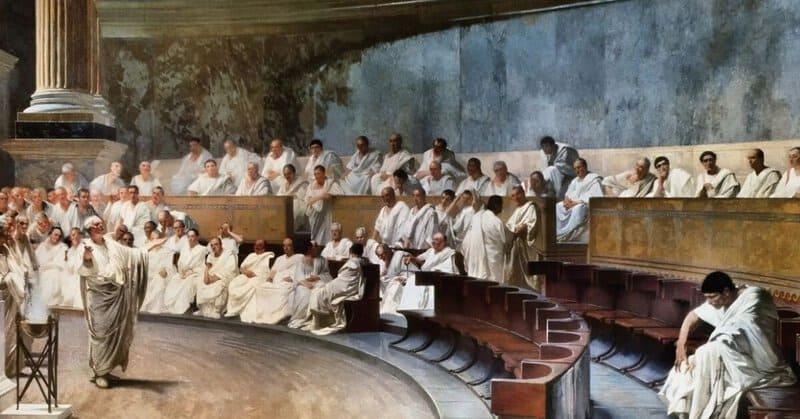
On December 5, 63 BC, Marcus Tullius Cicero stood before the Roman Senate and made a decision that would define his legacy and destroy his life. Five men were in chains before him — Roman citizens, co-conspirators of the senator Lucius Sergius Catilina, who had plotted to burn the city and seize the Republic by force. Cicero had them executed without trial. The crowd outside the Senate House roared his name. He walked home that night as the most celebrated man in Rome.
He would spend the rest of his life paying for it.
The Conspiracy That Almost Swallowed the Republic
Catilina had run for consul twice and lost. By 63 BC, drowning in debt and bitter at a system that rewarded bloodline over talent, he assembled a coalition of the dispossessed — ruined aristocrats, discharged veterans, debtors facing slavery — and planned an armed insurrection. His lieutenants would torch Rome in multiple districts simultaneously while he marched on the city with an army from Etruria. The plot was meticulous, the conspirators numerous, and the timing exact.
What Catilina did not count on was the consul he was facing. Cicero, a novus homo — a “new man” with no consular ancestors, who had clawed his way to Rome’s highest office through sheer legal brilliance — had built an intelligence network that penetrated the conspiracy to its core. When Catilina rose to speak in the Senate on November 8th, Cicero was already reading from transcripts of his private meetings. The famous opening line was not rhetoric for posterity. It was a trap snapping shut: Quo usque tandem abutere, Catilina, patientia nostra? — “How long, Catilina, will you abuse our patience?”
The Execution That Could Not Be Undone
Catilina fled Rome that night and died in battle the following January, sword in hand, facing the legions sent to destroy him. But the five conspirators left in the city were a different problem. Under Roman law, citizens could not be executed without a trial and the right of appeal. Cicero convened a Senate debate. Julius Caesar — already calculating, already dangerous — argued for life imprisonment. Cato the Younger argued for death. The Senate voted with Cato.
Cicero gave the order. The five men were strangled in the Tullianum prison on December 5th, and when Cicero emerged and announced their deaths with the single Latin word vixerunt — “they have lived” — the crowd erupted. He was hailed as pater patriae, Father of the Fatherland, an honor previously reserved for Romulus himself. The Senate voted him a thanksgiving, the first ever granted for a civilian achievement. Rome breathed again.
Three years later, the tribune Publius Clodius Pulcher passed a law specifically targeting any magistrate who had executed Roman citizens without trial. The law named no names. It needed none. Cicero left Rome before the vote was counted, walking into exile in Greece with the words of the Senate’s gratitude still ringing in the marble halls behind him.
The Man Caesar and Pompey Both Failed to Protect
What makes the exile so devastating is not the injustice — Roman politics was never just — but the abandonment. Cicero had spent his consulship cultivating what he called the concordia ordinum, a coalition of senatorial and equestrian classes unified in defense of the Republic. In his hour of need, that coalition dissolved entirely. Pompey, whom Cicero had championed, refused to intervene. Caesar, whose execution he had opposed, did nothing to stop the exile bill. The Republic Cicero had saved was constitutionally incapable of saving him back.
He was recalled eighteen months later to a rapturous reception — crowds lined the road from Brundisium to Rome for miles. But something had broken. He never again held the political weight of 63 BC, and he knew it. He turned instead to philosophy and rhetoric, writing the works — De Re Publica, De Officiis, the Philippics — that would outlast the Republic itself by two thousand years.
The Voice That Outlived the System It Defended
Cicero was killed on December 7, 43 BC, hunted down on the orders of Mark Antony, whose political destruction he had engineered in the Philippics. His hands and head were nailed to the Rostra — the very platform from which he had spoken. Antony’s wife Fulvia, according to later sources, drove a hairpin through his tongue. The image is grotesque and possibly apocryphal, but it captures something Rome understood instinctively: the man’s true weapon had always been his voice.
What survives of Cicero is not his consulship, not the Catilinarian conspiracy, not even the execution that haunted him. What survives is the prose — clear, precise, devastating — that became the template for Latin composition for the next fifteen centuries. Every Renaissance humanist who reached for eloquence reached first for Cicero. Every lawyer who has ever shaped an argument owes something to the new man from Arpinum who saved Rome on a December night and never stopped paying the price.
The Republic he died defending had already died before him — and yet his words, written in its defense, are the most durable thing either of them produced.

 English
 Arabic
 French
 Portuguese
 Deutsch
 Turkish
 Dutch
Dutch
 Italiano
 Russian
 Romaian
 Portuguese (Brazil)
 Greek
Greek