


 PUBLISHED
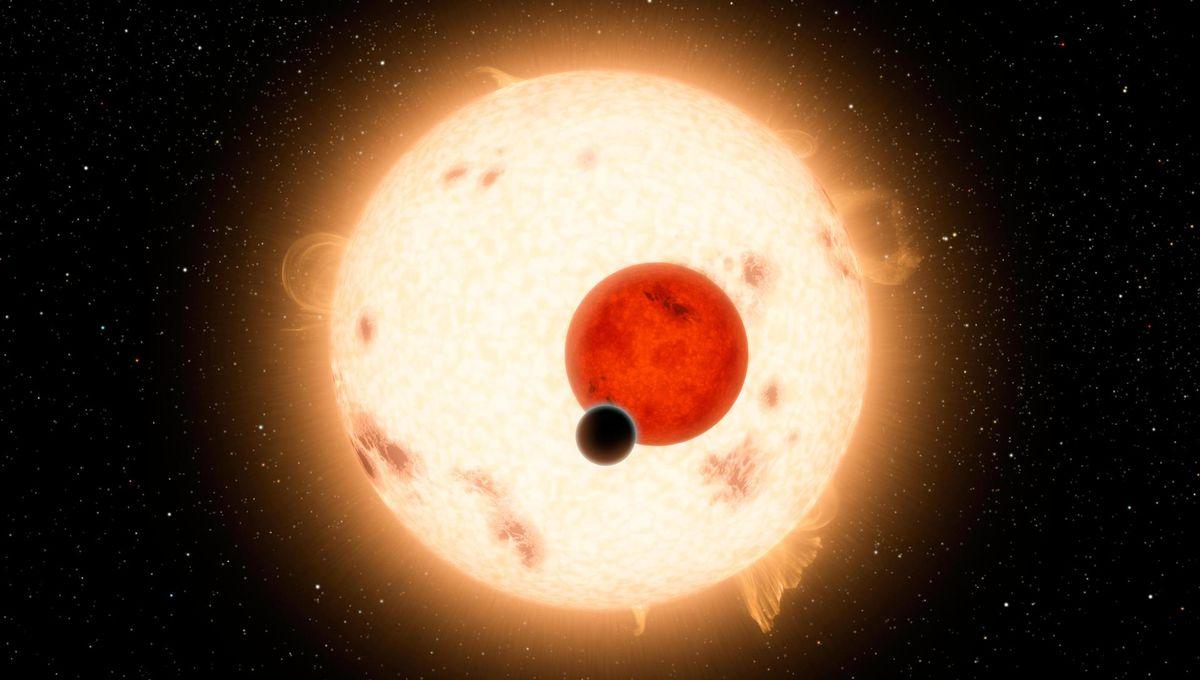
A timelapse has been released showing the newly discovered Tatooine-like planet HD 143811 AB b making part of its journey around the two stars that give it light. The planet can be seen directly because it is both very large and very young, so the observations provide insight into how systems like this form and evolve.
The rest of this article is behind a paywall. Please sign in or subscribe to access the full content. When Luke Skywalker stared into a double sunset on his home planet, Tatooine, George Lucas not only gave the original Star Wars one of its most memorable moments, he gave astronomers a name for planets that orbit two stars. At the time, many doubted the name would be needed much. It was widely thought that systems with two stars would be too disruptive to allow planets to exist, unless the stars were very close together and the planets extremely far out. Since then, we have discovered several Tatooine-like planets, enough to make us suspect they’re common in the galaxy. Few have been viewed directly, however. Instead, we’ve noticed the dip in one of the stars’ light when the planet passes across its face. Existing telescopes usually can’t pick out planets against the overwhelming brightness of a nearby star. The exception is in the infrared, when planets are still glowing from the heat of their formation, particularly when they are giving their star a wide berth. But if one star creates a problem for planet-hunting telescopes, two are worse. “Of the 6,000 exoplanets that we know of, only a very small fraction of them orbit binaries,” said Dr Jason Wang of Northwestern University in a statement. “Of those, we only have a direct image of a handful of them, meaning we can have an image of the binary and the planet itself." "Imaging both the planet and the binary is interesting because it’s the only type of planetary system where we can trace both the orbit of the binary star and the planet in the sky at the same time," he added. "We’re excited to keep watching it in the future as they move, so we can see how the three bodies move across the sky.” Time-lapse footage of the newly discovered Tatooine-like exoplanet six times the size of Jupiter as it makes its slow journey around two stars. Image credit: Jason Wang/Northwestern University, gif made by IFLScience When telescopes are chasing a planet’s own radiation rather than what it reflects, the further it is from its star (or stars), the easier it is to find. So both previous cases of direct imaging of Tatooine-like planets have involved those orbiting at distances more than 500 times further from their stars than Earth is from the Sun. Unsurprisingly, most systems don’t seem to have a planet that far out, let alone one young and hot enough to see. Wang hoped the Gemini Planet Imager (GPI), an instrument installed on the Gemini South telescope in Chile for just this purpose, would boost the numbers. “I spent most of my time during my Ph.D. just looking for planets,” Wang said. “During the instrument’s lifetime, we observed more than 500 stars and found only one new planet. It would have been nice to have seen more, but it did tell us something about just how rare exoplanets are.” However, almost 10 years later, in the lead-up to the GPI being moved to Gemini North, Wang asked northwestern PhD student Nathalie Jones to check the data again with the more advanced analysis techniques now available. Jones noted a dot that appeared to follow HD 143811 A and B across the sky from 2016-19. “Stars don’t stand still in a galaxy, they move around,” Wang said. “We look for objects and then revisit them later to see if they have moved elsewhere. If a planet is bound to a star, then it will move with the star. Sometimes, when we revisit a ‘planet,’ we find it’s not moving with its star. Then, we know it was just a photobombing star passing through. If they are both moving together, then that’s a sign that it’s an orbiting planet.” Deeper analysis confirmed the suspect was the second planet found by GPI. More than 50 astronomers besides Wang and Jones contributed to the confirmation that HD 143811 AB b really is a planet, and squeezed out what information could be found about it. By chance, a separate team found the same planet independently, although with less detail on its attributes. The new exoplanet HD 143811 AB b is estimated to be 5.6 times the mass of Jupiter. At 1,042 Kelvin (769°C or 1,416°F), it’s almost twice as hot as Venus, or we wouldn’t have found it, but still one of the coolest exoplanets to be directly imaged, being 13 million years old. With a 300-year orbit, HD 143811 AB b could not be considered remotely close to its stars – it’s twice as distant as Neptune. By contrast, the stellar pair are very close indeed, whirling around each other every 18 days. The relative closeness means HD 143811 AB b almost certainly formed around the stars, rather than being a captured rogue planet, or one flung far from its original location, in contrast to previous directly imaged Tatooine-like worlds. Wang sees the discovery as an opportunity to learn how the process works. “Exactly how it works is still uncertain,” Wang said. “Because we have only detected a few dozen planets like this, we don’t have enough data yet to put the picture together.” Meanwhile, Jones is seeking more telescope time so we can track the orbit a little bit further. For the curious, the designation AB b indicates this is the first planet we have found orbiting both stars in a particular binary. Planets that orbit just one star in a more widely separated pair have the capital letter of the star (A for the brighter, B for the secondary) and a small letter to indicate the order of detection of the planet, starting with b. Wang and Jones' paper is published in The Astrophysical Journal Letters. The team that found HD 143811 AB b independently published in Astronomy and Astrophysics. 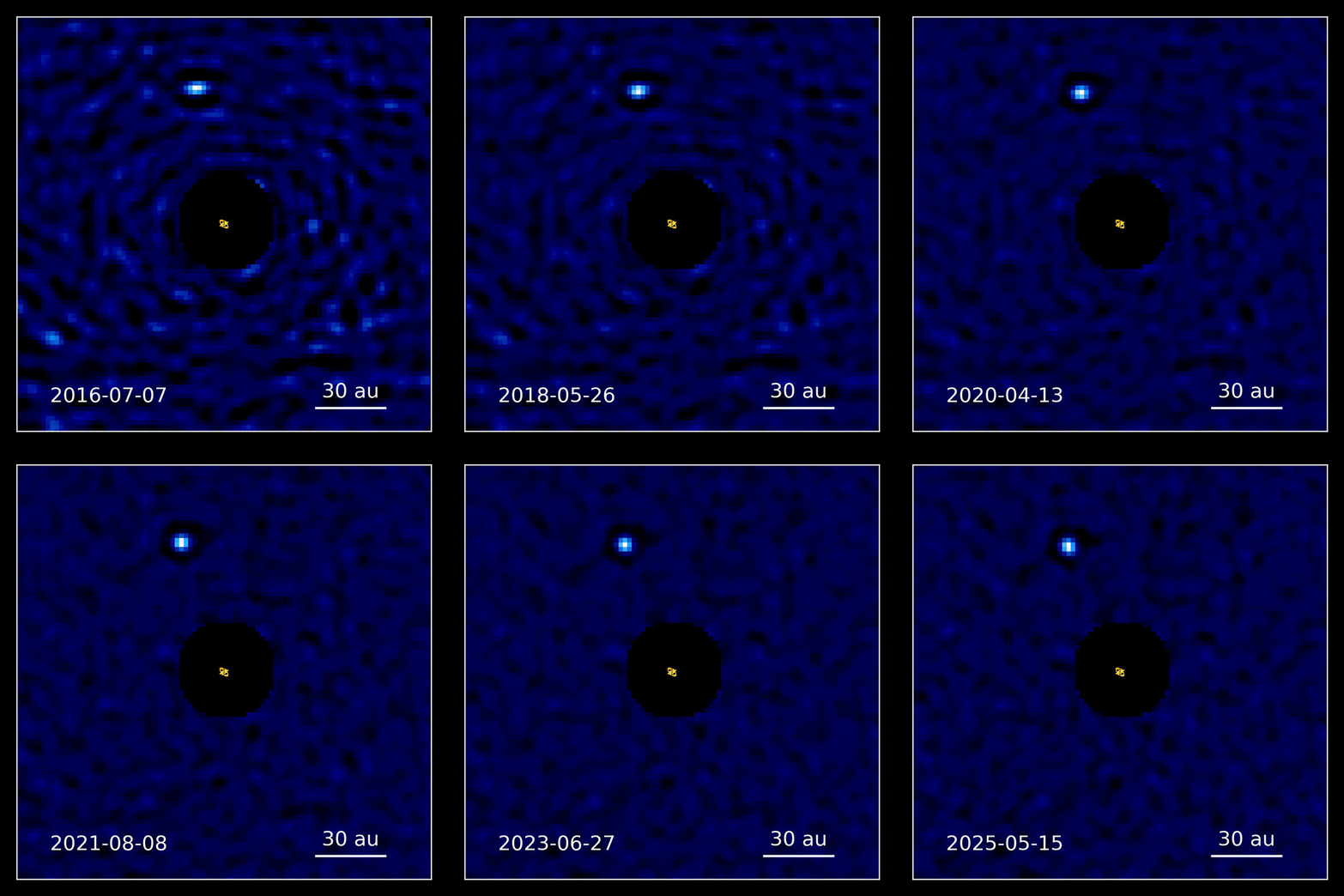



 English
 French
 Spanish
 Portuguese
 Deutsch
 Turkish
 Dutch
Dutch
 Italiano
 Russian
 Romaian
 Portuguese (Brazil)
 Greek
Greek