How Many Native Americans Were Killed During Colonization?
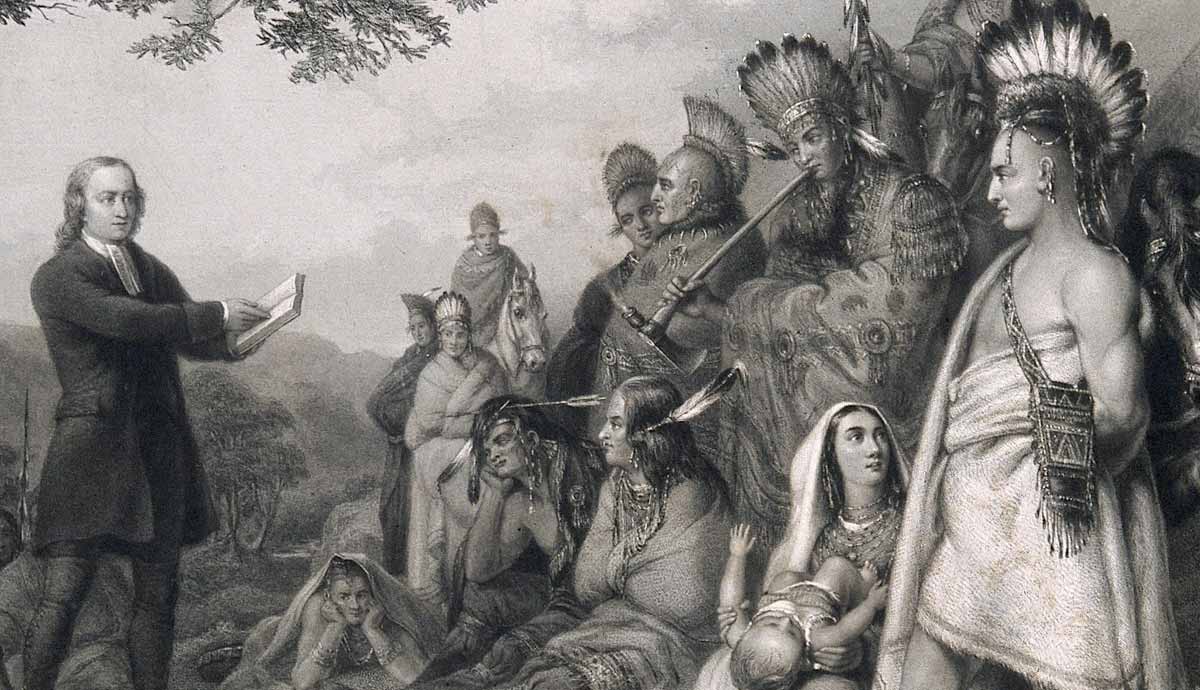
John Wesley preaching to native Americans, unknown artist and date. Source: The Wellcome CollectionThe Native American population reached around seven million before European contact. Estimates for all the Americans range up to or past 45 million. In North America, Native Americans are grouped into six tribes, numbering between three and seven million people. The Eastern Woodland groups, with their densely populated societies, such as the Iroquois, were the largest, being over 1.5 million people.Many Native people reached a high level of sophistication. For example, the Pueblo created complex agricultural systems. In the Woodlands, the Native Americans built centers like Cahokia. And trading networks connected many, spreading culture and increasing trade.By 1900, roughly 250,000 remained.The Biggest ContributorEnglish Landing at Jamestown 1607 Source: New York Public LibrarySeveral factors contributed to the collapse in Native American numbers, but none more lethal than disease. Old World diseases rampaged through Native American communities, especially after first contact. Due to a lack of exposure, these tribes had no acquired immunity. Some did exist, but nothing like what would come after 1500 CE. Another factor in play was isolation. Unlike heavily populated Europe, smaller populations meant less contact over time and fewer chances for transmission. This created a reduced gene pool, unlike most parts of the world.Smallpox proved especially deadly to Native Americans, striking in waves over decades. Tribes could easily lose half or more of their population in one outbreak. In America, diseases often preceded actual settlements, spreading among traders or through unintended carriers. In 1620, the Pilgrims landed at their future settlement to find swathes of land devoid of people. The cause? Weils disease, a blood infection spread by European rats. This contagion wiped out 90% of the local Wampanoag tribes.More than Just Disease16th century Aztec drawing of smallpox. Source: WikipediaWhile disease ranked as the highest killer of Native Americans, forced relocations ranked next. These relocations, either by force or broken treaty, killed thousands. European and later American settlements took the best land, often at the expense of Native Americans. Events like the 1832 Trail of Tears found Cherokee Nation tribes escorted from east of the Mississippi River to Oklahoma. Around 4,000 members died from exposure or starvation on the 1,000-mile march, much worse than shown below.The Impact of Relocations1832 Trail of Tears Source: PBSThe relocations disrupted traditional food gathering (hunting, farming, gathering). Upon losing their traditional lands, tribe members now lived in unfamiliar territory, often in arid or resource-poor areas. With good nutrition lacking or shelter removed, thousands more perished.U.S. government officials, termed Indian agents, interacted with Native American tribes. With primary responsibility for disbursing supplies and money, few did so. Most skimmed off the top, failed to deliver, or distributed insufficient or substandard goods. Thus, many tribe members starved or revolted.War and Involuntary AssimilationKiowa Drawing from Red River War 1874 Source: University of TexasAside from neglect, intentional or not, war and involuntary assimilation contributed to the Native American death toll. After first contact, Native Americans became embroiled in a nearly endless cycle of violence punctuated by wars. Though diseases killed more, war killed an estimated 15,000 plus Native Americans between 1850 and 1890. These conflicts occurred during Americas Manifest Destiny to settle the West. The casualties included women and children in events like the 1864 Sand Creek Massacre (up to 150 dead) and the 1890 Wounded Knee (350 dead).Only in one conflict did the Native tribes win: Red Clouds War between 1866 and 1868. The U.S. government asked for a treaty, unable to defeat the coalition led by Red Cloud, the Southern Cheyenne chief. The U.S. later violated the treaty, leading to the Great Sioux War.1887 Dawes Act Advertisements Source: Library of CongressThe near constant fighting disrupted Native American life and resettlement. Epidemics of cholera or smallpox became common, killing many. While disease and war directly killed thousands, forced assimilation indirectly helped. The 1887 Dawes Act aimed to assimilate Native Americans. Gradually, this act broke down Native tribes culturally and physically, with the government parceling out Native American lands.Decades later, research showed that Native American mortality jumped by 20%. The land parcel also caused a spike in miscarriages by up to 50%. Even Native American lifespan decreased, taking decades to recover. By 1900, Native American tribes had lost 98% of tribal lands.The sheer numbers of Native Americans killed are staggering. No specific records were kept; however, even scholarly research shows high numbers of deaths. The drop from upwards of seven million people to sub 250,000 is a 28-fold decrease or simply 1/28 of what existed before. Fortunately, Native American tribes have recovered in numbers to where they were prior.




 English
 Arabic
 French
 Spanish
 Portuguese
 Deutsch
 Turkish
 Dutch
Dutch
 Italiano
 Russian
 Portuguese (Brazil)
 Greek
Greek