Tiny mammoth ivory bird figurines found at Hohle Fels cave
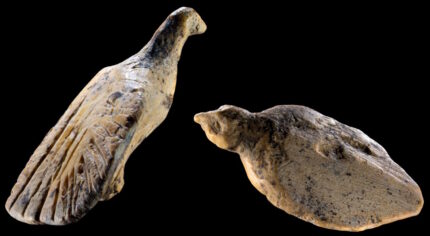
The Hohle Fels Cave in the Swabian Alps of southwestern Germany has yielded two more mammoth ivory figurines: tiny birds that despite their small size are carved with intricate anatomical details. One of them is a bird at rest, the other with wings outstretched, although one of the wings has broken off. They weigh just 1.3 and .7 grams each and may have been carried as talismans by the hunters who occupied the cave 40,000 years ago.The newly discovered birds are remarkably small. At two centimeters long, one centimeter wide, and half a centimeter high, the bird with outstretched wings is even the smallest of all the Ice Age artworks known to date in the World Heritage region. Most other Ice Age figures measure between three and nine centimeters. Despite their small size, the birds are exceptionally well-crafted: the resting bird has striking round eyes, the other a distinctive beak, and parallel markings on its wings that represent the birds plumage. Here, the mammoth tusk wasnt simply used to create some simplified form of a birds body, says [research director Professor Nicholas Conard from the Department of Prehistory and Early History at the University of Tbingen], here, precise observations of nature were translated into figures whose wealth of detail even allows for an examination of which bird species is depicted and what it is doing.While the majority of the Ice Age animal figurines are depicted in a static pose, the bird figurines exhibit specific behaviors. Professor Conards team interprets the resting bird, with its outstretched, flattened posture, head drawn close to its body, and legs tucked in, as possibly brooding. For the animal with the widely spread wings and elongated neck, interpretations range from flying or landing on the water to threatening or displaying courtship. Just as the animals body language cannot be definitively determined, so too can the species of bird. They may be ptarmigan, whose bone remains are frequently found in the regions archaeological record; however, the researchers are also considering other pheasant-like birds such as the capercaillie or certain birds of prey.This discovery brings the number of carved birds found at the UNESCO World Heritage site in the Achtal valley to three. (A water bird was discovered there 25 years ago.) No birds have been found at any of the other three Paleolithic sites in the area even though a plethora of other carved animals are represented.The Hohle Fels cave is home to some of the most extraordinary Paleolithic ivory artifacts including the Venus of Schelklingen, the oldest known human figurative art, the worlds oldest flutes and a unique rope-making tool. The birds will be displayed at the Blaubeuren Museum of Prehistory and Ice Age Art, the museum built near the Stone Age caves to showcase the artifacts found there, until April 3, 2027.




 English
 French
 Spanish
 Portuguese
 Deutsch
 Turkish
 Dutch
Dutch
 Italiano
 Russian
 Romaian
 Portuguese (Brazil)
 Greek
Greek