A Berry Picker Just Stumbled Upon The Remains Of A Downed World War II Plane In A Polish Forest
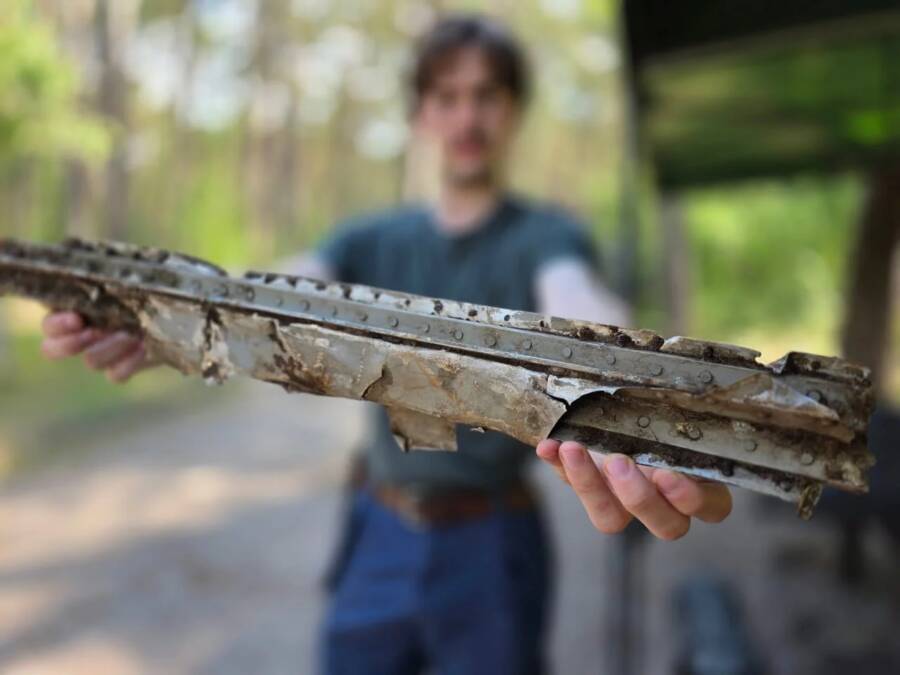
Muzeum Obrony Wybrzea w winoujciuA berry picker on a routine walk in the woods near the Polish city of winoujcie found a pit with metal debris from a World War II plane.For a man recently walking through a forest near the Polish city of winoujcie, a routine berry-picking outing turned into an astonishing moment of discovery. In the woods near the historic Fort Gerhard, the man came across a pit containing scattered pieces of metal.Convinced that the debris was not mere scrap metal, he brought a piece to the nearby Museum of Coastal Defense at Fort Gerhard. Now, after initial examination, museum experts believe that the metal belonged to a British aircraft that crashed in the woods during the waning days of World War II.The Chance Discovery Of Remains From A World War II Plane In A Polish ForestApart from the initial debris, experts from the museum also discovered ammunition and various metal components of a war plane.Muzeum Obrony Wybrzea w winoujciuExperts believe that the newly-uncovered remains come from a British Royal Air Force bomber.The very first inspection indicated that this was no random piece of scrap metal, said the museums Wiktor Czeszewski. The nature of the sheet metal, riveting, traces of aircraft structure, and spent ammunition indicate these are fragments of an aircraft.These finds, as well as the severely disturbed terrain, indicated to experts that this spot was likely the site of a wartime plane crash.Particularly helpful for the experts investigation was the ammunition recovered from the pit. After initial analysis, they determined the ammunition to be .303 British caliber cartridges, which were commonly used in Royal Air Force Browning machine guns during World War II.Muzeum Obrony Wybrzea w winoujciuExperts found identification numbers on the debris that are associated with the Royal Air Force.Therefore, experts speculated that the wreckage belonged to an Allied aircraft, likely one from the British Royal Air Force.During the excavation, experts also found a section of seamless copper tubing with an identification number. After carefully cleaning the tubing, researchers revealed the marking T7, a number used by the RAF on seamless copper tubing fitted to oil, fuel, and gas systems on its planes.In 2009, a different numbered tube that some researchers believed was once part of a Rolls-Royce Merlin engine was found less than half a mile away from this crash site. Researchers are now cautiously linking this discovery with the earlier find, which would mean that this combined wreckage belongs to a single plane, either a Lancaster heavy bomber, a de Havilland Mosquito, or another Allied aircraft powered a by Merlin engine.Muzeum Obrony Wybrzea w winoujciuFragments of a Lancaster aircraft were found less than half a mile away 17 years ago.However, any connection between this find and the one from 2009 remains speculative for now. We cannot state with complete certainty what type of aircraft this was. However, all the available evidence suggests we are dealing with the site of a major wartime incident, museum officials said.The Many Allied Planes Shot Down In The Region As World War II Drew To A CloseAlthough the exact model of the wrecked aircraft cannot be determined yet, the discovery still sheds important light on what happened in this region toward the end of World War II.During the final months of the war, winoujcie held an important position on the Baltic coast beneath major Allied flight paths leading toward bombing targets, including the Polish towns of Szczecin and Police, as well as many ports, shipyards, and industrial facilities across this German-occupied territory.Public DomainMuseum experts hypothesize that the aircraft was a Lancaster heavy bomber (pictured here), but they cant say for sure.Due to the citys location, it saw intense aerial operations in the closing months of the war. Germanys anti-aircraft defenses made the regions skies especially dangerous, and many Allied aircraft were lost in the area.Researchers hope that this newly-found wreckage could aid in the search for other missing aircraft that were lost toward the end of the war.We still have many questions and likely more than one surprise ahead of us, said museum official Milan Litwinowicz. An inconspicuous copper pipe may prove to be the first key to solving a mystery from over 80 years ago.In the meantime, the team has also warned against unauthorized excavation and exploration of the crash site.This is not a place for souvenir hunters, Czeszewski said. We cannot rule out the possibility that the remains of crew members are still buried here. The site must be professionally secured and investigated.The Provincial Conservator of Monuments, the Midzyzdroje Forest District and other organizations responsible for military memorials have all been informed about the site, allowing the team to start formal archaeological and forensic investigations.After learning about the chance discovery of a World War II crash site in Poland, read about how a metal detectorist in Poland found a 2,700-year-old bronze sword. Then, learn about the Allies four-day firebombing of Dresden that killed 25,000 people, mostly civilians.The post A Berry Picker Just Stumbled Upon The Remains Of A Downed World War II Plane In A Polish Forest appeared first on All That's Interesting.




 English
 Arabic
 French
 Spanish
 Portuguese
 Deutsch
 Turkish
 Dutch
Dutch
 Italiano
 Romaian
 Portuguese (Brazil)
 Greek
Greek