


ALLTHATSINTERESTING.COM
The Strange Story Of Albanias Pyramid, The Communist Monument That Became A Cultural Hub
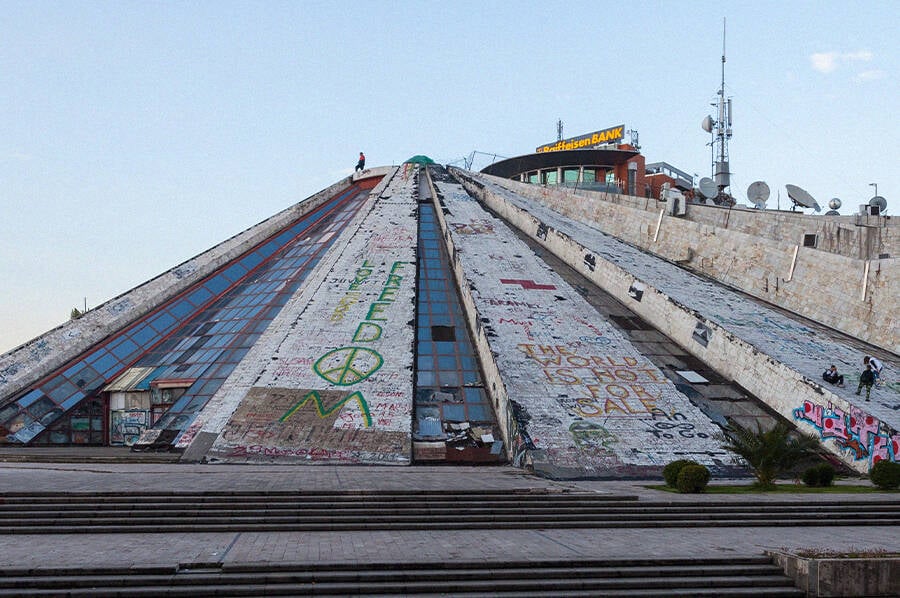
Diego Delso/Wikimedia CommonsBuilt as a monument to dictator Enver Hoxha, the Pyramid of Tirana fell into disrepair after the collapse of communism in Albania.Travel to the capital of Albania, and youll see a surprising structure: an illuminated pyramid near the heart of the city.Today, the pyramid is a cultural destination but it didnt start that way. The origins of the structure can be traced back to Albanias former dictator, Enver Hoxha.Under Hoxha, Albania was one of the most isolated countries on Earth. While he cooperated with other communist and socialist states at the beginning of his rule, he gradually dissolved these relationships, convinced that each one had become revisionist. At the same time, Hoxha became increasingly paranoid imprisoning, exiling, or executing suspected enemies while forbidding citizens to leave the country and filling the countryside with concrete bunkers to prepare for an invasion that would never come.When Hoxha died in 1985, the country was still largely in the grips of his cult of personality. As a result, it was announced that a museum would be built to memorialize him and honor his reign. This monument would take the form of a polished marble pyramid, placed directly in the center of Tirana.Enver Hoxhas Museum After The Fall Of CommunismIn 1988, three years after Hoxhas passing, the Enver Hoxha Museum opened in Tirana. Designed by a team including Hoxhas own daughter, architect Pranvera Hoxha, and her husband, Klement Kolaneci, the museum served as a shrine to the former leader.The museum boasted numerous photographs and personal possessions from Hoxhas life and even housed a 22-ton statue of the man, which greeted all who entered. The peculiar pyramid shape would become a distinctive addition to the Tirana skyline, with its outline complemented and potentially inspired by the nearby Mount Dajti. It was reportedly the most expensive individual building constructed in communist Albania. Public DomainEnver Hoxha, Albanias former dictator.The Enver Hoxha Museum, however, would be short-lived. Soon after Hoxhas death, tensions rose within the country and by April 1991, the Peoples Socialist Republic of Albania was no more.As the remnants of communist rule were dismantled, it became clear that the new Albania had no place for a museum dedicated to its former dictator. So, the contents of the museum were removed, and the building itself was hastily renamed the International Center of Culture while a purpose for the structure was determined.As it turns out, finding a use for an enormous pyramid is more difficult than one might think. Initially, the building simply served as a site for conferences and trade fairs. From there, its uses became fairly scattered: It briefly housed a nightclub called Mumja (or The Mummy) before becoming a home base for NATO and humanitarian operations during the 1999 Kosovo War. It was also the temporary headquarters of broadcasters Top Channel and Top Albania Radio.But as the building fell into disrepair, a new purpose emerged.How Albanias Youth Took Over The Pyramid Of TiranaAs the building fell apart and became less desirable to tenants, it found a new audience: teenagers.While the public was largely denied access to the interior of the building, it became a central meeting point for the citys youth. Kids climbed up the pyramid and slid down its smooth embankments. Teens snuck away with their partners to the top, turning the peak into a place where they could smoke cigarettes and enjoy each others company away from the prying eyes of the public. Graffiti artists, too, took to the monument and by the early 2010s, the pyramid was covered in artworks and political slogans.At this time, the interior of the pyramid was, for all intents and purposes, unusable. Every tenant left a scar on the building, and by 2010, the pyramids marble cladding had deteriorated or disappeared, its glass roof was leaking, and the building was too dark and cluttered to serve any actual purpose.David.r.1929/Wikimedia CommonsAfter a massive renovation, the Pyramid of Tirana reopened in 2023 as a state-of-the-art technology center for the citys youth.The government suggested demolition, commissioning an Austrian firm to design a new parliament building. This was quickly met with backlash from citizens, who delivered a petition to stop the buildings destruction. No one in a normal state of mind would ever decide to demolish the Pyramid, Adrian Klosi told Albanias Top Channel in 2011. This is a caprice, or maybe more than that. This is a big affair and many people could make a fortune out of it, while the Albanian culture will become poorer.While the plan was ultimately abandoned, the future of the pyramid remained uncertain. Eventually, it was announced that the former monument would be refurbished and turned into a genuine cultural hub.To do this, Dutch architecture firm MVRDV used the current building as a template. Seeing that kids liked to climb up the pyramid and sit at its top, they turned that into a central feature, adding staircases along the sides of the building. The purpose of this new structure would primarily focus on the youth who had embraced it so wholly: the exterior would be filled with cafes, bookstores, and restaurants, while the interior would host classes to teach children and teens coding and other skills. The resultant building, known simply as the Pyramid of Tirana, opened in October 2023.Today, the pyramid has become an icon in Tirana once again even if its new purpose differs greatly from its original.After learning the history of the Pyramid of Tirana, go inside the story of King Zog, the Albanian monarch who survived over 50 assassination attempts. Then, read about Templo Mayor, the massive pyramid built by the Aztecs.The post The Strange Story Of Albanias Pyramid, The Communist Monument That Became A Cultural Hub appeared first on All That's Interesting.
0 Комментарии
0 Поделились
25 Просмотры

 English
 Arabic
 French
 Spanish
 Portuguese
 Deutsch
 Turkish
 Dutch
Dutch
 Italiano
 Romaian
 Portuguese (Brazil)
 Greek
Greek