


ALLTHATSINTERESTING.COM
How Five Points Became The Most Infamous Slum In The History Of New York City
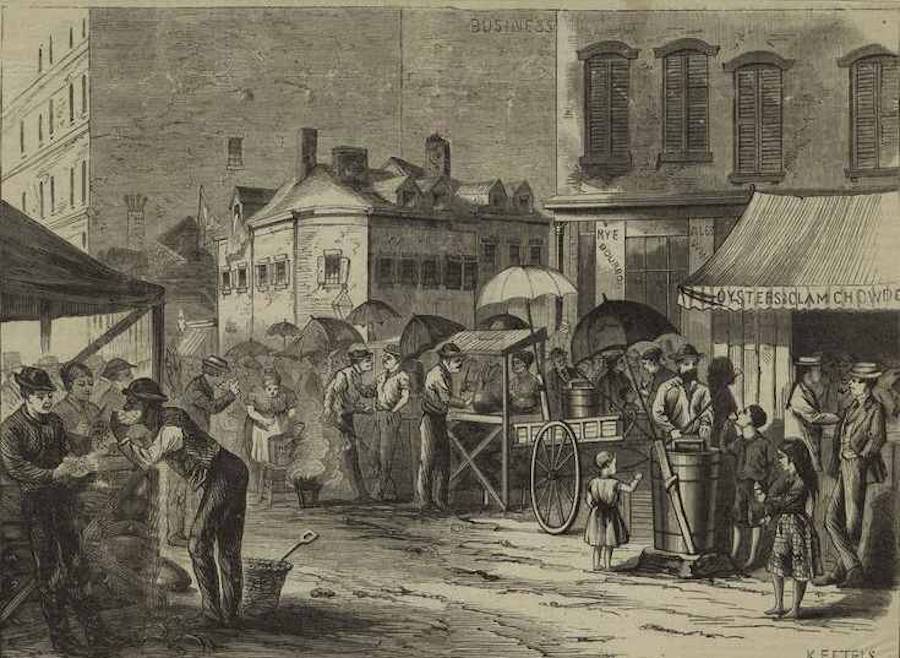
Public DomainA 19th-century depiction of the impoverished Five Points neighborhood.In the mid-19th century, the Five Points neighborhood of Manhattan was perhaps the most dangerous place in New York City. In addition to a high rate of violent crime, the area was a cesspool for disease, and squalid living conditions further contributed to the poor health of residents.Five Points was built on the land that once held Collect Pond in Lower Manhattan, near present-day Chinatown. In 1811, the pond was filled in so a middle-class neighborhood could be constructed on the site, but poor drainage left the streets full of mud and mosquitoes. The wealthier families fled, leaving the neighborhood to those who couldnt afford to live elsewhere.When Irish immigrants began pouring into the city in the 1800s, many of them found themselves living in crowded tenements in Five Points. To further their interests and protect themselves from those who opposed immigration, they formed street gangs. The most infamous was the Dead Rabbits, who had a heated rivalry with the nativist Bowery Boys that often erupted into violence.This violence ultimately spelled the end for the neighborhood. By the end of the century, it had all but vanished due to redevelopment and city initiatives to clear out crime-ridden areas. Walking through the streets that once made up Five Points today, you would never know that it was once New York Citys most notorious slum.The Emergence Of The Five Points Neighborhood In New York CityAs settlers first arrived in New York City in the 1600s, the main source of fresh drinking water was Collect Pond, which was centered on what is today the intersection of Leonard Street and Centre Street. By the early 19th century, businesses had sprung up around the pond, severely polluting it.Public DomainPainter Archibald Robertsons 1798 depiction of Collect Pond in Lower Manhattan.So, around 1811, Pierre Charles LEnfant the same engineer who designed Washington, D.C. suggested that the city fill in the pond to create more room for housing. The first neighborhoods that were constructed in the area consisted mostly of middle-class homes, but these residents soon fled as it became evident that the project was plagued by drainage issues. Mud and feces filled the streets, and mosquitoes thrived in the damp conditions.As wealthier families left, the abandoned houses were left to people who couldnt afford to live anywhere else mostly newly emancipated Black Americans and immigrants who had just arrived from Ireland. Many buildings were transformed into tenements, which quickly became overcrowded. By 1850, each small apartment held an average of six people.This mix of nationalities led to a unique blend of cultures. For instance, the combination of West African rhythms and Irish jigs led to the emergence of tap dance. However, it also led to strife that often turned violent. This tension was heightened by anti-immigrant New Yorkers who hated the Irish, Catholics, and anyone who wasnt a born-and-bred native.Its been said that Five Points had the highest murder rate of any slum in the world. And one urban legend claimed that the neighborhoods most infamous tenement, the Old Brewery, saw at least one murder per night for 15 years straight between 1837 and 1852.Public DomainThe Bowery Boys were involved in frequent brawls with the Dead Rabbits in the streets of Five Points.In order to protect themselves, Irish immigrants banded together to form street gangs. The most well-known was the Dead Rabbits, whose greatest enemies were the Bowery Boys a local nativist gang led by William Bill the Butcher Poole with members who lived in the adjoining Bowery neighborhood. This rivalry was so historic that it inspired the 2002 Martin Scorsese film Gangs of New York.But violence wasnt all that Five Points was known for.The Squalid Conditions Of Manhattans Most Notorious SlumAs the 19th century progressed, even more immigrants flooded into New York. Many were from Italy, including Adolfo Rossi, a journalist who moved to the city to document the lives of his fellow Italians. He served as the editor of the daily newspaper Il Progreso Italo-Americano.In the 1880s, he described life in the Five Points neighborhood of Manhattan in the paper:The vast majority of our compatriots, comprised of the wretched class from the southern provinces, live in the dirtiest neighborhood in the city, called the Five Points. It is an agglomeration of repulsive, dilapidated, black houses where people are piled on top of each other worse than beasts. Large families live in only one room: men, women, dogs, cats, and monkeys eat and sleep together in the same cubbyhole without air or light.This high population density, combined with the general filth on the streets, allowed diseases to spread rapidly through the neighborhood. Cholera, tuberculosis, malaria, and typhus were common, and childhood mortality rates were high.The 1832 cholera epidemic that swept through New York City devastated Five Points. Many residents outside of the neighborhood reportedly blamed the inhabitants for the disease, claiming that theyd brought it upon themselves due to their sin and debauchery.Library of CongressAn 1873 drawing from Frank Leslies Illustrated Newspaper titled Among the Poor A Summer Evening Scene at the Five Points.New York City officials eventually had enough of the murder, prostitution, and crime that plagued Five Points and they started making plans to destroy the problems at the source.The Fall Of Five PointsNew Yorkers were petitioning to have Five Points destroyed as early as the 1820s. In 1829, merchants in the neighborhood which was bordered by Centre Street, the Bowery, Canal Street, and Park Row asked the city to widen the streets that ran through it, demolishing the bulk of the slum in the process.Public DomainBandits Roost in Mulberry Bend, the heart of Five Points tenement slums.In the petition, the merchants stated, That the place known as Five Points has long been notorious as being the nursery where every species of vice is conceived and matured; that it is infested by a class of the most abandoned and desperate character.They further noted that residents of the slum may be enticed from the path of rectitude, by being familiarized with vice; and thus advancing step by step, be at last swallowed up in this sink of pollution, this vortex of irremediable infamy.These efforts were renewed in 1890, when Jacob Riis published How the Other Half Lives. His book exposed the realities of life in the Five Points neighborhood, and public leaders were spurred to action.Public DomainJacob Riis famous photo of a crowded tenement on Bayard Street, where lodgers paid five cents for a place to sleep.Some of the worst parts of the slum were razed, and the dens of death were replaced by a public park (now known as Columbus Park). Other sections of the neighborhood were revitalized, a project led in part by Christian charities one of which purchased the Old Brewery and turned it into a mission house.By the dawn of the 20th century, Five Points had all but vanished. Today, the area is encompassed by Chinatown and Lower Manhattans Civic Center neighborhood. Tenements and crime-ridden saloons have been replaced by government buildings, souvenir shops, and expensive apartments a far cry from the modern Sodom that the area was once considered.After reading about the history of New Yorks Five Points neighborhood, learn about the Five Families that ruled the New York City Mafia. Then, look through these photos of New York City slums at the turn of the 20th century. The post How Five Points Became The Most Infamous Slum In The History Of New York City appeared first on All That's Interesting.
0 Комментарии
0 Поделились
24 Просмотры

 English
 Arabic
 French
 Spanish
 Portuguese
 Deutsch
 Turkish
 Dutch
Dutch
 Italiano
 Romaian
 Portuguese (Brazil)
 Greek
Greek