What Distinguishes the B-24 Liberator from Other WWII Bombers?
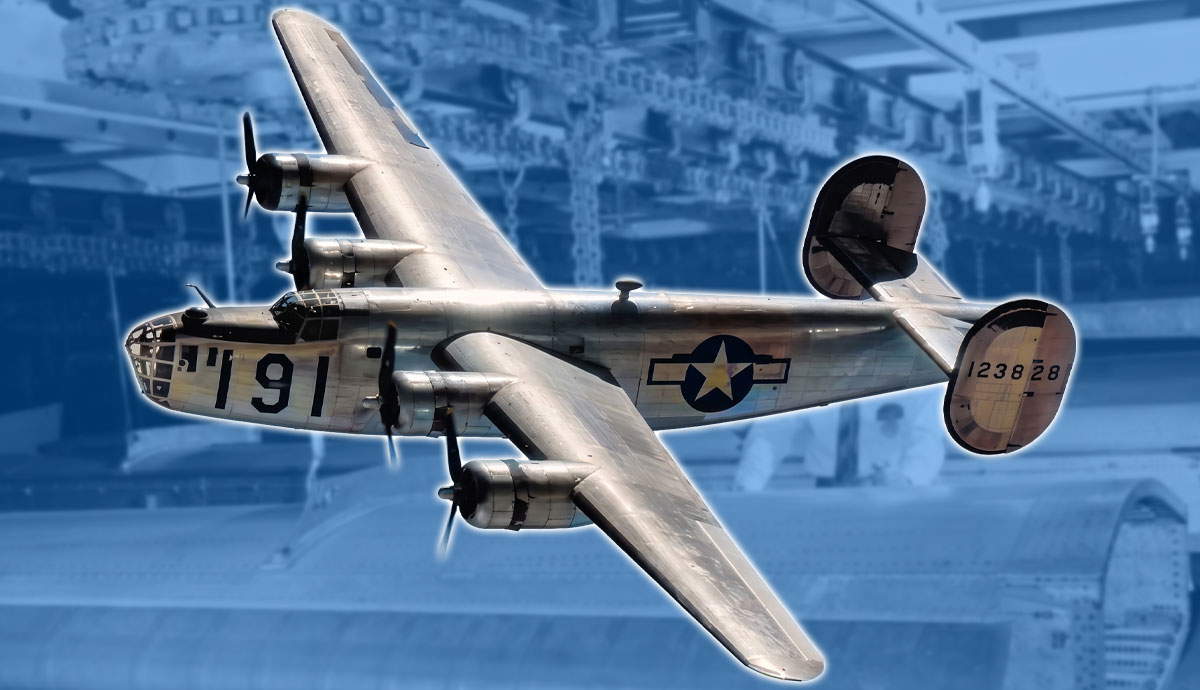
During World War II, the US Army Air Force called for a bomber with a larger bomb load, greater speed, and much greater range than its rivals, particularly the B-17. To achieve this, Consolidated Aircraft used the radical Davis wing in the construction of the new, innovative B-24 Liberator. This new high aspect ratio wing (long and narrow) provided greater lift and reduced drag. It allowed the B-24 to carry more fuel efficiently and fly further. The twin tail also meant the B-24s maneuverability and speed increased, reaching 290 MPH and a 28,000-foot ceiling. Consolidated won the government contract on March 30, 1939.The B-24 could carry up to 8,800 pounds. Designers took this attribute and tweaked the B-24 in unanticipated ways. Its tricycle landing gear afforded better ground stability.Where Was the B-24 Produced?Engine Installation at Willow Run. Source: Library of CongressIn 1941, America armed the Allies via Lend-Lease for national defense. The US government paid for Willow Run (Michigan) to meet demand for the new B-24. This new factory space, built in a year, incorporated five million square feet under a single roof and built nearly half of all the B-24s.The Ford Motor Company, renowned for its assembly line approach, managed the factory. Fords son, Edsel Ford, supervised production. Employing 42,000 people, the plant built 8,685 Liberators. Willow Run workers became so skilled by 1944 that they assembled one B-24 every 63 minutes. Around 18,400 B-24s rolled out of American factories, owning the record for the most American warplanes produced. Consolidateds other factories went on to build thousands more in Texas and California.How the B-24 Liberator Showed Its Adaptability in Multiple RolesXB-24 Prototype. Source: Vintage Aviation NewsWhile the B-17 excelled as a heavy bomber, the Liberator became the plane that exceeded design expectations. While overshadowed by the famous Flying Fortress, the Liberator served in more theaters and roles. Designers exploited the Liberators strengths, tweaking the basic design to meet the needs of different war theaters. The RAF liked its excellent range, converting it to transports designated LB-30. The AT-22 trainer appeared in 1942 to train Liberator crews. Consolidated also created the C-87 Liberator Express in 1942, building around 287 models.The C-87 filled a gap where twin-engine C-47s couldnt operate, like the Himalayas. Here, the Allies flew supplies to China, regularly flying over 20,000-foot peaks. They could reach farther into China thanks to their higher ceilings and fuel capacity. The Himalayan route, called The Hump, also saw B-24s used as fuel carriers designated as C-109s. Crews removed all weapons, bomb equipment, and turrets, replacing them with large fuel tanks.The C-109s carried up to 2,900 gallons of gas. Crews found these flammable, flying gas tanks challenging to handle during landing or in flight. Because of these gas flights, crews nicknamed the C-109 The Flying Bomb, rightly so, with much stored fuel.A Campaign in Which the B-24 Proved InvaluableB-24 Liberator. Source: Imperial War Museums / Wikimedia CommonsThe Liberators shining moment came in 1941 in the Battle of the Atlantic. Since 1939, German U-boats decimated Allied supply convoys, often in groups or wolf packs, sinking ships by the hundreds. And exactly in the center of the Atlantic was the mid-Atlantic gap. Here, U-boats operated freely until the Liberators arrival.The B-24s great reach enabled the four-engine heavy to wreak havoc. Liberators closed that gap by flying from bases like the Azores, England, and Ascension Island. Weapons included depth charges, bombs, and the dreaded 22 million-lumen Leigh searchlight.U-boats surfaced nightly to charge batteries or cruise faster. Before the Liberator, most did so impudently in the mid-Atlantic gap. Now, B-24s pounced using radar, spotlighting their foes with the Leigh Light. U-boat losses skyrocketed, and Allied ship losses were reduced significantly. By mid-1943, the Atlantic Campaign was essentially over, partly because of the Liberator. In the Pacific theater, the B-24 became Americas mainstay bomber. By 1943, all bomber squadrons flew the Liberator, utilizing its range over the Pacific Oceans empty spaces. The B-24 would be partially replaced by the B-29 Super Fortress in 1944.What Structural Flaws and Combat Vulnerabilities Did the B-24 Have?A B-24 losing its wing after being hit by flak. Source: USAAF / Wikimedia CommonsNo plane is immune to flaws. The B-24s distinct advantage was the Davis wing. Built along a central spar, it meant a thinner wing, but if broken, the entire wing collapsed, often disastrously. Unable to absorb damage like the B-17, this meant higher loss rates. Though both heavies were important, the B-24s range, speed, and versatility gave it the edge. Unlike the B-17, the Liberator would fly in all of Americas deadliest WWII combat zones.




 English
 Arabic
 French
 Spanish
 Portuguese
 Turkish
 Dutch
Dutch
 Italiano
 Russian
 Romaian
 Portuguese (Brazil)
 Greek
Greek