


ALLTHATSINTERESTING.COM
How Eight Climbers Perished In A Blizzard While Descending Mt. Everest In 1996
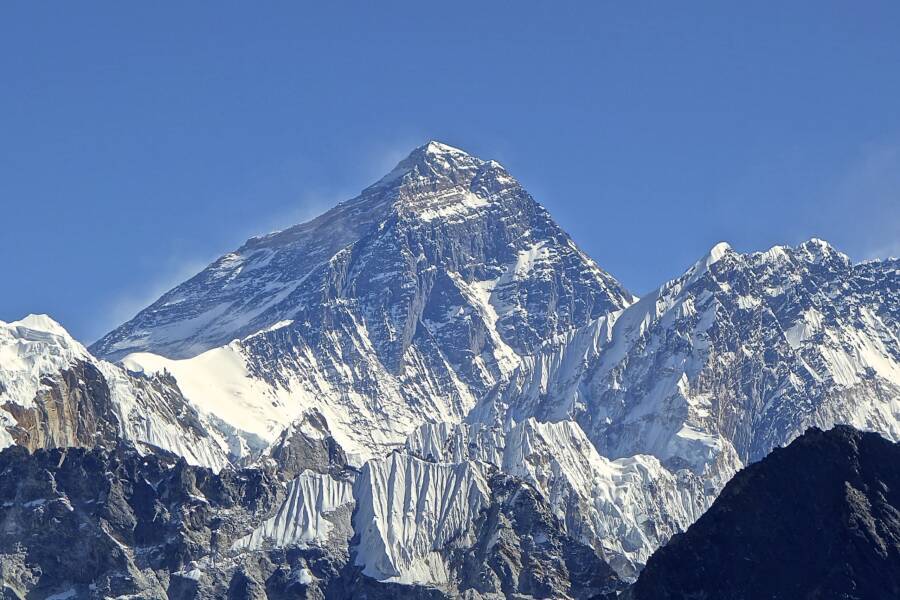
Rdevany/Wikimedia CommonsBetween May 10 and 11, 1996, eight climbers perished when a blizzard struck Mt. Everest.The 1996 Mt. Everest disaster was one of the greatest tragedies in the mountains history. On May 10, 1996, at least 33 climbers set out to summit the worlds highest mountain. Eight of them would never make it back down.Due to various delays and the climbers determination to reach the peak despite the waning day, dozens of people found themselves caught in a blizzard and trapped in the Death Zone overnight. Some of them like Beck Weathers eventually managed to make it back to camp, but others perished on the side of the mountain.Rob Hall spent his final moments on the phone with his wife choosing a name for their unborn child. Yasuko Namba died from exposure hours after becoming the oldest woman to summit Everest. And Dorje Morups frozen body became a grisly landmark known as Green Boots.At the time, the 1996 Everest disaster was the mountains deadliest day. It was later overtaken by staggering death tolls from avalanches in 2014 and 2015, but the tragedy remains a chilling reminder of the perils of nature and just how fragile life truly is.What Caused The 1996 Mt. Everest Disaster?In the early morning hours of May 10, 1996, three teams set out from the South Col of Mt. Everest with plans to reach the peak by early afternoon. One group was led by Rob Hall, the head of the Adventure Consultants team. He was an experienced mountaineer who had already summited Everest four times. Halls clients included Jon Krakauer, a journalist who would later document the 1996 Everest disaster in his book Into Thin Air.FORA.tv/YouTubeRob Halls Adventure Consultants team before beginning their summit attempt. Four of them would die on the mountain: Doug Hansen (front, far left), Andy Harris (front center in black), Rob Hall (to the right of Harris in purple), and Yasuko Namba (front, far right). Another group, the Mountain Madness team, was headed by Scott Fischer, who was known for climbing some of the worlds highest mountains without using supplemental oxygen. These two groups were joined by a smaller Taiwanese expedition. Meanwhile, a group of six men with the Indo-Tibetan Border Police were attempting to summit from the Northeast Ridge. This team included Tsewang Paljor and his fellow officer, Dorje Morup. The expedition got off to a rocky start. The Sherpas and guides hadnt set up the fixed ropes ahead of time, so climbers were delayed as they waited for the lines to be installed. This also led to traffic jams in narrow stretches along the route, as everyone was arriving at the same time. Wes Krause/Wikimedia CommonsScott Fischer, the leader of the Mountain Madness team, scaling Mt. Annapurna in 1984.Hall had informed his team members that they must turn around to begin their descent by 2 p.m., even if they hadnt yet reached the summit. As recorded in Into Thin Air, he reportedly told Krakauer, With enough determination, any bloody idiot can get up this hill. The trick is to get back down alive.Halls words would tragically prove prophetic. Due to the delays along the way, few climbers reached the summit within the allotted time. But instead of turning back around as Hall had ordered, many of them continued up the mountain, determined to fulfill their goal. They didnt realize that an unexpected blizzard was approaching and it was about to leave them stranded in the Death Zone.The Blizzard That Killed Eight ClimbersAround 3 p.m., the weather on Mt. Everest started deteriorating, and by 5 p.m., the blizzard had begun in earnest. While the climbers had turned around by that point, they didnt have time to get back to camp. Their descent would have taken hours in ideal weather, and in whiteout conditions, the task was virtually impossible.Tirthakanji/Wikimedia CommonsThe blizzard came on so suddenly that climbers didnt have time to make it back to Camp IV on the South Col.Visibility was close to zero, temperatures plummeted to around negative 22 degrees Fahrenheit, and the wind reached speeds of more than 45 miles per hour. The fixed ropes were buried in snow drifts, obscuring the path back down the mountain. Whats more, many climbers were running low on supplemental oxygen, and any delays during their descent would leave them unable to breathe.It was chaos up there, Krakauer told TIME in the immediate aftermath of the 1996 Everest disaster. The storm was like a hurricane, only it had a triple-digit wind chill. You dont have your oxygen on, youre out of breath, you cant think.Rob Hall was stuck near the top of the mountain helping his client Doug Hansen, who had run out of oxygen. Scott Fischer had begun his descent, but he was suffering from altitude sickness and exhaustion and sent his Sherpa on without him. Meanwhile, the Indo-Tibetan Border Police team radioed their commander to tell him theyd reached the summit but they were never heard from again. Its possible that they were actually several hundred feet short of the peak but couldnt tell because visibility was so low by that point.Debasish biswas kolkata/Wikimedia CommonsRob Hall and Doug Hansen were stranded on the South Summit just a few hundred feet from the mountains peak.One group of 11 climbers managed to get within 300 yards of the South Col camp but couldnt find the tents in the raging whiteout. Around midnight, there was a brief break in the storm that allowed some of the stronger members of the group to make their way to the camp for assistance. They left several of their teammates behind, including Beck Weathers and Yasuko Namba, who were both too weak to move.By the time help arrived, Namba was close to death and Weathers had vanished. In order to save more people, rescuers left Namba where she was. But several hours later, Weathers shocked everyone by stumbling into camp. He was suffering from severe frostbite, but against all odds, he survived. Unfortunately, the same couldnt be said for eight of his peers.The Victims Of The 1996 Mt. Everest DisasterAs dawn broke on May 11, Rob Hall radioed base camp. He reported that Hansen had died and Andy Harris, who had arrived during the night to help the men, had gone missing. Hall attempted to continue his descent, but he was exhausted, and his hands were too frostbitten to hold onto the few fixed ropes that were still visible.That afternoon, Hall called camp again and asked his team to phone his wife, who was pregnant with their first child. Over the radio, they chose a name for their baby together. As TIME reported in 2007, Halls final words to her were, Sleep well, my sweetheart. Please dont worry too much. He died shortly after.Samuel Saidel Goley/Wikimedia CommonsA memorial dedicated to Scott Fischer in Nepal.Scott Fischers body was also found that day. Anatoli Boukreev, a Mountain Madness guide who rescued several other climbers during the 1996 Everest disaster, came across his frozen corpse near the spot where his Sherpa had left him the previous afternoon. According to National Geographic, Boukreev reported back to camp, His oxygen mask is around face, but bottle is empty. He is not wearing mittens; hands completely bare. Down suit is unzipped, one arm is outside clothing. There is nothing I can do. Scott is dead.Yasuko Namba perished on the mountain, too. At 47, she had just become the oldest woman to summit Mt. Everest, a record she would hold until 2000. The other three deaths from the 1996 Mt. Everest disaster were the three members of the Indo-Tibetan Border Police: Tsewang Smanla, Dorje Morup, and Tsewang Paljor. In the aftermath of the tragedy, a corpse with bright green boots was found huddled in a cave along the path. It was long believed to belong to Paljor, but DNA analysis recently identified it as Morup. For years, the body served as a landmark for other climbers as they made their way toward the summit.Maxwelljo40/Wikimedia CommonsThe famous Green Boots body is that of Dorje Morup, who died in the 1996 Everest disaster.These eight victims knew the risk they were taking when they set out to climb Mt. Everest, but that didnt stop people from pointing fingers in the aftermath of the tragedy. Hall and Fischer were blamed for allegedly putting profit over safety. As the heads of rival companies, they wanted to get as many clients to the top of the mountain as possible to bolster their success rates even if that meant bending the rules on the 2 p.m. cutoff to turn around.Sir Edmund Hillary one of the first two people to summit Mt. Everest, along with his Sherpa, Tenzing Norgay also spoke out about the commercialization of Mt. Everest in 2003. As he told TIME, the 1996 Everest disaster was inevitable. Hillary continued, Ive been forecasting a disaster of that nature for some time. And it will happen again.After reading about the 1996 Mt. Everest Disaster, learn about the dead bodies that litter the worlds highest mountain. Then, discover how British explorer George Mallory perished on Mt. Everest in 1924. The post How Eight Climbers Perished In A Blizzard While Descending Mt. Everest In 1996 appeared first on All That's Interesting.
0 Commenti
0 condivisioni
9 Views

 English
 Arabic
 French
 Spanish
 Portuguese
 Deutsch
 Turkish
 Dutch
Dutch
 Russian
 Romaian
 Portuguese (Brazil)
 Greek
Greek