Why Billions of People Are Still Ruled by Napoleons Code
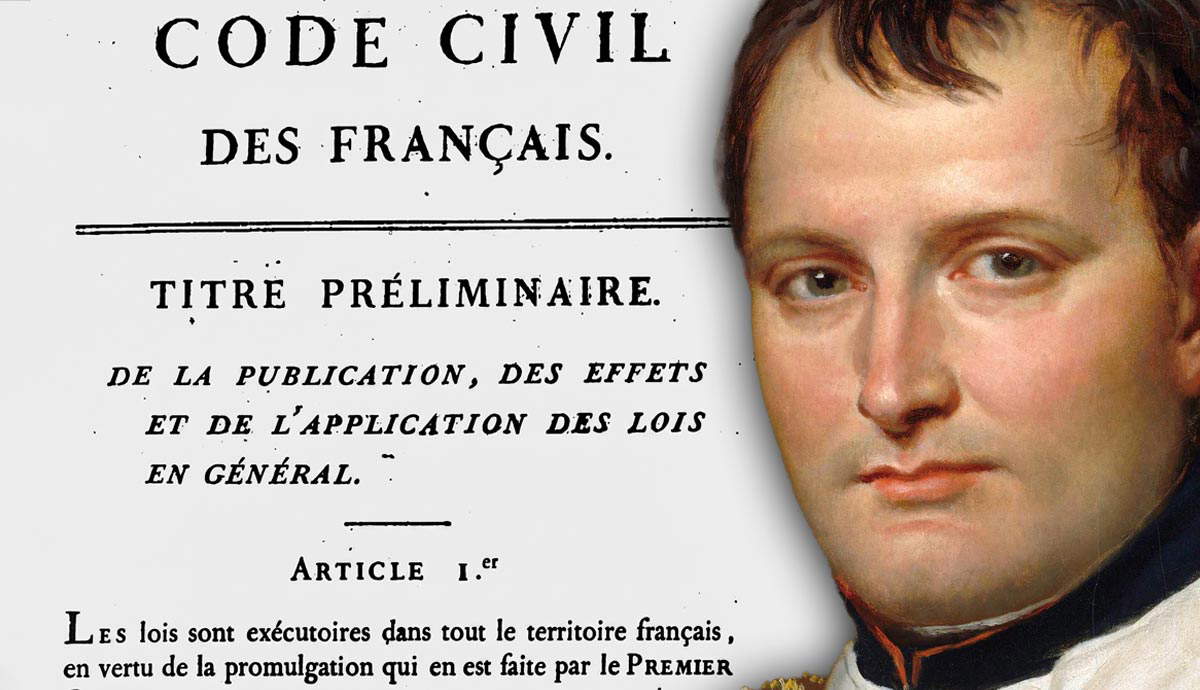
Before the creation of Napoleons Code in the 19th century, France faced legislative chaos as it had no single unified law. In the south of France, written Roman law was used predominantly. To the north, where old Germanic Frankish tribes had settled after the fall of Rome, hundreds of different local customary laws existed. These conflicting laws meant that a traveler taking a horse and carriage through France in the late 1700s needed to follow many changing laws during his journey. As a result, legal reforms became one of the main goals of the French Revolution of 1789.There was, however, little progress until Napoleon Bonaparte rose to power as First Consul. In 1800, Napoleon appointed a four-man commission of jurists that included Jean-tienne-Marie Portalis, Franois Denis Tronchet, Flix-Julien-Jean Bigot de Prameneu, and Jacques de Maleville to draft the new code. Napoleon personally presided over many of the sessions to debate the laws. He made sure that the code would be clear and simple enough for everyday citizens to understand.The Radical Principles That Shattered Feudal EuropeThe Napoleonic Code in the Historical Museum of the Palatinate in Speyer. Source: Wikimedia CommonsThe original Napoleonic Code contained 2,281 articles when it was published in 1804 and was based on three major principles The Law of Persons (Jus personarum), The Law of Property (Jus rerum), and The Law of Actions (Jus actionum). The changes it brought ended feudal privileges based on birth and kept the Enlightenment principles from the Revolution. The code also separated the government from the church by creating civil laws for marriage and divorce. Before the code, the Catholic Church controlled matters of personal status. By placing these matters under state control, the churchs authority over people declined.The law did, however, heavily favor men. Wives were, for example, required to obey their husbands, and children were under strict paternal authority. This reflected Napoleons wish to restore a traditional family structure after years of legal uncertainty.Why Europe Kept Napoleons Laws After His DefeatEmperor Napoleon in His Study at the Tuileries, 1812 by Jacques-Louis David. Source: National Gallery of Art / Wikimedia CommonsWhile the Napoleonic Code was first used only in France, Napoleon Bonapartes Grande Arme spread the legal framework to other nations as it moved across Europe. The army introduced the laws to Belgium, Luxembourg, the Netherlands, and parts of what are now Germany and Italy. Even today, the code is seen as one of the first steps toward a more unified legal system across the continent. Many countries kept the code after Napoleon was defeated at the Battle of Waterloo in 1815 because it made trade and business easier. This aspect appealed to a growing middle class that wanted stable commercial laws.The Global Conquest of French LawModern map of the United States overlapped with territory bought in the Louisiana Purchase (in white). Source: Wikimedia CommonsEven before the Battle of Waterloo, the codes influence had reached across the Atlantic. When the United States purchased Louisiana from France in 1803, just one year before the Napoleonic Code was officially published, the territory created its own civil code based on the Napoleonic Code in 1808 and made a major revision in 1825. French law was used again about half a century later when the drafters of the 1866 Civil Code of Lower Canada (now Quebec) turned to the French system for guidance.When nations in South America, Africa, and Asia wanted to modernize their legal systems in the 19th century, many looked to Napoleons Code. Leaders such as Andrs Bello of Chile used the Napoleonic Code as the foundation for a new system to replace the old laws left by Spanish colonizers. Brazil and Argentina followed similar paths.Why Napoleons Legacy Still Rules 120 Countries TodayFirst page of the 1804 original edition of the Napoleonic Code. Source: Wikimedia CommonsThe Ottoman Empire also added French legal principles during its 19th-century reforms known as the Tanzimat, and Egypt adopted French legal structures during its modernization in the late 19th century. While Japan and Turkey later chose to use laws from Germany and Switzerland in the 20th century, they still shared the global goal of creating a logical, written system for their citizens. The result was a global family of civil law systems that use clear logic and flexibility to handle everything from divorce cases to international business.Currently, Napoleons Code serves as the foundational law in approximately 120 legal jurisdictions, including most of Europe (excluding Britain and its former colonies), Latin America, and parts of Africa and the Middle East. Most modern legislatures that have based their laws on the code have updated their laws with new statutes to solve emerging issues such as those dealing with digital intellectual property rights.




 English
 Arabic
 French
 Spanish
 Portuguese
 Deutsch
 Turkish
 Dutch
Dutch
 Russian
 Romaian
 Portuguese (Brazil)
 Greek
Greek