Researchers In Hungary Just Used DNA Analysis To Reconstruct Ancient Romans Faces Right Down To Their Eye Color
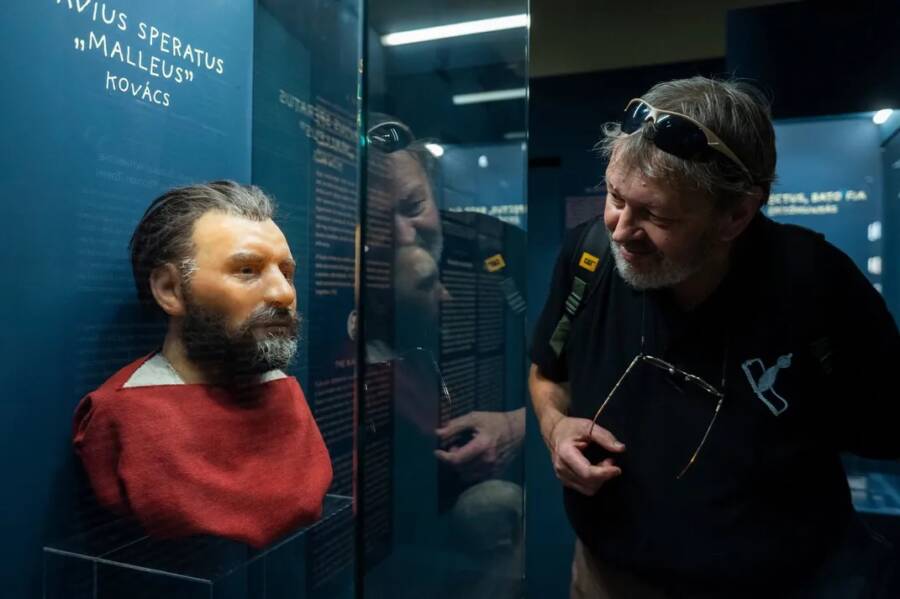
Aquincum MuseumAn exhibit at the Aquincum Museum in Budapest features 16 facial reconstructions of ancient Romans who lived in the area some 2,000 years ago.Nearly 2,000 years ago, the ancient Roman city of Aquincum was bustling with 15,000 residents, even serving as the capital of the Roman province of Lower Pannonia. Now, the city lies in ruins beneath modern-day Budapest, Hungary, but researchers have just helped bring Aquincums story back to life.While many of the ancient citys walls and structures have been preserved and the bones of its residents have been unearthed, the actual faces of the individuals who lived in Aquincum have been lost to history until now. In an exhibit that opened at Budapests Aquincum Museum in June, researchers have reconstructed the faces of 16 ancient residents of Aquincum.Reconstructing The Faces Of 16 Ancient Romans Who Once Lived In AquincumThe exhibit, entitled Once We Were Like You, opened in late June and will run through October. The main goal of curators and researchers was to give 21st-century audiences an intimate understanding of what life was like for these people two millennia ago.Wikimedia CommonsAt the peak of the Roman Empires power, the ancient city of Aquincum had a population of 15,000.They may have had different life conditions, different social status, but people are people. I dont think that has changed much across history, archaeologist Lrnt Vass, co-curator of the exhibition, told the Associated Press.In order to reconstruct the individuals faces, experts with the museum employed DNA analysis of excavated bones to indicate the hair, skin, and eye color of the person, and even whether they had freckles. Six of the reconstructions are made with painted silicon, and decorated with realistic hair, clothing, and jewelry.Researchers analyzed the skull in particular, as the shape and density of the cranium pointed to the structure of the persons face, as well as their age.Aquincum MuseumResearchers used DNA analysis to determine each individuals hair, skin, and eye color.According to the state news agency MTI, the idea for the facial reconstructions was spurred after excavations of the ancient city between 2019 and 2021 revealed thousands of burial sites.gnes Kustr, an anthropologist and facial reconstruction expert, completed six faces, each one taking about a month. Tragically, Kustr died unexpectedly in 2023, and the portrait artist Emese Gbor also an expert in facial reconstructions finished her work, bringing the reconstructed faces to a total of 16.How These Facial Reconstructions Shed Light On Individual Lives In Ancient RomeBeyond the appearance of these individuals, the exhibit focuses on telling their life stories, with the goal of enabling audiences to envision ancient Roman life in Aquincum.Aquincum was first settled by the Celts, and a few decades later served as a Roman military base. The city became the capital of Lower Pannonia by 106 C.E., and grew to a population of 15,000. However, by the fifth century, the era in which Rome fell, the city became practically empty.Museum researchers invented the personal narratives of the 16 Aquincum residents, but made sure details were based on authentic historical foundations, Pter Vmos, another of the exhibits co-curators, told the AP.Aquincum MuseumTwo of the 16 faces of ancient Romans that have been reconstructed and presented by the Aquincum Museum in Budapest, Hungary.One of the faces, for instance, was given the name Respectus and the occupation of a construction worker. Respectus plastered walls and split stone blocks for a living. The exhibit goes on to say that the physical labor is seen in his bones, and that his nose was broken and a tooth was knocked out after a brawl in the local tavern.Details like those given to Respectus were based on DNA analysis indicating whether the individual sustained any injuries or suffered from congenital disease as well as other evidence that emerged during excavation of the burial sites.A mirror buried alongside the body of a teenage girl, a matron laid to rest in fine clothing or a condemned individual buried face down speaks to us from the depths of history just as much as a cut mark on a thigh bone, Balzs Mende, a research fellow at the Hungarian Academy of Sciences, told MTI.Still, evidence of physical labor and starvation in their skeletons could indicate a certain social status.It can be concluded that most of them belonged to the lower middle class, which is the least-remembered segment of Roman society, Vass told the AP.By combining scientifically verifiable findings and historical imagination, the exhibit is as an experiment that illuminates the lives of these ancient Romans closer for todays audiences, as the museum put it. Things certainly did not happen this way but they could just as easily have.After reading about these facial reconstructions of 16 ancient Romans, discover this 3D reconstruction of ancient Rome at its height in the fourth century C.E. Then, read about these dozens of elongated skulls found in Hungary that give clues about the fall of Rome.The post Researchers In Hungary Just Used DNA Analysis To Reconstruct Ancient Romans Faces Right Down To Their Eye Color appeared first on All That's Interesting.




 English
 Arabic
 French
 Spanish
 Portuguese
 Deutsch
 Turkish
 Dutch
Dutch
 Italiano
 Romaian
 Portuguese (Brazil)
 Greek
Greek