The Surprising Story Of Sue The T. Rex And The Legal Battle Surrounding One Of The Worlds Most Famous Fossils
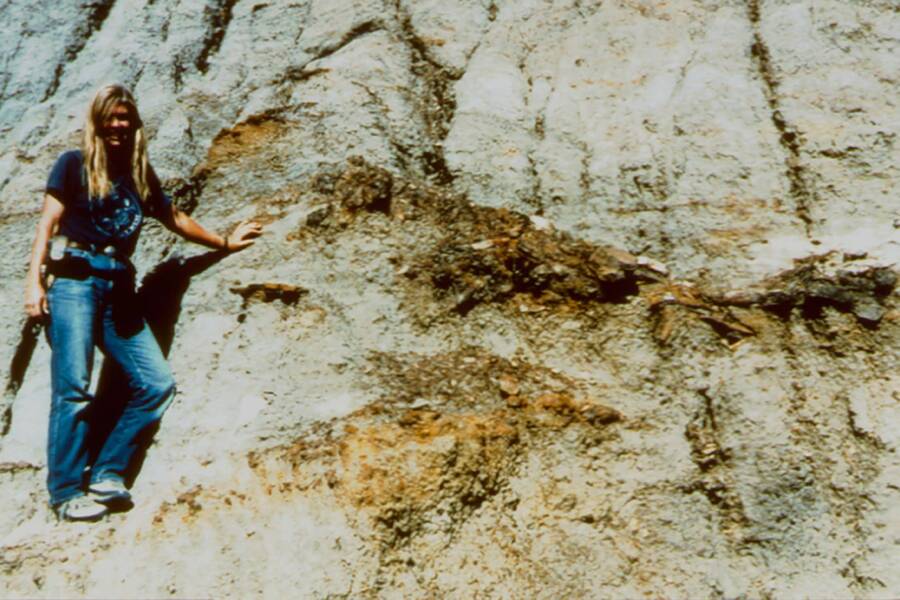
Sue the Tyrannosaurus rex is one of the most famous fossils ever discovered. But few people know about the bizarre legal battle that followed the discovery of the dinosaur.In August 1990, a fossil collector named Sue Hendrickson was working with the privately-owned Black Hills Institute of Geological Research near the town of Faith, South Dakota. As her team was preparing to leave the area, she spotted several bone fragments at the base of a rocky cliff. Upon further investigation, it became clear that the majority of a T. rex skeleton was lodged in the stone.Field Museum of Natural HistorySue Hendrickson with the T. rex fossil before it was excavated.After 17 days of excavation work, the Black Hills Institute team had uncovered 250 of the roughly 360 bones thought to compose a T. rex skeleton. However, many of the missing pieces were tiny bones. By volume, the fossil was 90 percent complete. The researchers dubbed the dinosaur Sue in honor of Hendrickson.But as soon as Sue had been fully excavated, questions arose about who really owned the skeleton resulting in one of the strangest legal battles in history.Who Owns A Dinosaur?The land upon which the Black Hills Institute team had been searching was, by their understanding, owned by a man named Maurice Williams, a member of the Cheyenne River Sioux Tribe. The researchers had struck an agreement with Williams for the use of his land and paid him $5,000 to excavate Sue.However, after Sue was discovered, Williams disputed that the $5,000 payment entitled the Black Hills Institute to take the dinosaur. Instead, he suggested that the money simply covered access to the property and temporary possession of the skeleton rather than permanent ownership.Making matters more complicated was the fact that the land was located within the Cheyenne River Reservation. While Williams was the beneficial owner of the property, the United States technically held the legal title to it in a trust. Thus, federal law limited Williams ability to sell interests connected with the land without approval from the Department of the Interior.Connie Ma/Wikimedia CommonsSue on display at the Field Museum of Natural History in Chicago, Illinois.This raised a bizarre legal question: Legally speaking, what was Sue? Was the T. rex personal property being held unknowingly on Williams land? Or, after 67 million years, had Sue become part of the land itself?In the midst of this debate, federal agents arrived at a warehouse where Black Hills Institute researchers were cleaning the bones and seized Sue. I just couldnt believe what was happening, Peter Larson the founder of the institute told PBS in 1997. There was FBI agents, sheriffs officers running around with guns, and a police line all around the building It was like a dream.This was just the first in a bizarre string of events that would lead Sues fossil to its final home.The Battle For Sues FossilAfter a lengthy legal battle, a federal court ultimately ruled that Maurice Williams was the rightful owner of the fossil. In turn, Williams decided that he wanted to auction Sue off.Officials from the Field Museum of Natural History in Chicago were worried that a private buyer would purchase the T. rex fossil and keep it from the public. They wanted to put Sue on display but they also knew that bids could reach extraordinary heights. So, they hatched a plan.Greg Goebel/Wikimedia CommonsA replica of Sue made for Disneys Animal Kingdom.The Field Museum solicited funding from a wide variety of supporters, from individual donors and public institutions like the California State University system to corporations like Disney and McDonalds. Their strategy was successful, and the museum purchased Sue for $8.4 million, the highest amount ever paid for a fossil at the time. McDonalds further funded two research labs dedicated to preparing the bones for public viewing. As thanks, the Field Museum donated full-sized replicas of Sue to both McDonalds and Disney. Disney displayed their copy at Animal Kingdom in Florida, while McDonalds financed a traveling tour that sent their two replicas to museums across the United States.Meanwhile, the real Sue remains one of the Field Museums most popular exhibits and its all thanks to a fast food chain.After reading about the legal battle surrounding Sue the T. rex, discover 31 fascinating facts about dinosaurs. Then, go inside the story of renowned female fossil hunter Mary Anning.The post The Surprising Story Of Sue The T. Rex And The Legal Battle Surrounding One Of The Worlds Most Famous Fossils appeared first on All That's Interesting.




 English
 Arabic
 French
 Spanish
 Portuguese
 Deutsch
 Turkish
 Italiano
 Russian
 Romaian
 Portuguese (Brazil)
 Greek
Greek