WWW.THEHISTORYBLOG.COM
Gold offering to Jupiter Dolichenus discovered in Georgia
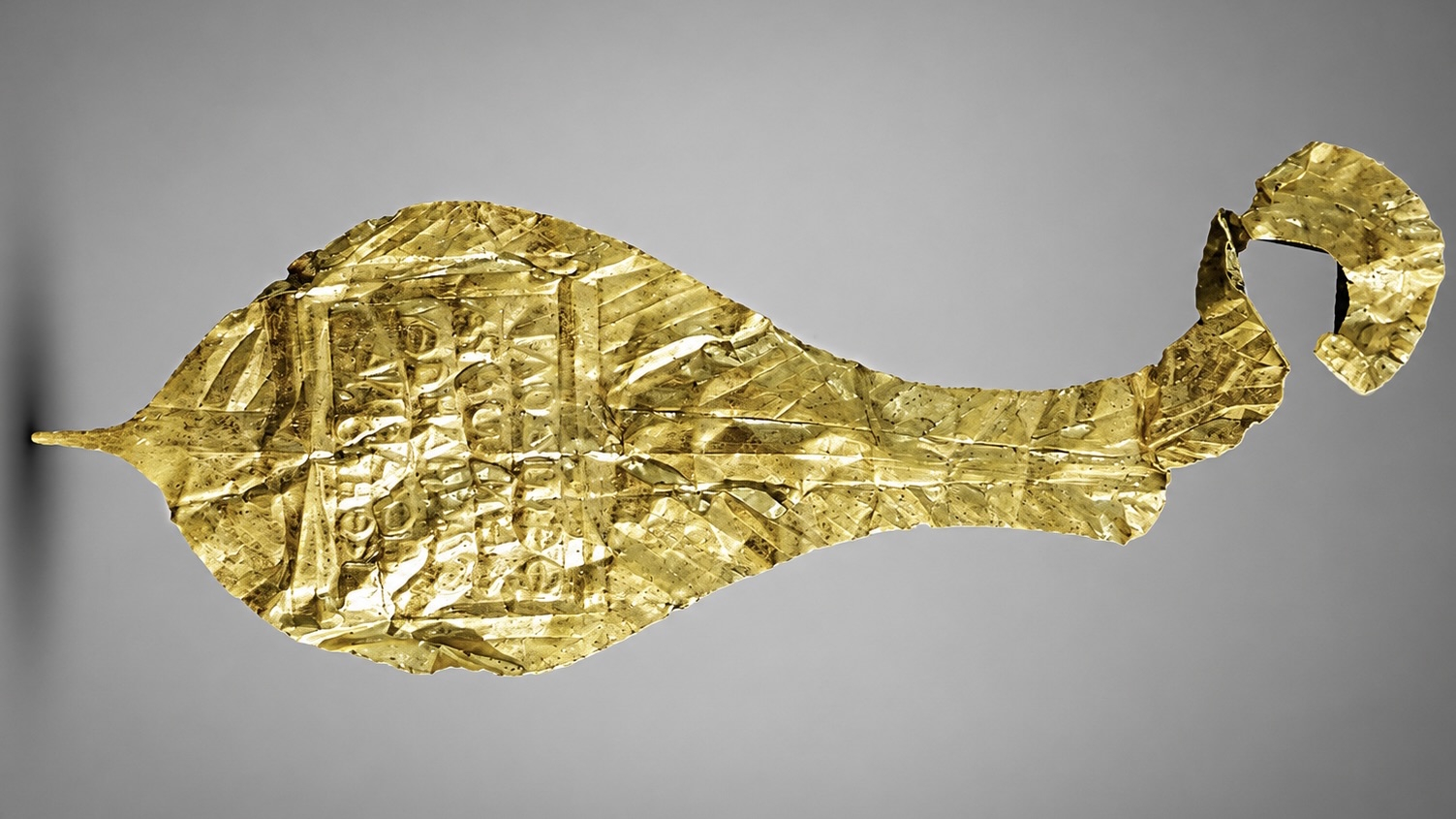
A thin sheet of gold with a Greek inscription to Jupiter Dolichenus is the first votive to the god ever discovered at the Roman Apsaros fort on the eastern coast of the Black Sea in Georgia. The plaque was discovered in the 2024 excavation at the 1,800-year-old military fort. Archaeologists previously believed the fortress had a sanctuary to the god, but so far it has not been found. This is the first epigraphic evidence that there was a Jupiter Dolichenus cult at the fort, and one of very few inscriptions of any kind found there.The artefact takes the form of a stylised leaf and was produced using repouss technique. Its Greek inscription records that an individual named Thrasymedes dedicated the offering to the Dolichenian God, that is, Jupiter Dolichenus and the cult of this deity enjoyed particular popularity among soldiers of the Roman army and eventually spread throughout large areas of the Roman Empire.The dedicator himself is an especially intriguing figure. Thanks to the inscription, we know his name, allowing us, almost two millennia later, to glimpse the religious beliefs of a specific individual associated with the Roman garrison at Apsaros. The researchers note that the name Thrasymedes was relatively uncommon during the Roman period. Although neither his origin nor his role within the garrison can be established, his dedication provides valuable evidence for the presence of individuals with Greek cultural backgrounds within the forts multi-ethnic community. The fact that the offering was made of gold further suggests that the cult of Jupiter Dolichenus attracted devoted worshippers willing to commission costly votive gifts.As the authors emphasise, the discovery may indicate the existence of a cult place dedicated to Jupiter Dolichenus within Apsaros. Other objects associated with the deity have been found in the vicinity of the plaque, including a bronze figurine depicting an eagle seated upon a bull, one of the gods characteristic symbols. Taken together, these finds contribute significantly to our understanding of the religious life of soldiers stationed at the fort and the role played by eastern cults in Roman frontier garrisons.Shrines and votives dedicated to Jupiter Dolichenus have been found at sites throughout the empire, including the British fort of Vindolanda under the shadow of Hadrians Wall. The mystery religion was popular in the military, but not exclusive to it, from the late 1st century A.D. until it came to an abrupt end after Sassanid Persian emperor Shapur I destroyed the gods temple of origin at Doliche in 255 A.D.The 2024 Apsaros excavation also unearthed the remains of a mosaic floor in what was likely the home of the garrison commander. The mosaic is heavily damaged, but it looks like it was a geometric design with red and pink lines on a field of white tiles. The discovery of winepresses and kilns used to make amphorae indicates wine was made on the premises, and given the manufacture of vessels on the site, it may well have been transported elsewhere.
0 Compartilhamentos
23 Visualizações




 English
 Arabic
 French
 Spanish
 Deutsch
 Turkish
 Dutch
Dutch
 Italiano
 Russian
 Romaian
 Portuguese (Brazil)
 Greek
Greek